Zinc hybrid cathode battery and energy storage system maker Eos Energy Enterprises has reported its highest quarterly revenue to date alongside a narrowing gross margin loss.
The US-based emerging battery energy storage system (BESS) technology startup announced its preliminary financial results for Q3 2026 yesterday, 19 October.
Eos expects revenue of between US$82 million and US$83 million, representing sequential growth of approximately 19% to 21% and year-on-year growth of approximately 169% to 172%.
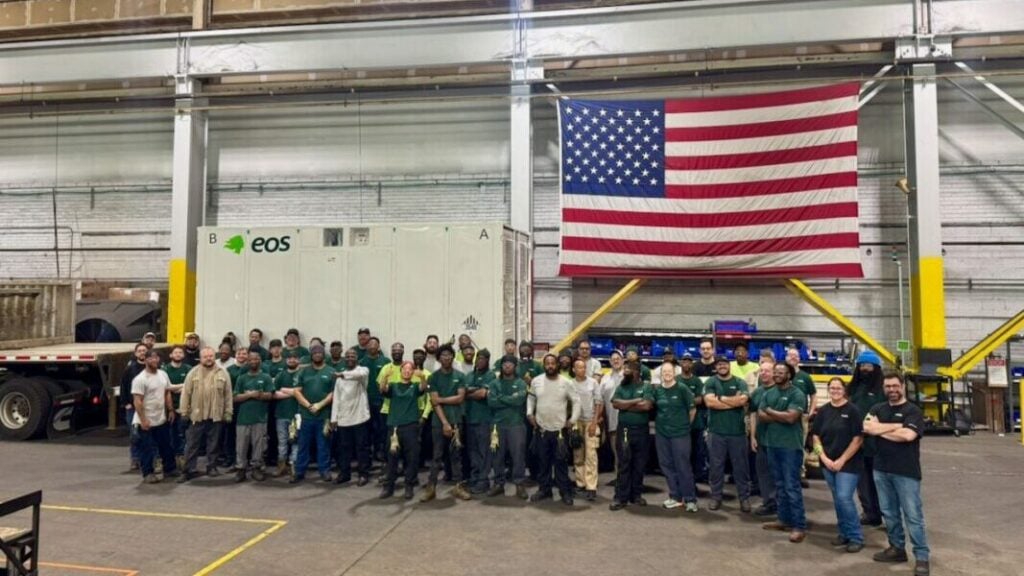
Shipments rose roughly 23% quarter-on-quarter, which Eos attributes to continued production scaling at Line 2, its second manufacturing line at the Thorn Hill manufacturing facility in Marshall Township, Pennsylvania.
Try Premium for just $1
- Full premium access for the first month at only $1
- Converts to an annual rate after 30 days unless cancelled
- Cancel anytime during the trial period
Premium Benefits
- Expert industry analysis and interviews
- Digital access to PV Tech Power journal
- Exclusive event discounts
Or get the full Premium subscription right away
Or continue reading this article for free
Line 2 contributed approximately 17% of total battery production during the quarter and finished the period with first-pass yield in line with Line 1 performance, according to Eos.
The line continued to operate on a partial-shift schedule as Eos works through hiring, onboarding, and training additional staff to support full-shift operations.
Q3 also marked the company’s eighth consecutive quarter of gross margin improvement. For comparison, Eos reported a gross margin loss of between 69% and 73% in Q2 2026, following a loss of US$44.4 million on Q1 revenue of US$56.9 million.
The company says it expects further margin improvement as staffing and training progress on Line 2, alongside higher capacity utilisation, consolidation into a single manufacturing footprint, and ongoing material cost-reduction efforts.
Total cash, including restricted cash, stood at approximately US$344 million as of 30 September 2026, down from US$364 million at the end of Q2.
The company reported approximately US$114 million in operating cash inflows during the quarter, driven primarily by customer deposits, project milestone receipts, and tax credit collections, along with an additional US$87 million drawn under the Department of Energy (DOE) loan facility.
Capital expenditure totalled approximately US$35 million, primarily related to completing Line 2 automation.
Backlog stood at approximately US$765 million, representing approximately 3.2GWh, after accounting for revenue recognised during the quarter and new orders booked.
This compares with a backlog of approximately US$807 million reported at the end of Q2. During the quarter, Eos received six purchase orders from six different customers, including a previously announced US$100 million order under an existing capacity reservation agreement, which the company says did not contribute to quarter-on-quarter backlog growth.
Eos reported continued commercial activity across the defence, commercial & industrial, and data centre markets. During the quarter, the company announced projects supporting the Golden Dome missile defence initiative, as well as a data centre project alongside MN8 for Google.
Eos said it now expects full-year 2026 revenue to fall in the lower half of its previously guided range of US$300 million to US$350 million.
The company attributed the forecast to the addition of a final shift bringing Thorn Hill to 24-hour operation during Q4. Following manufacturing consolidation and the achievement of full-scale operations, Thorn Hill is expected to serve as the company’s primary manufacturing facility, with approximately 4GWh of annual nameplate production capacity across its two production lines.