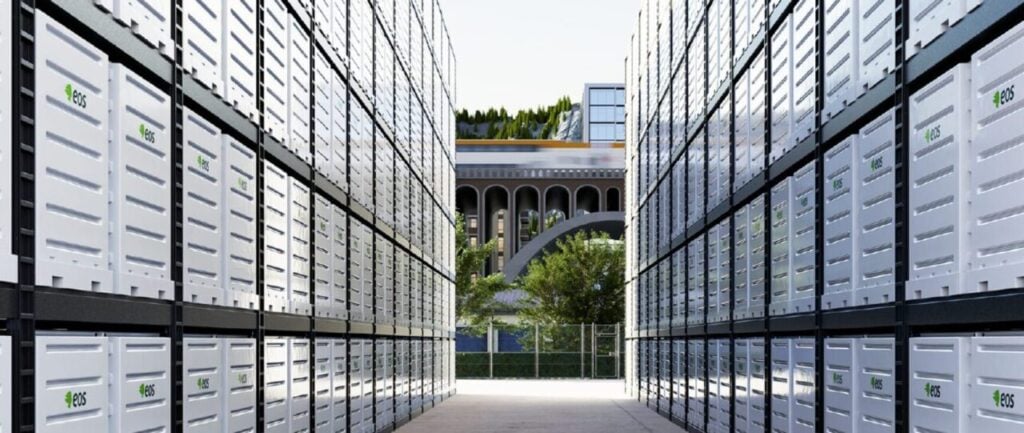
FlexGen and Eos Energy Enterprises, two US energy storage sector companies with different specialisations, have entered the European market.
FlexGen awarded projects in Nordics, UK, Portugal and Ukraine
FlexGen, a software-focused company onboarding its HybridOS energy management system (EMS) and controls and data platform to third-party systems from suppliers such as CATL and Hithium, is entering the European market via projects in the Nordics, UK, Portugal, and Ukraine.
According to the company (on 17 June), it has been awarded projects across the UK, Finland, and Sweden, “to boost availability, reduce risk, and improve asset management through its software and service offerings.”
Additionally, the company claims that for the data centre market, it can speed up interconnection, lower operating costs, provide reliable cut-overs, and support power quality when controlling battery energy storage systems (BESS) paired with gas turbines.
Try Premium for just $1
- Full premium access for the first month at only $1
- Converts to an annual rate after 30 days unless cancelled
- Cancel anytime during the trial period
Premium Benefits
- Expert industry analysis and interviews
- Digital access to PV Tech Power journal
- Exclusive event discounts
Or get the full Premium subscription right away
Or continue reading this article for free
FlexGen launched in 2009 as a microgrid developer for remote locations, gradually shifting toward large-scale BESS applications. The company leveraged expertise from off-grid projects—which required integrating multiple energy technologies and managing weak or unstable grid conditions—to build software-driven solutions for utility-scale storage.
In summer 2025, FlexGen acquired “almost all the assets” of bankrupt rival Powin, which had deployed 11.3GWh of systems since the mid-2010s. According to Drew Leibowitz of consultancy PowerSwitch Advisory, Powin likely struggled because it manufactured BESS using third-party battery cells while competing against Chinese battery OEMs that integrated their own cells at lower cost.
The acquisition included Powin’s hardware and software IP, with FlexGen teams taking over service responsibilities for existing Powin installations to ensure uninterrupted support.
In April 2026, FlexGen acquired Clean Energy Services (CES), a US-based services company that claimed to operate the largest BESS commissioning team in the country. CES had established partnerships with multiple BESS OEM suppliers, giving FlexGen access to those relationships through CES’s authorised service provider (ASP) channels.
The acquisition also brought utility-scale solar PV service capabilities, allowing FlexGen to expand deployment opportunities for its recently launched HybridOS Solar power plant controller (PPC). CES began operating as a FlexGen subsidiary, maintaining service continuity for existing customers while offering them access to the HybridOS platform.
FlexGen’s European team is led by Mike Wallace, who has held the managing director of Europe position at FlexGen since June 2025 and previously worked with multiple energy and energy infrastructure-focused companies in the UK.
Rising renewable curtailment, electricity prices, and grid flexibility demands across Europe are driving storage deployment. Along with FlexGen’s projects in the UK, Nordics, and Portugal, the company is seeking the European Union (EU) safety and quality standards VDE certification, to enter other countries such as Germany.
FlexGen contends that it will increase revenue through its hardware-agnostic software, which works with different battery suppliers in each market, while its integration expertise supports both hybrid renewable sites and data centres requiring co-located backup power. Local teams in the UK, Ireland, France, Spain, and Poland will handle project commissioning, integration, and service.
Eos enters Germany, Austria, Switzerland
US zinc battery firm Eos Energy Enterprises and CAPAC Energy (formerly Nala Energy GmbH), a German BESS developer-operator, have announced a binding master supply agreement establishing an exclusive partnership across Germany, Austria and Switzerland (DACH region).
Announced 17 June, the agreement expands an existing customer relationship into a long-term commercial framework extending through 2031 and establishes a 750MWh capacity commitment with potential to scale up to 2GWh.
It also designates CAPAC Energy as Eos’ exclusive distribution partner in the DACH region. This marks the first international commercial framework agreement for Eos’ Indensity, the company’s large-scale energy storage architecture, which it claims will position the company for continued expansion across key European markets.
Germany has become a focal point for multi-hour battery storage deployment. The country’s coal phase-out scheduled for 2038, expanding solar capacity, and grid integration challenges are creating demand for flexible storage capable of managing supply-demand imbalances.
Recent policy developments, including building code privileges for grid-scale batteries, reforms to grid connection procedures, and a capacity market mechanism targeting launch in 2027, are shaping the regulatory environment for storage projects in Germany.
CAPAC claims it is currently advancing construction of its first Eos projects in Germany with commercial operations targeted for late 2026. The new agreement builds on that momentum by establishing a structured framework for future deployments, enabling project-by-project execution through call-off orders under the master supply agreement.
The partnership opens the possibility of establishing manufacturing and assembly operations within the European Union. Local production could enhance supply chain security, support European industrial capacity development, and generate skilled manufacturing jobs in Germany and surrounding markets.
As purchase orders are issued under the master supply agreement, they will be added to Eos’ reported backlog.
Nathan Kroeker, chief commercial officer of Eos noted of the move, “Germany is an attractive energy storage market in Europe, and we believe Indensity is particularly well positioned to address growing demand from data centres, industrial customers and critical infrastructure where space, flexibility and reliability are increasingly important. This agreement creates a foundation for long-term growth in the region alongside a local partner.”
Eos’ US updates
Eos, founded in 2008, was among numerous companies that went public through special purpose acquisition company (SPAC) mergers during the Covid-19 pandemic, when these deals surged in popularity as a faster alternative to traditional IPO processes.
The company has not been profitable thus far, but in its Q1 2026 financial reports, it highlighted its ambitions through a 2GWh firm capacity reservation agreement with LDES development and investment company Frontier Power USA (FPUSA), and its manufacturing expansion in Marshall Township, Pennsylvania.
Announced 18 June, Eos revealed the first purchase order under the 2GWh capacity reservation agreement with FPUSA supporting FPUSA’s Redbird project, a 100MW/400MWh BESS in the Electric Reliability Council of Texas (ERCOT) market.
Developed by Bimergen, and previously by Bridgelink, Redbird was previously approved under a joint development agreement with Eos, using Eos’ Z3 BESS technology for deployment.
FPUSA and its affiliates have acquired and will provide 100% of the equity for construction of the Redbird project. Bimergen retains a minority economic interest and will collaborate with FPUSA to bring the project into commercial operation.
As part of the acquisition and purchase order by FPUSA and its affiliates, the Redbird volume will be applied against the 2GWh firm capacity reservation agreement between FPUSA and Eos.
Meanwhile, in Pennsylvania, Eos announced the start of commercial production at its Thorn Hill manufacturing facility in Marshall Township, on 16 June.
The company initially announced the plan in 2025, saying that it would invest US$352.9 million to relocate its headquarters to Pennsylvania from New Jersey.
Additionally, Pennsylvania announced it would dedicate US$22 million to the project, with the expectation of generating at least 735 new jobs and preserving 265 existing positions.
Eos received a funding proposal from the Pennsylvania Department of Community and Economic Development (DCED) for a US$10 million Pennsylvania First grant, along with US$12 million through the Redevelopment Assistance Capital Programme (RACP), which also includes US$3 million awarded to Eos in 2022.
The company claims that the Thorn Hill facility itself was engineered to optimise manufacturing flow and productivity. Compared to Battery Line 1, the new layout “reduces raw material travel by 86% and shortens overall production line length by 40%, improving material handling, reducing complexity, and supporting higher operating efficiency.”
The line will ramp throughout the year, with subassemblies coming online in the early third quarter and full production targeted in Q4 of 2026.