Sungrow will supply both the battery energy storage system (BESS) and the grid-forming power conversion equipment for ENGIE’s Hazelwood BESS expansion in Victoria, Australia.
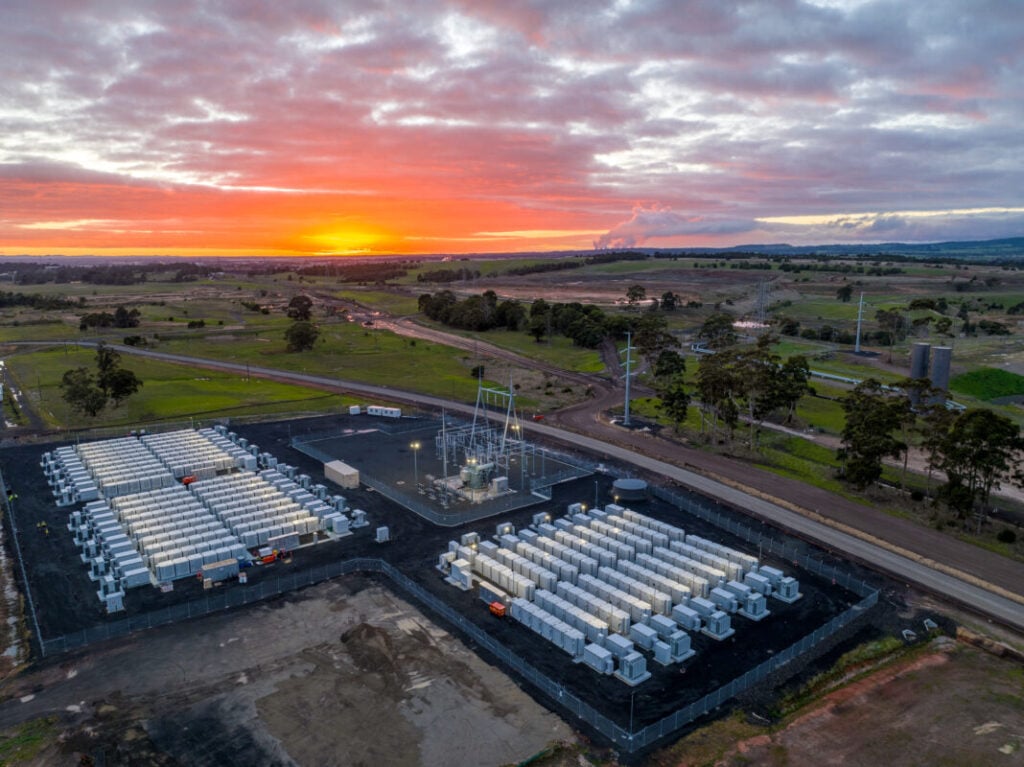
Sungrow revealed last week (27 October) that it is partnering with ENGIE and Elecnor on the 150MW/300MWh Hazelwood Battery Energy Storage System expansion (HBESS 2), a 2-hour system in Victoria’s Latrobe Valley.
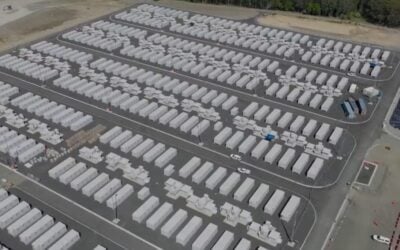
Sungrow Australia is the technology provider and Elecnor the balance of plant (BOP) contractor. The project will use 66 of Sungrow’s ST5015-UX BESS units, part of its PowerTitan 2.0 series, with 33 SC6900UD-MV power conversion system (PCS) inverters and an EMS3000 controller.
The PCS converts the direct current (DC) stored in the cells into the alternating current (AC) used by the grid, and back again when the BESS charges. It also determines whether the BESS can operate in grid-forming (GFM) mode.
Try Premium for just $1
- Full premium access for the first month at only $1
- Converts to an annual rate after 30 days unless cancelled
- Cancel anytime during the trial period
Premium Benefits
- Expert industry analysis and interviews
- Digital access to PV Tech Power journal
- Exclusive event discounts
Or get the full Premium subscription right away
Or continue reading this article for free
Most BESS and solar PV plants use grid-following inverters, which track the grid’s voltage and frequency. Grid-forming inverters set their own reference, responding to disturbances in a manner similar to spinning generators in coal and gas plants.
Sungrow said grid-forming at HBESS 2 will support voltage and frequency stability, respond rapidly to changing grid conditions and help the network accommodate more variable renewable energy generation.
“The Hazelwood BESS 2 represents an important step in advancing grid-forming energy storage in Australia,” said Thomas Hou, managing director at Sungrow Australia.
The Hazelwood order lists the PCS separately from the BESS units. In a company update on Energy-Storage.news, Sungrow described PowerTitan 2.0 as an “AC Block” design that can house up to 5MWh of storage and a 2.5MW PCS in one 20ft container.
Its successor, PowerTitan 3.0, combines a 1.7MW silicon carbide PCS with 7.14MWh of storage in a 20ft container, in 4-hour or 8-hour configurations. Sungrow called grid-forming a “functionality” of PowerTitan 2.0 and a “capability” of PowerTitan 3.0.
Other suppliers are pairing storage and PCS through partnerships. At All-Energy Australia last week, CATL launched its 9MWh TENER+ BESS and signed an MoU with Hitachi Energy to combine its DC-side products with Hitachi Energy’s PCS.
Commercial operations at HBESS 2 are targeted for 2028. When the Victorian government declared a transmission operator for the expansion on 16 October.
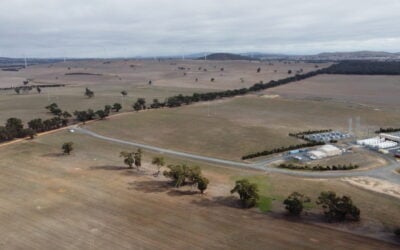
The expansion will sit beside the existing BESS at the former 1.6GW Hazelwood coal plant, which ENGIE operated until 2017, using the site’s 1,600MW of transmission network capacity.
The existing 150MW/150MWh Fluence system came online in June 2023 as Australia’s first large-scale BESS on a decommissioned coal plant site. HBESS 2 will double the site’s output to 300MW, with 450MWh of combined capacity.
ENGIE, the French multinational utility, took full ownership of the existing BESS in January 2026 when it acquired Eku Energy’s 30% stake, and has signed a virtual battery storage agreement for 40MW of Neoen’s 300MW/450MWh Victorian Big Battery.
Grid-forming and data centres put PCS in focus
As coal plants retire, the Australian Energy Market Operator (AEMO) made grid-forming BESS a priority in its engineering roadmap for 2026. Grid-forming inverters already feature in around 74% of the 33.2GW NEM BESS pipeline, according to AEMO data.
PCS and inverters make up a small share of project cost but are essential to renewable energy assets. ABB cited demand across solar PV, battery storage and wind when it acquired Gamesa Electric’s power electronics division in December 2025.
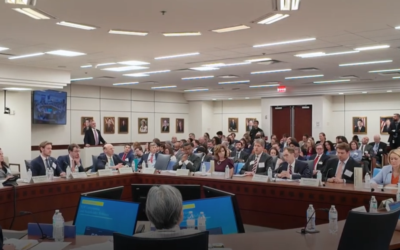
Data centres are adding to that demand. AI training loads can swing by up to 70% of base load, Prevalon’s Frank Rodriguez said in a panel on BESS for AI data centres reported by ESN Premium.
On the same panel, Chris Liu, responsible for US pre-sales at Kehua Digital, said more frequent cycling can make the semiconductor switches in the PCS run hotter, requiring good thermal control in the inverters.
Manufacturers are expanding in response. Spain-headquartered Power Electronics broke ground in September on a Houston, Texas factory with 40GW of annual capacity when fully ramped up. If data centre demand keeps growing, BESS developers could be competing with data centre operators for the same PCS supply chains.
Sungrow sells into both markets. Storage was its largest business in the first half of 2026, with shipments up 28% year-on-year to 25GWh, and it reported about 2GWh of firm AI data centre storage orders.
Never miss an Australian energy storage story. Sign up for our Australia newsletter and get the latest project announcements, policy updates and market analysis delivered directly to you.