Spain-headquartered Power Electronics has opened a new factory in Houston, Texas, as the US market increasingly looks to build domestic content supply chains.
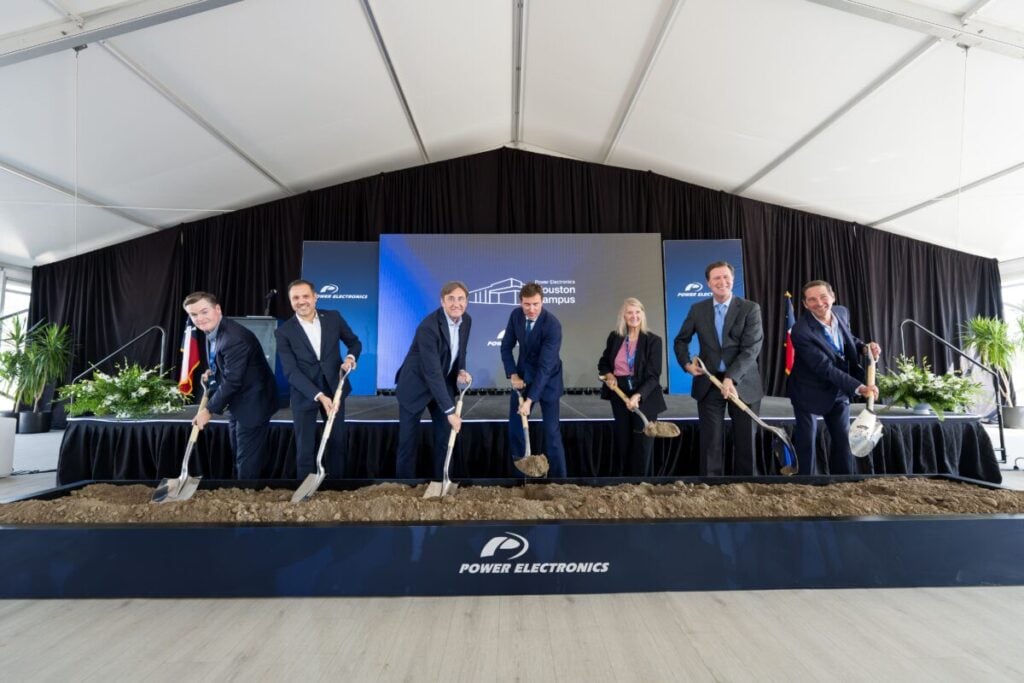
Power Electronics, which provides solar inverters and power conversion systems (PCS) for battery storage, as well as solutions for the data centre and e-mobility industries, held a groundbreaking celebration yesterday (24 September).
The 53-hectare site will integrate functions, including logistics, production, electronics manufacturing, R&D, and training, into a single campus. It is expected to create more than 400 jobs in the Houston area.
Power Electronics said the site will have an annual production capacity of 40GW when fully ramped up, although the company did not say what the initial capacity is, what the product split at the factory will be, or provide a date by which ramp-up is expected.
Try Premium for just $1
- Full premium access for the first month at only $1
- Converts to an annual rate after 30 days unless cancelled
- Cancel anytime during the trial period
Premium Benefits
- Expert industry analysis and interviews
- Digital access to PV Tech Power journal
- Exclusive event discounts
Or get the full Premium subscription right away
Or continue reading this article for free
The Spanish company said the Houston campus will become its most automated inverter production site to date and claimed it represents long-term investment in US industry, skilled employment, technological innovation, and energy infrastructure.
The new campus will bring Power Electronics’ total annual production capacity worldwide to 105GW.
M&A interest in PCS manufacturers
The announcement comes amid growing demand for power electronics from both the energy and, increasingly, data centre markets, coupled with a growing appetite for a US-based domestic content supply chain.
Earlier this month, the sale of US-headquartered power electronics manufacturer EPC Power Corp to manufacturing group Flex was agreed by owners Goldman Sachs Alternatives and Cleanhill Partners, in a deal worth US$4.4 billion.
The transaction brings to an end Goldman Sachs Alternatives and Cleanhill Partners’ four-year ownership of the inverter manufacturer. During that time, other power electronics companies have also been the target of M&A activity within the battery energy storage system (BESS) industry, perhaps most notably US system integrator Powin and then subsequently Hitachi Energy’s purchase of Eks Energy after Powin went out of business.
In the solar sector, ABB recently re-entered the power electronics market with the acquisition of Gamesa Electric and its line of solar PV and battery inverters in 2025, followed by the launch of a product portfolio based on Gamesa Electric IP a year later.
RWE to pilot Baglino’s Heron Link with integrated SST technology
Limited access to technologies that can expand and enhance the grid was identified by Drew Baglino, founder and CEO of Heron Power, as a bottleneck to meeting rising electricity demand.
The former Tesla senior VP of powertrain and energy engineering hopes his new power electronics startup will be able to produce up to 40GW of its Heron Link integrated power conversion solution annually from a factory in Morgan Hill, California, by late 2027.
That equates to up to 10,000 Heron Links, a 5MW medium-voltage PCS for large-scale energy and data centre projects, integrating bidirectional inverters with solid-state transformers (SST). Heron Power said in August that it intends to invest more than US$100 million in the facility.
Heron Power has raised US$200 million in two funding rounds since February 2026, and just recently hired former Tesla CFO Zachary Kirkhorn to its board.
In its latest announcement, earlier this week (21 September), Heron Power said RWE Americas will pilot the deployment of Heron Links at a renewable energy and storage project in Texas.
Low-voltage inverters and 60Hz transformers at an RWE BESS installation adjacent to the energy company’s 249MW Pyron Wind Farm in Texas’ Scurry County will be replaced with Heron Link units.
Traditionally, low-voltage inverters and medium-voltage transformers convert DC electricity from solar PV and battery storage plants into medium-voltage AC for the grid; Heron Link replaces both components. Heron Power claims the product delivers 98.6% DC-to-MV conversion efficiency and 99.5% lifetime availability.
Other claimed advantages include lower maintenance costs, a US-based domestic supply chain and native grid-forming (GFM) controls.
Other manufacturers are now pursuing success with solid-state transformers, including Enphase, which has already brought one to market, and Canadian Solar’s E-Storage subsidiary, which, according to the company’s CTO, Dr Shawn Qu, is currently “exploring” SST technology.
Enphase co-founder and CTO Raghu Belur told ESN Premium in a June interview that SST technology can help address the “power problem” in data centres by consolidating and making more efficient the power delivery chains that carry electricity from the utility to the server racks.
RWE has an operating renewable energy and battery portfolio exceeding 13GW across 27 US states, including 6GW of solar PV and 1.2GW of BESS.
Based on the outcome of the pilot, RWE may order more Heron Links, beginning with an initial 500MW capacity reservation from Heron Power’s US manufacturing facilities.