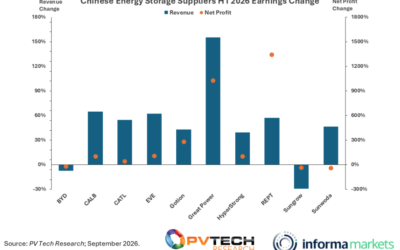
Sungrow’s first-half-of-year (H1) revenue fell 28.99% year-on-year to RMB 30.912 billion (US$4.6 billion), while net profit attributable to owners of the parent company dropped 32.01% to RMB 5.259 billion.
The Chinese solar PV inverter and battery energy storage system (BESS) manufacturer released its semi-annual report for H1 2026 on 28 August. On a quarterly basis, the company posted a net profit of RMB 2.291 billion in Q1 and RMB 2.967 billion in Q2, marking a 29% sequential increase in Q2 and reflecting improved profitability.
By segment, revenue from PV inverters and other power conversion equipment totalled RMB 12.388 billion, down 19.17% year‑on‑year. This segment accounted for 40.08% of total revenue, with a gross margin of 42.72%.
Storage systems generated RMB 15.456 billion in revenue, representing 50% of the total despite a 13.18% year-on-year decline. This segment has surpassed inverters as Sungrow’s largest revenue source, though the decline was primarily driven by lower revenue from utility-scale projects. Storage shipments reached 25GWh in H1 2026, up 28% year-on-year.
Try Premium for just $1
- Full premium access for the first month at only $1
- Converts to an annual rate after 30 days unless cancelled
- Cancel anytime during the trial period
Premium Benefits
- Expert industry analysis and interviews
- Digital access to PV Tech Power journal
- Exclusive event discounts
Or get the full Premium subscription right away
Or continue reading this article for free
Overseas revenue (including Hong Kong, Macao, and Taiwan) totaled RMB 22.690 billion in H1 2026, down 10.59% year-on-year. However, its share of total revenue increased significantly from 58.30% to 73.40%. Revenue from mainland China fell 54.71% year-on-year to RMB 8.222 billion, accounting for 26.60% of the total.
Sungrow made its highest-ever BESS shipments and sequential improvement in gross margins, despite the year-on-year drop in revenues, which it attributed to weaker sales in domestic and Middle Eastern markets, noting the significant impact of deliveries from a major Saudi project during the same period last year. Looking ahead, Sungrow projects that the European storage market will grow by more than 50% next year.
Regarding its storage segment’s pricing and profitability, Sungrow noted that gross margins have fluctuated quarter-over-quarter in recent years. This volatility is primarily driven by three factors: storage duration, regional sales mix, and upstream lithium carbonate prices.
The global shift toward longer-duration storage exerts downward pressure on margins. Additionally, margins vary significantly across geographies, with distinct gaps between China, Europe, the Asia-Pacific, and the Middle East. The varying revenue recognition mixes across regions each quarter also impact gross margin.
Following a sharp rally, lithium carbonate prices have recently stabilised between RMB 130,000 and RMB 160,000 per ton, continuing to weigh on margins. However, Sungrow’s storage gross margin improved sequentially, reaching 32% in Q1 and 35% in Q2. The company noted that actual margins for Q3 and Q4 will depend on the regional revenue recognition mix and lithium carbonate cost trends in each quarter.
AIDC business expected to grow in next two years, company pulls back from US market
Over the long term, utility-scale storage gross margins are expected to remain stable with a slight downward bias. Management views this trend as largely positive, as it can help curb cutthroat competition and support healthy industry development. Sungrow remains confident that its economies of scale, product innovation, service capabilities, and brand strength will allow it to sustain a pricing premium amid future market competition.
Regarding its AI data centre (AIDC) operations, Sungrow stated that the business is progressing steadily. The company has officially launched its EnerNeo series Solid-State Transformers (SST) and has begun commercial shipments.
Sungrow expects robust growth in its AIDC-related businesses starting next year or the year after, driven by two core segments: AIDC power supplies and AIDC storage. Currently, the company holds approximately 2GWh in firm orders for its AIDC storage business, with a pipeline of over 10GWh.
Addressing the impact of US FCC regulations and a recent presidential executive order targeting power equipment, Sungrow noted that the FCC policy appears to apply to new product models. Given the relatively long product cycles for PV and storage in the US market, existing product lines are expected to remain commercially viable for several years, assuming no further policy changes.
US Executive Order 14420 specifically targets equipment used in transmission systems operating at 69kV and above, excluding local distribution hardware. Since US decentralised PV-plus-storage projects typically interconnect at 13.8kV, and utility-scale projects connect at 34.5kV before stepping up to 69kV or higher, the exact point at which regulatory constraints will apply remains unclear.
Amid geopolitical volatility, Sungrow anticipates a gradual pullback in its US operations. The company is strategically pivoting to mitigate risk by boosting R&D, shifting resources to other regions, and focusing on channel-led operations.