
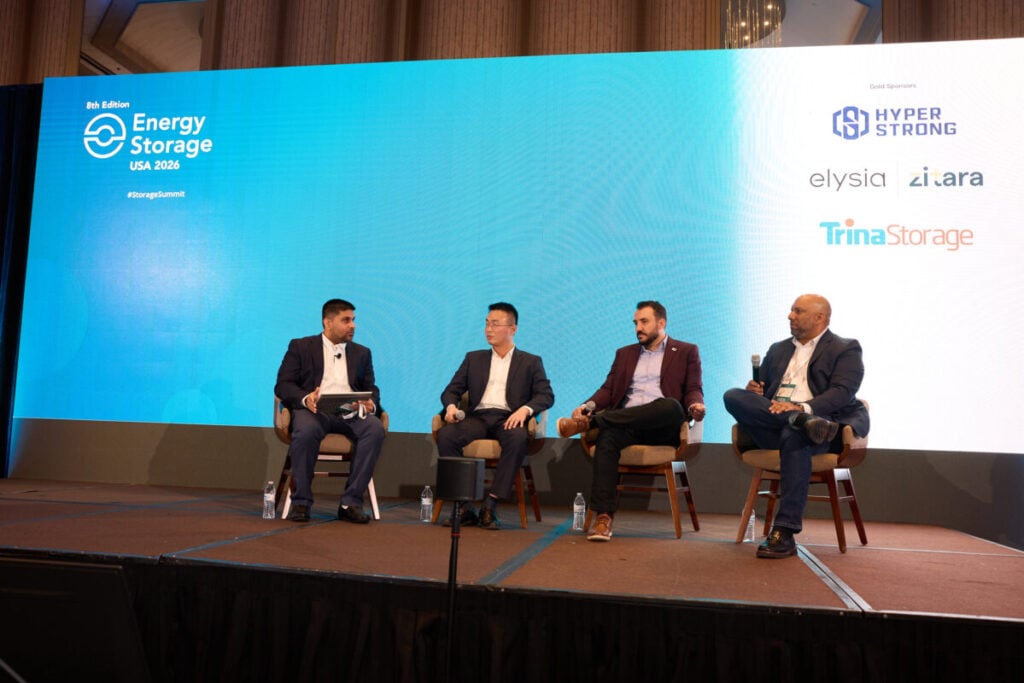
The many considerations developers must factor in when deploying battery storage for data centres were discussed on a panel at Energy Storage Summit USA 2026.
There are many opportunities presented by artificial intelligence (AI) in today’s world. Behind the scenes of that tantalising promise, helping to power all of that computational might is, of course, one of the big potential opportunities for battery energy storage systems (BESS).
We’ve heard a lot from various sources about the technical challenges of meeting the very high uptime and availability demands of AI training, and how market co-optimisation could mean merchant revenue streams for BESS operators open up outside the day-to-day running of data centre workloads.
So, how to actually put those principles into practice?
Try Premium for just $1
- Full premium access for the first month at only $1
- Converts to an annual rate after 30 days unless cancelled
- Cancel anytime during the trial period
Premium Benefits
- Expert industry analysis and interviews
- Digital access to PV Tech Power journal
- Exclusive event discounts
Or get the full Premium subscription right away
Or continue reading this article for free
The panel discussion, ‘What developers of data centres need to know,’ delved into topics including the right sizing of BESS assets, degradation risk and long-term service agreements (LTSAs), whether to go behind- or in front-of-the-meter and the financing options big tech companies are weighing up for the energy portion of their data centre campuses.
Moderator Raafe Khan, head of energy storage and emerging markets at consultancy Camelot Energy Group led the conversation, taking place on the first day of the conference in Dallas, Texas, hosted by our publisher Solar Media (part of the Informa Group).
Khan was joined by:
- Frank Rodriguez, senior VP of commercial operations at system integrator Prevalon, spun out of Mitsubishi Power and with 4GWh of deployed energy storage under its belt at the time of the event in late March.
- Nadim Kanan, VP of independent power producer (IPP) BrightNight, which claims a 30GW development pipeline across the US, alongside operational and in-construction projects. The company’s activities include renewables, energy storage, natural gas and data centre energy hubs.
- Chris Liu, responsible for pre-sales in the US market, particularly focused on the AI data centre-plus-BESS segment, for power conversion system (PCS) manufacturer Kehua Digital, which has had a hand in the deployment of 45GW of battery storage worldwide.
Sizing an interoperable battery storage system
BESS sizing has always been a million-dollar question in the industry: size it too big and your costs spiral as some of the assets are potentially left idle, size it too small and revenue opportunities are missed and the health of the batteries is put at risk.
In the context of AI data centres, it becomes a billion-dollar question. As moderator Raafe Khan explained, co-locating a battery to make it interoperable depends on meeting AI workloads that are typically highly stochastic. Gas turbines can’t ramp up or down fast enough to meet some of those situations.
Khan asked the panellists what sort of optimal BESS sizing methodology developers could adopt in terms of metrics like power-to-energy ratio, state of charge (SoC) buffer or response latency to meet the ‘five nines’ (99.999%) uptime metrics data centre campuses typically require.
Prevalon’s Frank Rodriguez said, as would be a common refrain throughout the session, that each project has different requirements. As an integrator, Prevalon engages with stakeholders on the power generation side, consultants and the end-customer to understand the features and requirements.
There are big differences, for example, between data centres handling data analytics and content management and data centres doing AI and large language model (LLM) training.
“In our experience, for AI training data centres, you need a completely different application. You’re focused on power delivery in milliseconds. You are focused on frequency regulation when you are doing load management,” Rodriguez said, adding that Prevalon has designed a new product called a Hybrid Power Stabiliser that is neither battery nor traditional infrastructure system but instead controls power demands, including load swings and frequency stability.
However, Rodriguez added, reliability requirements are a big factor that influences the design of a system, perhaps the most critical factor, because it will determine the margins and redundancy that need to be built into the system.
“From our perspective as an IPP, we do offer, for example, the co-location as a product, where we bring data centres to our sites,” Nadim Kanan from BrightNight said.
These customers care more about “having energy that’s available at a very competitive price point,” Kanan said. In those instances, 4-hour duration, roughly 1:1 power-to-energy would be adequate.
However, for customers seeking a solution beyond energy, such as integrating with the UPS, IPPs are asked to deliver more customised solutions for data centres, according to Kanan. In that case, the 4-hour duration is perhaps more than what’s needed but can be “a cherry on the top.”
It also depends on whether the customer business model includes market participation, in which case, a longer-duration, larger battery would be desirable. Kanan said BrightNight’s different customers each had their “own unique solution” over the past year of discussions.
“If they’re mainly interested in having smoothing for the peaky loads, then you really don’t need 4-hour duration. In terms of power, I think it’s still going to be around 70%-100% of the data centre power demand, but in terms of duration, I think there’s a lot of freedom there,” Kanan said.
Kehua Digital’s Chris Liu noted that some developers are opting for supercapacitors in their AI data centre (AIDC) design solutions, putting the supercap at the front end to handle peaks in load shifting. Meanwhile, the BESS behind it will mostly handle energy shifting and frequency regulation, in which case 2-hour duration is sufficient.
Outside of this use case, from a PCS manufacturer’s perspective, a longer-duration battery system will provide more buffer to handle the load fluctuations and changes in frequency, Liu said.
Degradation risk and long-term warranties
AI training loads have a very high frequency of partial and deep discharges, moderator Raafe Khan said, which is not a typical operating profile for a 4-hour BESS doing wholesale market arbitrage, which would handle a more predictable rate of charge and discharge.
With BESS for data centres likely falling outside of those Standard Lifecycle Assumptions embedded in OEM warranties and long-term service agreements (LTSAs), Khan asked how contracting is evolving in terms of degradation measurement protocol, throughput caps or state of health (SoH) benchmarking or triggers for augmentation.
Frank Rodriguez said that with one project Prevalon has recently contracted, the BESS is being used as a “shock absorber” for IT load with “huge amounts of load and huge swings”.
The system integrator took a multi-layer control approach to the batteries to guarantee their performance over 20 years as they constantly charge and discharge while coupled to a power generation system.
“You need the battery energy management system (EMS) to be integrated with the distributed control system and be able to have a two-step control,” from a design perspective, Rodriguez said.
In terms of Opex and long-term services, the key is building up a spare part management inventory, a “robust” maintenance crew that can be onsite to provide services continuously.
BrightNight is yet to see a battery OEM offer a specific warranty or LTSA structure for data centre loads, Kanan said. He noted that deep cycles tend to be tougher on the battery than partial cycling, so the general structure of contracts largely remains the same: based on total throughput.
Kanan didn’t think that a typical 4-hour BESS would find data centre applications more difficult than the energy shifting the technology is more accustomed to being used for, based on established data centre use cases.
One potential technical difference, Kehua’s Chris Liu said, is that more frequent cycling to handle constant AIDC loads means that the insulated gate bipolar transistors (IGBT) in the PCS might gather more heat as it works more continuously, necessitating good heat control within the inverters.
Behind-the-meter microgrids: ‘Everybody wants power, and they want it now’
With wait times for generator grid connections in most major US wholesale markets in the order of four years or more, Khan asked how IPPs and hyperscalers are structuring behind-the-meter (BTM) versus front-of-the-meter (FTM) contracts.
Speed-to-power, perhaps a fancy way of saying “getting online as quickly as possible,” is one of the most critical factors for data centre developers locked in the global AI race, which is driving those decisions.
The answer from the panellists was unanimous: data centre energy solutions are going behind-the-meter, essentially developing microgrids, but often with the optionality of connecting to the grid at a later date.
“Everybody wants power, and they want it now,” Kanan said.
The IPP has sites suitable for data centres where natural gas, solar and BESS resources are already deployable. It can also help the data centre developer shape their sites’ energy systems around specific needs.
“Assuming that the data centre has their location and is ready and they need power, we could come in and develop the solar and BESS solution for them so that they can have energy and build it in a way that it’s a bridge product. They need to wait a few years before they get their interconnection,” Kanan said.
“It’s strange for an IPP to be doing this, but this is where the market is,” Kanan said, adding that BrightNight also has a third solution where the IPP provides a medium-voltage UPS for data centres willing to connect in BrightNight’s existing co-located sites.
Rodriguez said all of the opportunities Prevalon has engaged with in the space are off-grid microgrids, albeit likely working toward future grid connections, if only to source auxiliary power or to run specific parts of their data centres.
Data centres’ aggressive schedules to come online mean that “unless you have a developed site with all the interconnection [in place], they will be doing BTM sites,” he said.
Liu added that supplying gas turbines-plus-BESS solutions for off-grid applications is a good opportunity for the industry.
Offtake contracts, availability guarantees and augmentation
A large data centre co-located with BESS is a “very capital-intensive play” that could cost more than half a billion dollars just for energy infrastructure alone, Raafe Khan said. The moderator asked Nadim Kanan what he had learned from talking to some of the large tech companies about their preferences in terms of financing these assets.
While the answer broadly was, again, that it depends on the different hyperscalers and data centre companies are looking for, quite often they would favour something that resembles a typical offtake agreement, which Kanan said is the “cleanest” option in terms of financing.
“Others we’ve seen would like some sort of joint ownership structure, and we’ve even seen somebody who actually wants to get the full ownership structure. We’ve seen all of it and I think the market is still evolving.”
From the lender perspective, banks see hyperscaler projects as very bankable, Kanan said, while smaller data centres will be seen as less so, which would be reflected in the way the IPP structures its deals.
As the session neared its close, someone in the audience asked about the scope for data centre co-located battery storage to earn accretive revenues from participating in energy arbitrage and ancillary services while fulfilling reliability and backup power obligations.
The good news there was that the panellists did not see any obstacle to market co-optimisation. Kehua’s Chris Liu said if sufficient power is retained for backup applications, it is “totally okay from the technical side,” and fellow panellists Kanan and Rodriguez answered: “yes, they can,” and “they certainly can do that,” respectively.
Ensuring the availability guarantees are met, and this perhaps comes back to system design and sizing, was also revisited in an another audience question. While the audience question specifically asked whether data centres require a 100% availability guarantee and how to contractually address that, if so, the panellists explained that while 100% is not feasible, getting very close to it is.
“You can build systems that are N-minus-1, N-minus-2 reliable, and that’s how you prove reliability,” Brightnight’s Nadim Kanan said.
“I don’t know if Prevalon or other OEMs would offer 100% uptime, but I think there are different ways where the industry, up to the day, has it, without having commercial backstops, by designing redundancy, by relying on available.”
In other words, the system can be designed in such a way that even if one or two circuits are lost, the full availability requirement for the data centre’s uptime can be met.
Rodriguez said contractually, Prevalon will guarantee the required availability, and deliver it through a combination of design redundancy and the maintenance programme, including spare parts inventory.
Following on from that, in response to a question about whether augmentation is a viable capacity maintenance approach to avoid technology obsolescence, particularly in batteries that are cycling frequently, with both deep and shallow discharges, Rodriguez said Prevalon opts for an overbuilding approach.
“We overbuild without considering augmentation for the future, and the reason is because when I talk about a multi-layer control system, you do that in order to optimise the average SoC of the batteries,” Rodriguez said, helping the system handle the combination of big load cycles and power swings that can be up to 70% of the base load and occur frequently and quickly.
BrightNight’s Nadim Kanan said that designing for augmentation really means designing a system to maintain a certain capacity for a given duration, which is a function of the use case.
“If you’re speaking about only smoothing the peaky loads, you don’t need to have a 4-hour battery for that. You don’t need to have 3-hour battery for that. You’re probably good with a 1-hour battery, but the market today doesn’t have 1-hour batteries, so you’re going to start with two hour battery,” Kanan said.
“This would help you with the redundancy of the system. This would help you with the reliability of the system. Would this mean that you need to do augmentations? The answer is no, but if you have a data centre that also has a battery or power plant on it, that is going to be participating in merchant markets, and have to have an RA (resource adequacy requirement – Editor), then you need to maintain 4-hour capacity. Under that construct, yes, you will be doing augmentation, because that’s the most feasible way of maintaining capacity for the battery system,” he said.
“I think this has been my theme of answering questions. It depends!”
This article has been amended from its originally published form to more accurately reflect BrightNight’s development pipeline total.
