Two Australian battery energy storage system (BESS) projects in South Australia and Victoria have been submitted to the federal government under the Environment Protection and Biodiversity Conservation (EPBC) Act.
Riverland Solar Energy, as trustee for the Riverland Solar Energy Trust, has referred the 300MW/1,200MWh Riverland BESS near Morgan in South Australia, a 4-hour duration system that would connect to the Project EnergyConnect interconnector.
Separately, developer ACEnergy has referred its 350MW/1,400MWh Little River BESS in Victoria, saying it submitted the referral “for legal certainty” regarding potential impacts on the habitat of the golden sun moth, a threatened species.
Riverland BESS to connect to Project EnergyConnect
The Riverland BESS would be built on leased private land about 10.5km northeast of Morgan and 150km northeast of Adelaide.
Try Premium for just $1
- Full premium access for the first month at only $1
- Converts to an annual rate after 30 days unless cancelled
- Cancel anytime during the trial period
Premium Benefits
- Expert industry analysis and interviews
- Digital access to PV Tech Power journal
- Exclusive event discounts
Or get the full Premium subscription right away
Or continue reading this article for free
The BESS would connect through an overhead 330kV line to Project EnergyConnect, the 900km interconnector linking South Australia, New South Wales and Victoria that transmission network operator Transgrid said in June was being fully energised.
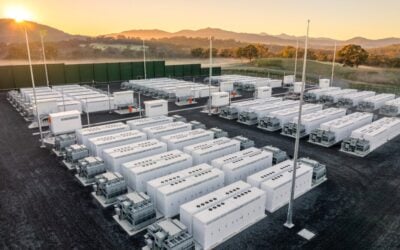
The referral lists about 344 enclosed BESS units with 86 inverters and transformers, a 330/33kV transformer and switchyard, and an operations and maintenance building.
The estimated start date is 1 June 2027 and the end date 1 June 2064, with an operational life of up to 35 years. That compares with the 20 to 25 years Pacific Blue expects from its 201MW/855MWh Bendigo BESS in Victoria, also referred under the EPBC Act.
Nearly all of the 479.61-hectare project area is native vegetation. The project would clear up to 49.5 hectares, mostly degraded chenopod shrubland, including 0.11 hectares of understorey within one endangered ecological community.
A significant impact assessment by environmental consultancy Umwelt concluded the project is “unlikely to have a significant impact” on any matters of national environmental significance (MNES).
Eight threatened fauna species, including the endangered black-eared miner, and one migratory species could lose potential habitat.
The BESS forms part of the Riverland Solar and Storage Project, which received development approval in 2017 under previous ownership and was announced that year by then-premier Jay Weatherill.
Time extensions were granted in 2020, 2023, and 2025, and BESS construction must start by 30 June 2028. In July 2026, South Australia’s Department for Housing and Urban Development approved a variation to relocate the BESS, change its grid connection point, and increase its storage capacity.
ACEnergy’s Little River BESS referred for ‘legal certainty’
ACEnergy, a Melbourne-based developer of solar PV plants and standalone BESS, is proposing the Little River project in Victoria.
The BESS and a switching station would be built on the eastern portion of a farming-zoned site at Sandy Creek Road, Little River, in the City of Greater Geelong. The referral says the project “has since received the relevant planning approvals”.
The referral does not state a capacity. The Victorian government fast-tracked ACEnergy’s 350MW/770MWh Little River BESS through its Development Facilitation Program in 2025, with a direct connection to AusNet’s 220kV network.
The program has since accelerated a further 700MW of battery storage from Atmos Renewables and Akaysha Energy at Heywood and Glenrowan.
Little River is also one of three projects covered by ACEnergy’s 3GWh supply and integration deal with Chinese manufacturer CATL, alongside its Joel Joel BESS in Victoria and Yanco BESS in New South Wales.
ACEnergy said public concern about the golden sun moth after its planning application prompted a further ecological study, which assessed the species’ likelihood of occurrence as “low-moderate” and a significant impact as “unlikely”.
The developer said the BESS is also unlikely to significantly affect three other listed species: the white-throated needletail, grey-headed flying-fox and diamond firetail. It is preparing a voluntary cultural heritage management plan with the Wadawurrung Traditional Owners Aboriginal Corporation.
The referral follows ACEnergy’s submission of its 250MW Joel Joel BESS in western Victoria to the EPBC Act, alongside AGL’s 500MW/2,000MWh Mount Britton BESS in Queensland.
Other recent referrals include Samsung C&T Renewable Energy Australia’s 200MW/800MWh Darnum BESS in Victoria’s Gippsland region and Gingerah Energy’s 1GW off-grid data centre with a 5,000MWh BESS south of Broome in Western Australia.
Never miss an Australian energy storage story. Sign up for our Australia newsletter and get the latest project announcements, policy updates and market analysis delivered directly to you.