
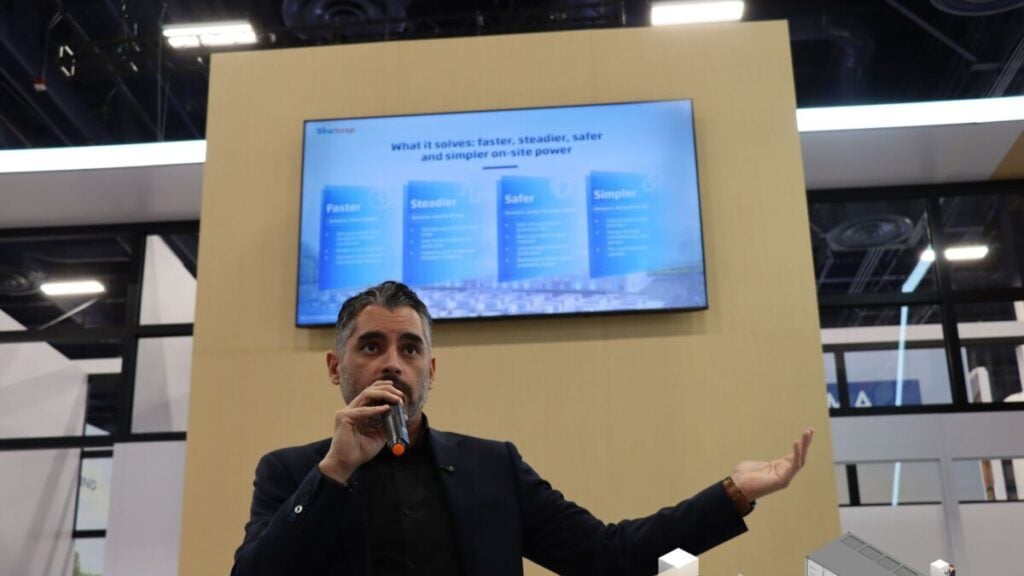
Energy-Storage.news speaks with Trina Storage’s Mike Watson about the company’s genset-BESS solution and its approach to safety.
Trina Storage, the energy storage arm of solar PV manufacturing giant Trinasolar, has unveiled a new hybrid genset solution designed to provide standalone, rapid-response power for AI-driven data centres.
Announced 20 November at North America’s largest renewable energy conference, RE+ in Las Vegas, Nevada, US, Trina’s Elementa Hybrid Genset pairs its battery energy storage system (BESS) technology with gas generation to create what the company describes as a self-contained microgrid capable of powering data centres without drawing on the local grid or community resources.
Speaking with Energy-Storage.news at the show, Mike Watson, head of product and engineering at Trina Storage, said the solution was developed in direct response to market demand as AI workloads strain traditional power infrastructure.
Try Premium for just $1
- Full premium access for the first month at only $1
- Converts to an annual rate after 30 days unless cancelled
- Cancel anytime during the trial period
Premium Benefits
- Expert industry analysis and interviews
- Digital access to PV Tech Power journal
- Exclusive event discounts
Or get the full Premium subscription right away
Or continue reading this article for free
“It was directly a response to the market, getting the voice of the customer right,” Watson says. “It was demand-driven. It was a response to the AI boom, and it turns out that batteries are the perfect solution. Trina has been in the battery space for almost ten years now, so it was just a natural fit.”
Solving multiple problems at once
Watson claimed the genset solution addresses three distinct challenges simultaneously. First, it acts as a bridge to power while traditional grid infrastructure is built out to support new data centre capacity.
Second, it meets the fast response-time requirements of AI training workloads, something conventional generation was never designed to handle. Third, it removes local communities’ concerns about data centres drawing on shared grid resources.
“Traditional data centres were primarily designed to store and retrieve data. Not a lot of power consumption, not a lot of power traffic,” Watson explains. “AI requires a lot of compute, and it requires it very quickly for training models. Traditional generation was not designed to handle the fast fluctuations that come from the compute power of AI.”
Because the system generates and consumes its own power on an islanded basis, Watson said it sidesteps lengthy grid interconnection queues, which can take years to clear.
“Even if you wanted to pull energy from the local community, you would need to connect to the grid, and the applications and the queues to build that out take years,” he says. “These companies can’t wait years, and that’s why they’re saying ‘let’s just bring our own generation.’”
It was also noted during the discussion that while the Elementa Hybrid Genset was created for AI data centres, it functions fundamentally as a microgrid solution with broader applications.
Watson acknowledged that community acceptance of standalone, self-generating power systems will take time. “It’s going to take market education for the communities to feel comfortable with that,” he notes. “At some point 100 years ago, AC power was considered dangerous, and now look at us.”
Vertically integrated approach
Trina Storage manufactures its own battery cells, modules, racks and containers in-house, rather than sourcing third-party cells, positioning the company as more than a battery supplier. The Elementa product is complemented by Electra, the AC integration component, together forming what Watson called a “full cell-to-grid solution.”
“We don’t want to be seen as just a battery supplier because we’re much more than that,” he explains, drawing a comparison to a car manufacturer that builds the engine but delivers the whole vehicle.
Fire safety and thermal runaway mitigation
With a background in electrical engineering and regulatory compliance, Watson explains that Trina’s approach to thermal runaway mitigation goes beyond the baseline requirements set out in NFPA 855, which allow operators to choose between exhaust ventilation and deflagration (explosion-proof) panels.
Watson says Trina consulted directly with the fire marshal and local authorities with jurisdiction when weighing the two options. “They said, ‘We fight fires, we train to fight fires, we fight fires every day. We’re comfortable with fires. Explosions scare us.'” As a result, exhaust ventilation became Trina’s default thermal runaway mitigation method, though the company now designs both features into its systems as optional add-ons.
Trina has also gone beyond standard-mandated testing requirements, according to Watson. While NFPA 855 requires cell-, module-, unit-, and then container-level testing to be carried out sequentially based on prior results, Trina opted to continue to full-scale testing even after its technology could technically have stopped at the module level.
“We did additional testing and did great with those results, and now the market has come back around and said now we need large-scale fire testing (LSFT),” Watson explains.
He personally oversaw LSFT of the company’s Gen 2 product overseas last year, with results validated by a third-party nationally recognised testing laboratory and an independent registered design professional. Trina’s Gen 3 product is due to undergo the same large-scale testing process next month.
“The requirements of a standard are just the threshold,” Watson says. “We get there, but I want to build confidence in the market, so we exceed those requirements and go above and beyond.”
What customers are prioritising
Asked what matters most to customers evaluating storage suppliers, Watson points to three priorities. Bankability tops the list, he says, because long-term warranties are only as good as the company standing behind them over a 20-year horizon.
“We focus on fire safety and quality and cost, but if the company’s not bankable, they walk away,” he says.
Second is the growing interest in long-term service agreements (LTSAs), which cover operating costs, maintenance, augmentation strategy, and capacity addition costs over a project’s lifetime, rather than just the upfront capital cost.
Third is levelised cost of energy (LCOE), with Watson cautioning that energy density figures quoted for a single DC container do not necessarily reflect site-level performance once systems are scaled up.
“Nobody ever puts one DC container on a site,” he says. “What you need to look at is site-level energy density.”
ESN will be hosting a webinar on grid-forming technology with Trina Storage and testing and certification company TÜV Rheinland on 3 December.