
Another edition of our BESS Industry Buzz, rounding up some of the hot takes, analysis and gossip from the past week on our feeds.
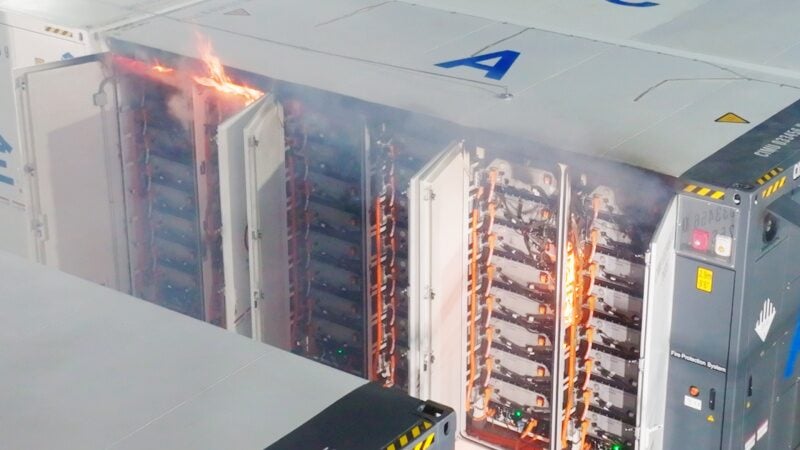
Stop designing battery tests just to pass, design them to fail and learn something
That was the message from battery fire safety expert Neza Lupsina, who pointed out that the tests she observes say nothing about the battery. The important question is why the battery passed (or failed), not just whether it did or not. Many of the commenters passionately agreed, see the post here.
What’s in a hug?
You can tell a lot from a hug, according to Pooja Shah, Senior Consultant in DNV’s Energy Storage and Emerging Technologies Advisory (and an Energy Storage Awards 2026 judge). Returning from RE+, Shah said the “shift in energy” at the show year-on-year could be measured by this perhaps overlooked metric. “I’ve felt the shift in energy over the last couple years at RE+, and the hugs seem to have gone from ‘hang in there’ to ‘we’ve got this’ to, dare I say, ‘cautiously optimistic’ this year,” she wrote, based on an impressive data set of >100 hugs. See Pooja Shah’s post here.
‘IPPs now face a full blown exits crisis’
Investors are trying but struggling to sell independent power producer (IPP) businesses, according to analysis by investment banker Charles Lesser. See his LinkedIn post about it here and its lively comment section.
Try Premium for just $1
- Full premium access for the first month at only $1
- Converts to an annual rate after 30 days unless cancelled
- Cancel anytime during the trial period
Premium Benefits
- Expert industry analysis and interviews
- Digital access to PV Tech Power journal
- Exclusive event discounts
Or get the full Premium subscription right away
Or continue reading this article for free
‘Europe has lost the mass market battery race’
Europe saw another battery bankruptcy recently, this time the Sweden-headquartered BESS company Polarium. Yair Reem of Extantia Capital said its time to admit it has failed in building a domestic battery sector, and should focus on other areas within the supply chain it can control or have influence on. See his post here.
Zonal ancillary services could split BESS revenues in GB
Henry Easterbrook, founder of risk platform Quantail, said on LinkedIn that Great Britain’s National Energy System Operator (NESO) has published a 12-zone map signalling where battery storage revenues are heading.
NESO proposes procuring ancillary services on a zonal basis, with zones splitting grid supply points along the main transmission boundaries. The auction would stay national, but prices could split by zone depending on boundary congestion. The principle, Easterbrook said, is that “more expensive but deliverable capacity is selected in place of cheaper constrained capacity”.
He said Reserve and Response are a thin share of BESS revenue, so the change is small on its own. The bigger signal is that constraints are becoming central to revenue, and that for the first time the core national ancillary markets would pay a BESS differently by location. A Scottish BESS, for example, could lose on turn-up Reserve but hold value on turn-down, because charging relieves the constraint.
The consultation closes on 8 January, with go-live planned for spring/summer 2027. See the post here
Important changes for US BESS developers
Drew Lebowitz, utility-scale BESS advisor, shared that two “critical thresholds step up” for BESS developers starting 1 January. FEOC material assistance increases to 60% for construction starts in 2027, and the domestic content adder increases to 55% for construction starts in 2027. “Storage keeps its full ITC for projects starting construction through 2033, but to lock in the 2026 thresholds, construction must be documented as started before year-end.” Read here.
GC0166
Modo Energy’s Wendel Hortop shared a meme with a brief look at what’s changed for BESS since GC0166 went live for the GB market. “For energy actions at least, not much has fundamentally changed. Batteries still aren’t being dispatched for longer periods.” Read the post here.
BAAJA debate continues before unscheduled House vote
Ira Matt from the National Association of Tribal Historic Preservation Officers shared a letter from seven members of Congress on the Senate-passed Bipartisan American Affordability and Jobs Act of 2026 (BAAJA), writing, “One example shows what’s at stake. Under Title III, federal agencies could decide which areas to study for potential harm to historic properties without consulting Tribal Nations at that stage. By the time a Tribal Nation is brought in, the agency may already have drawn the map that determines which places it will consider. Title III would also strip required public participation from the Section 106 process.” Read the letter and post here.
Waratah Super Battery celebrated by developer’s new CEO
Akaysha Energy celebrated the return to full power of Australia’s Waratah Super Battery a few days ago, inviting back project partners to the site. CEO Paul Curnow recently replaced Nick Carter, who oversaw the project. Curnow was in attendance as the company noted the challenges it faced in the final stretch through commissioning. “There were several moments when the finish line seemed to move just as we approached it. But our partners kept turning up, solving the next problem and finding a way forward,” the company wrote in a LinkedIn post.
‘Unsatisfactory outcome’ would put nearly 70% tariffs on China-US BESS imports
President Trump’s Thanksgiving gift to the world yesterday, when a fresh round of Section 301 tariffs were proposed for 14 US trading partners, could have another dramatic impact on the battery storage industry’s China-reliant supply chains, according to Xu Chen, EVP for financing and strategy at distributed energy solutions provider UPower Energy. While final rates depend on trade talks, Chen wrote on LinkedIn, an “unsatisfactory outcome” could push the total tariff rate on a BESS container to “as high as 68.4%.” See Xu Chen’s post, including a table of estimated duty by customs origin.
