Two Australian battery storage projects in Queensland and Victoria have entered federal environmental review, with AGL Energy and developer ACEnergy each submitting referrals under the same national process.
AGL has referred its 500MW/2,000MWh Mount Britton battery energy storage system (BESS) near Nebo in central Queensland under the federal Environment Protection and Biodiversity Conservation (EPBC) Act.
Separately, ACEnergy has referred its 250MW Joel Joel BESS in western Victoria under the same Act, connecting to the terminal station of an existing wind-plus-storage hybrid power plant.
The EPBC Act is Australia’s main national environmental law. A referral asks the federal government to decide whether a project could affect matters of national environmental significance, such as threatened species, and so needs formal assessment and approval as a “controlled action”.
Try Premium for just $1
- Full premium access for the first month at only $1
- Converts to an annual rate after 30 days unless cancelled
- Cancel anytime during the trial period
Premium Benefits
- Expert industry analysis and interviews
- Digital access to PV Tech Power journal
- Exclusive event discounts
Or get the full Premium subscription right away
Or continue reading this article for free
AGL’s Mount Britton BESS awaits grid connection decision
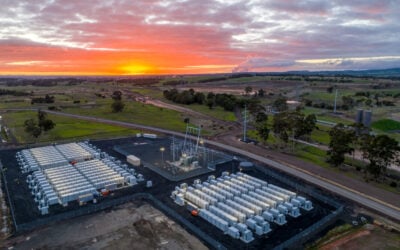
Mount Britton Battery Pty Ltd, a wholly owned subsidiary of AGL, is proposing the Queensland project, which would have a power output of up to 500MW and up to 2,000MWh of usable storage, a 4-hour duration.
The site sits about 75km southwest of Mackay and 6km north of Nebo township, in the Isaac Regional Council area, immediately east of the existing 275kV Nebo Substation owned by Powerlink, the Queensland government-owned transmission network operator.
The new transmission line or underground cable connecting the BESS to the substation, and any substation upgrades, are excluded from the referral. AGL said the entity that will own, operate and maintain that infrastructure “is still to be confirmed and could be a third party”, and the timing of its construction is not known.
Mount Britton could be built in two phases of up to 250MW each or as a single 500MW phase. It would have a usable life of 20 years or more, with the action’s estimated start date set for 1 January 2029 and its end date for 1 January 2061.
Infrastructure would include BESS modules, inverters and transformers, grid-connection equipment, a control building and a noise wall.
The project area covers about 26.9 hectares of freehold land used to graze horses. A 15.6-hectare disturbance footprint in the west would see native vegetation and two farm dams removed, while an 11.3-hectare area in the east would be avoided.
The referral said the project is being referred for likely significant impacts on matters of national environmental significance. It lists the koala, greater glider, northern quoll and squatter pigeon (southern) among species that could be directly affected, with koalas recorded on site during an autumn 2025 survey.
The site lies on the traditional lands of the Widi People of the Nebo Estate #1. No registered heritage places were found in the project area, and AGL is working with the Traditional Owners on a cultural heritage management plan.
AGL holds an option to lease the land, expiring in March 2027 with an option to extend to September 2028, for a 21-year term with two further 5-year options. It will seek development approval under Queensland’s Planning Act 2016 and the Isaac Regional Planning Scheme.
Mount Britton follows AGL’s referral of its 125MW/500MWh Abermain BESS near Ipswich in southeast Queensland, which the company did not consider a controlled action.
It matches the size of AGL’s 500MW/2,000MWh Tuckeroo BESS in Queensland’s Western Downs, which was ruled not to be a controlled action. The Mount Britton referral also cites AGL’s Tomago BESS in New South Wales, which received the same decision.
ACEnergy’s Joel Joel BESS to connect at Bulgana
ACEnergy, a Melbourne-based developer of solar PV plants and standalone BESS, is proposing the 250MW/1,000MWh Joel Joel BESS.
The site is at Joel Joel in the Northern Grampians Shire, about 20km east of Stawell and 219km northwest of Melbourne. The BESS would connect through an underground 220kV cable to the terminal station of the adjacent Bulgana Green Power Hub.
Bulgana pairs a 204MW wind farm with a 20MW/34MWh BESS and came online in early 2022 under developer Neoen. It has since passed to asset manager HMC Capital, which completed its AU$950 million (US$610 million) acquisition of Neoen’s Victorian portfolio in August 2025.
ACEnergy’s referral said the BESS would “charge at times of high solar generation and discharge during peak demand periods, helping ease congestion within the existing transmission network”. Its estimated start and end dates are 30 September 2027 and 30 November 2030.
Equipment would include BESS containers and medium-voltage power stations (MVPS), units that typically house power conversion equipment and transformers, along with high-voltage switchgear and a control room.
In August 2025, ACEnergy signed a 3GWh supply deal with CATL covering Joel Joel, Little River and its Yanco BESS, which the NSW Independent Planning Commission approved in October 2025.
ACEnergy later sold the 250MW/1,000MWh Yanco BESS to BW ESS, the fifth large-scale BESS the developer has taken to financial close.
The Joel Joel works footprint covers 5.1 hectares of a 36-hectare site of former cropping and grazing land. A permit to remove native vegetation has been issued under Victorian planning rules, and the referral states that the project has been designed to avoid swift parrot habitat.
ACEnergy said it does not expect impacts on any matters of national environmental significance, and the project has an approved cultural heritage management plan developed with the Barengi Gadjin Land Council Aboriginal Corporation.
The two referrals follow several other large BESS submissions in recent weeks. Samsung C&T Renewable Energy Australia referred its 200MW/800MWh Darnum BESS in Victoria’s Gippsland region.
In Western Australia, Gingerah Energy referred a 1GW off-grid data centre with a 5,000MWh BESS about 100km south of Broome, powered by solar PV and wind.
Never miss an Australian energy storage story. Sign up for our Australia newsletter and get the latest project announcements, policy updates and market analysis delivered directly to you.