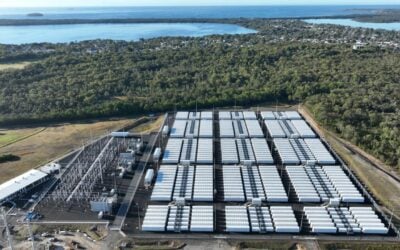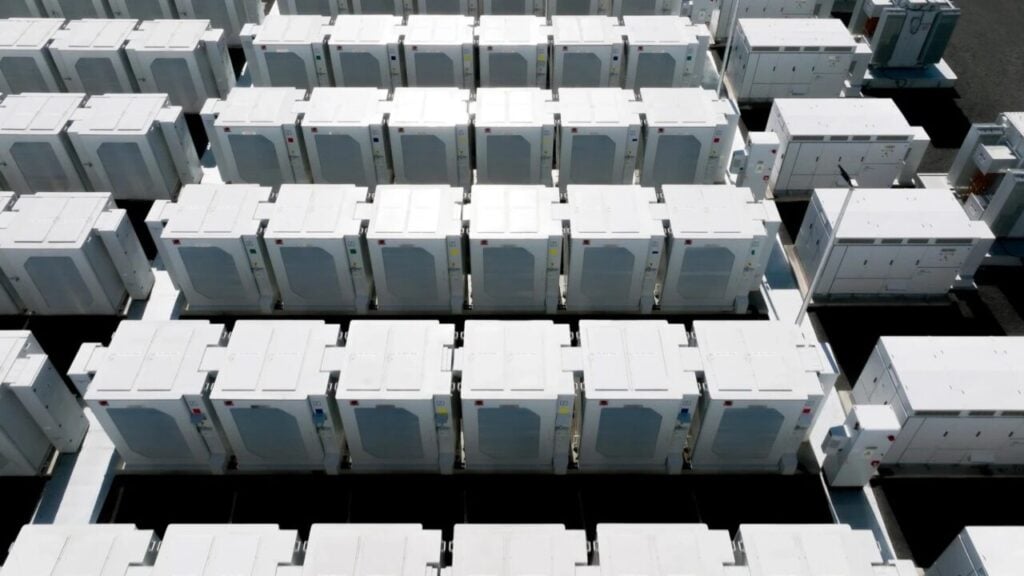
A consortium of lenders in Ukraine, including state-owned bank Oschadbank, has agreed to the country’s biggest financing for battery energy storage system (BESS) projects to date.
Ukrainian power generation and energy trading company DTEK announced yesterday that it has secured around UAH3 billion (US$76.17 million) for five BESS projects, totalling 180MW.
Energy storage has become considered an essential component of national energy security, given the current war with neighbouring Russia, which invaded Ukraine in 2022 and has targeted key energy infrastructure.
Oschadbank, the public state savings bank of Ukraine, led the financing. The consortium also comprises UKRGASBANK, another majority state-owned bank, which focuses on green finance, and privately-owned major Ukrainian bank, First Ukrainian International Bank (PUMB).
Try Premium for just $1
- Full premium access for the first month at only $1
- Converts to an annual rate after 30 days unless cancelled
- Cancel anytime during the trial period
Premium Benefits
- Expert industry analysis and interviews
- Digital access to PV Tech Power journal
- Exclusive event discounts
Or get the full Premium subscription right away
Or continue reading this article for free
All three financial institutions are designated as ‘systemically important banks’ by the National Bank of Ukraine, given their activities have an impact on the stability of the entire banking system.
The banks will cover a portion of the projects’ construction, with the rest to come from DTEK.
The projects form the lion’s share of a total 200MW/400MWh development portfolio by the power and energy company. This represents the first phase of a targeted 500MW buildout of energy storage by DTEK, as revealed by the company’s renewable energy subsidiary in late April.
‘Stable operation of energy sector is critically important for Ukraine’
DTEK won 140MW of ancillary services contracts for the 200MW, six-project portfolio in 2024. Under the contracts, the systems will provide automatic frequency restoration reserve (aFRR), or secondary reserve.
In March, Oschadbank agreed a €9.6 million (US$10.35 million) debt finance deal with another energy company, KNESS, for a project of undisclosed size, which has also won ancillary service contracts. The European Bank of Reconstruction and Development (EBRD) is also providing financing to the KNESS project.
As explained in an article by energy storage consultant Rachel Loquet of Clean Horizon, published in the most recent edition of our quarterly journal PV Tech Power Vol.42, aFRR “is activated to restore frequency to its nominal value and balance electricity supply and demand at the national level.”
It includes a capacity payment for reserving capacity in advance, typically through a day-ahead market, and an energy payment when the asset is activated in real-time by the transmission system operator (TSO).
“The stable operation of the energy sector is critically important for Ukraine, especially under constant attacks from the enemy targeting our energy infrastructure,” PUMB board chairman Serhiy Chernenko said.
“This is not just about investing in infrastructure — it’s about strengthening the strategic energy independence and security of our state.”
DTEK said it would invest around EU140 million (US$155 million) in the first phase of its portfolio buildout in a September 2024 announcement. It has since contracted Fluence to supply the BESS technology.
The company, the biggest private investor in Ukraine’s energy industry, was also behind the country’s first megawatt-scale BESS project, which went online in 2021, shortly before the Russian invasion.
DTEK is also active internationally. It is currently constructing a 132MW/532MWh BESS in Poland which has a capacity market contract beginning in 2027.
The company’s energy storage lead, Vadym Utkin, spoke with Energy-Storage.news in September 2024. Utkin said that in Ukraine, ancillary services contracts are linked to the Euro and not the Ukrainian Hryvnia, which helps mitigate currency fluctuations. At the same time, capacity market payments in Poland had improved the business case for battery storage by about 30%, Utkin said.
The DTEK energy storage lead also added that after the outbreak of the war, many Ukrainian homes have purchased residential behind-the-meter battery storage systems to get through power outages.
Utkin said that he had been “really surprised, even as someone working in the energy sector for many years, at the resilience of the grid.”