A new report from climate consultancy Ember highlights the important relationship between energy storage and solar, unlocking the “era of anytime solar.”
Published 12 August, the report, ‘Batteries have unlocked the era of anytime solar,’ examines how battery energy storage systems (BESS) are “turning solar power from a daytime-only resource into anytime electricity.”
The report uses hourly electricity data to reveal how solar’s record global share in H1 2026 is reshaping power systems across the day. It continues by comparing BESS deployment with solar growth across countries and profiles the leading markets already delivering solar during non-sunny hours.
Ember notes that solar met 10% of global electricity in H1 2026. However, even in the most solar-saturated markets, fossil fuels dominate generation, especially during non-sunny hours. In order to grow further, solar generation needs to be available during these non-sunny hours.
Try Premium for just $1
- Full premium access for the first month at only $1
- Converts to an annual rate after 30 days unless cancelled
- Cancel anytime during the trial period
Premium Benefits
- Expert industry analysis and interviews
- Digital access to PV Tech Power journal
- Exclusive event discounts
Or get the full Premium subscription right away
Or continue reading this article for free
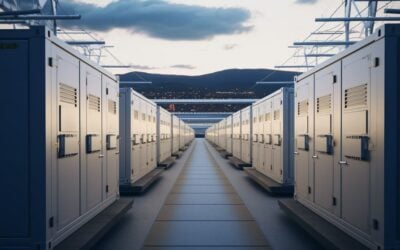
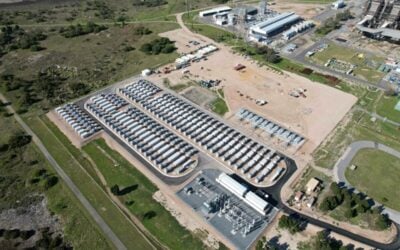
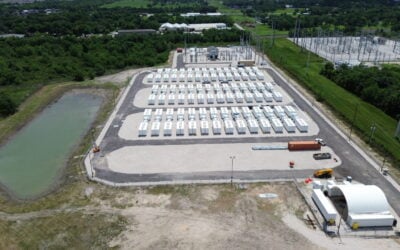
BESS, co-located with solar, is enabling this transition. Ember points to a low levelised cost of storage (LCOS) of US$65/MWh the company reported in 2025, further enabling BESS to help take solar further.
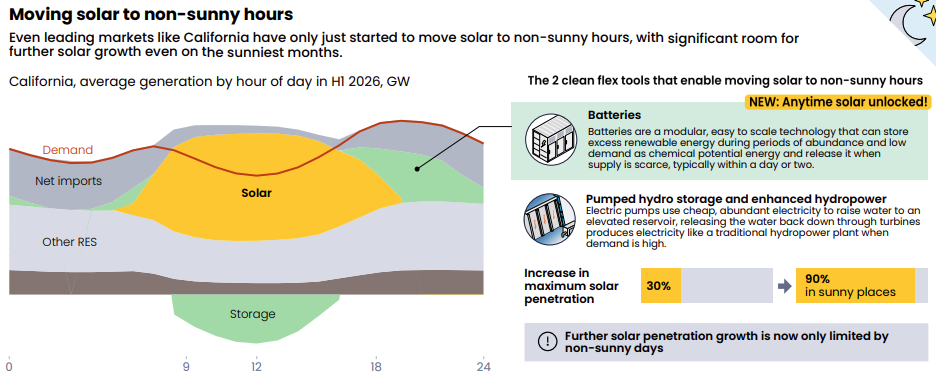
According to the report, solar demonstrated both its potential and its limitations in H1 2026. On average, it supplied more than 25% of global electricity demand between 11am and 2pm—over 50% in mature markets—before collapsing to nearly zero from 8pm to 5am. This disparity underscores why fossil fuels still dominate non-sunny hours when storage is unavailable.
An anticipated 459GWh of new BESS capacity in 2026 could theoretically shift 34% of daily solar generation to non-sunny hours, up from 18% in 2025. However, this represents a theoretical maximum. In reality, not all batteries are dedicated to solar shifting, and many operate below capacity. Improved market design and optimisation strategies are essential to unlock batteries’ full potential.
Bulgaria and Chile were global leaders in 2025, installing enough BESS to shift 77% and 76% of their new daily solar generation respectively, followed by Australia at 60%.
Bulgaria’s trajectory is particularly impressive. The country went from virtually no battery capacity in 2023 to 3GWh in 2025, then more than doubled again to 8.6GWh by May 2026—demonstrating how rapidly markets can transform.
By H1 2026, solar-plus-storage met over 25% of California’s evening peak demand (7–9pm). Chile and Bulgaria showed even more dramatic shifts, with solar contributing almost nothing to evening hours in H1 2023, to batteries delivering over 10% of evening demand in Chile and 24% in Bulgaria by H1 2026.
The report continues, “The next phase of solar growth will depend on more than installing additional batteries. Markets also need to ensure batteries can participate fully across electricity markets, so they are used where they deliver the greatest value. Where deployment is matched by effective market design, batteries can increase the use of cheap solar generation, reduce reliance on fossil fuels during the evening and strengthen the business case for continued solar expansion.”
Ember concludes that the “era of anytime solar has begun,” but its growth is dependent on the cost of solar and the speed at which BESS can be deployed and integrated into power systems.