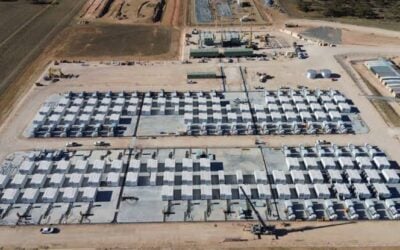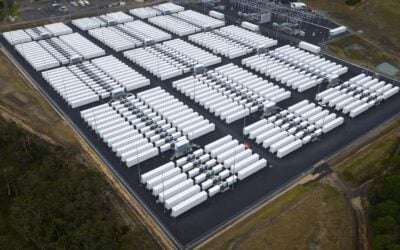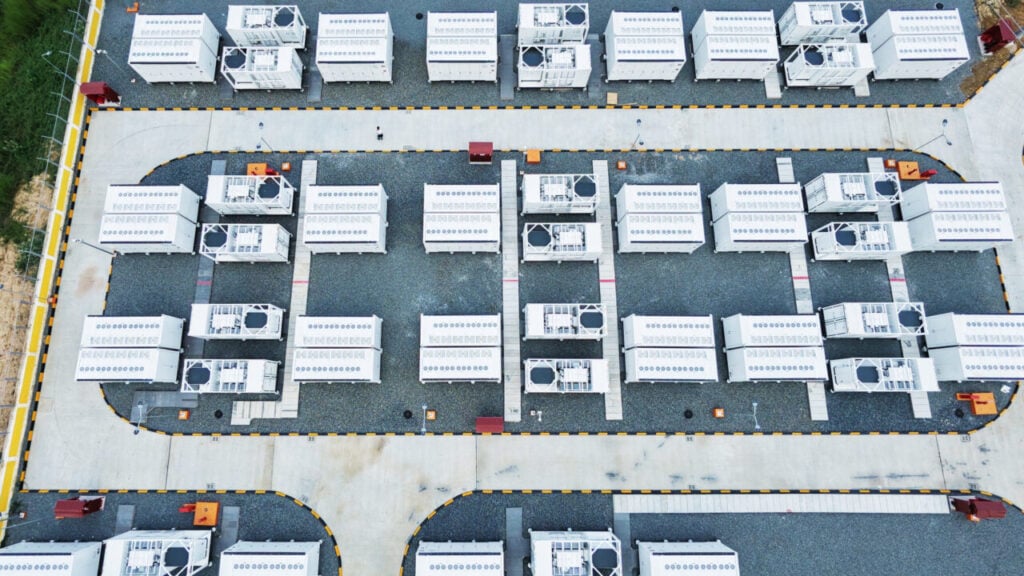
Sungrow has completed grid connection and full acceptance testing of a 108.4MW/215.6MWh grid-forming battery energy storage system (BESS) at the EDC Kandal Stueng substation in Takmao, Kandal Province, Cambodia.
China-headquartered PV inverter manufacturer and battery energy storage systems (BESS) integrator Sungrow delivered the project for Electricité du Cambodge (EDC), the state-owned utility responsible for electricity generation, transmission and distribution across the country.
The system uses grid-forming (GFM) inverter technology, which allows a battery storage system to behave more like a traditional power station turbine than a typical battery storage project.
Conventional, grid-following battery storage systems need an existing, stable grid signal to synchronise with before they can operate. Grid-forming BESS can instead establish their own voltage and frequency signals, allowing them to support or even rebuild sections of a power grid without an external reference.
Try Premium for just $1
- Full premium access for the first month at only $1
- Converts to an annual rate after 30 days unless cancelled
- Cancel anytime during the trial period
Premium Benefits
- Expert industry analysis and interviews
- Digital access to PV Tech Power journal
- Exclusive event discounts
Or get the full Premium subscription right away
Or continue reading this article for free
For a broader explanation of how grid-forming inverter technology works, Energy-Storage.news published a white paper in partnership with Kehua Digital Energy and TÜV Rheinland earlier this year.
That capability was demonstrated directly at Kandal Stueng. According to Sungrow, 516 grid-forming power conversion system (PCS) units energised the entire plant from zero voltage, a process known as black start, and went on to support the restoration of approximately 240km of transmission lines and five substations.
The system supported the start-up and synchronisation of the 60MW Kamchay Hydropower Plant before the restored network was operated alongside the 135MW CIIDG coal-fired power plant, the battery storage system and connected loads.
Sungrow said the system remained stable through five transformer energisation events, including one rated at 100MVA, and maintained synchronisation when connecting different power sources with a phase-angle difference of up to 15 degrees.
The BESS also operated independently from the main grid for 3.5 hours and completed three transitions between grid-connected and islanded operation, with voltage deviation kept below 2% and frequency fluctuation within 0.15Hz.
Michael Ruan, regional director of Sungrow Southeast Asia and South Asia, said the project demonstrated that grid-forming inverter-equipped storage has applications beyond simply storing electricity.
“When a power system faces disturbances or loses normal grid support, grid-forming technology can help establish and maintain stable voltage and frequency, support system restoration and keep the grid operating reliably,” Ruan said.
Sungrow said the on-site team completed commissioning and three rounds of performance testing within 20 days, working through rainy-season conditions with ambient temperatures of up to 40°C.
Cambodia builds out grid-forming capacity as renewables targets near
The Kandal Stueng project adds to a short but fast-growing list of grid-forming battery deployments in Cambodia.
Cambodia’s first grid-forming BESS, a 500MW/1,000MWh project co-located with solar PV in Pursat province, entered commercial operation in March 2026, developed by local firm SchneiTec and described by the country’s official news agency as a “significant and historic achievement.”
That project followed an earlier grid-forming demonstration project delivered by SchneiTec with Huawei Digital Power.
The Asian Development Bank approved a US$63.44 million financing package in June 2026 for a separate 250MW/500MWh grid-forming BESS at Takeo substation, also contracted with EDC, intended to help integrate renewable energy and support cross-border electricity trade with Vietnam under the ASEAN Power Grid initiative.
Cambodia is targeting 70% renewable energy capacity by 2030 under its Power Development Master Plan, and already sources about 63% of its generation from renewables, largely hydropower, putting it ahead of the wider ASEAN bloc’s 35% target for the same year.
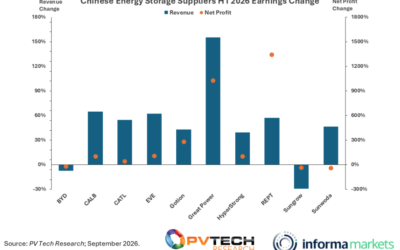
For Sungrow, the Cambodia project adds to a storage business that has become the company’s largest revenue segment. Sungrow’s battery storage revenue topped its PV inverter business in the first half of 2026, with shipments reaching 25GWh, even as overall company revenue declined year-on-year.
The company said it expects the European storage market to grow by more than 50% next year, and is pulling back from the US market in response to new import restrictions on power conversion equipment.