
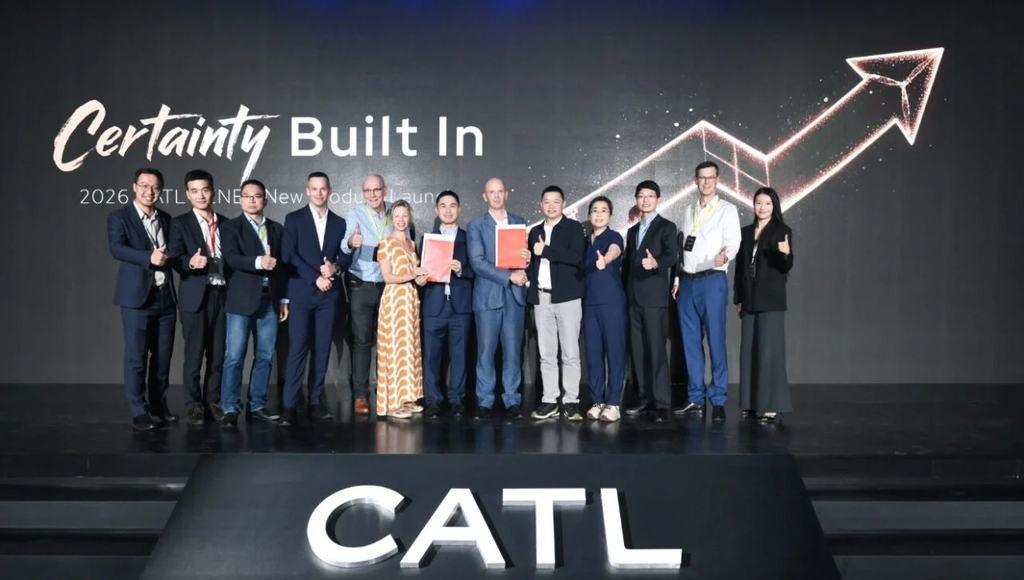
We catch up with the CEO of Netherlands-headquartered system integrator Alfen to discuss its sodium-ion BESS partnership with CATL and plans for the technology in Europe.
Alfen is an energy solutions firm that provides smart grid solutions, EV charging infrastructure and battery energy storage system (BESS) solutions. In the grid-scale BESS segment, it acts as a system integrator that buys BESS units and combines them with power conversion system (PCS) equipment, balance of plant (BOP) equipment, software to run the project, plus O&M and long-term services.
It is mainly active in Europe and has deployed some of the largest projects in the Netherlands, including a 100MW/200MWh project for owner Return that was recently inaugurated. Its main BESS supplier has been CATL.
Alfen was among the first system integrators globally to announce a 5GWh sodium-ion partnership with CATL in July, barely a month after the Chinese OEM announced its sodium-ion BESS product in Munich alongside Intersolar Europe. Alfen CEO Michael Colijn tells us that going big and early on sodium-ion was a ‘no-brainer’.
Try Premium for just $1
- Full premium access for the first month at only $1
- Converts to an annual rate after 30 days unless cancelled
- Cancel anytime during the trial period
Premium Benefits
- Expert industry analysis and interviews
- Digital access to PV Tech Power journal
- Exclusive event discounts
Or get the full Premium subscription right away
Or continue reading this article for free
Why sodium-ion?
Colijn explains that it boils down to long-term cost potential, environmental attributes and performance.
“Sodium is extremely abundant and at scale it will be a much cheaper solution than lithium-ion. It doesn’t need any mining or refining that you need with lithium-ion, so from an environmental point of view it was a no-brainer. We don’t talk about that side of things enough as an industry,” Colijn says.
“And when I looked at the performance and operating range of temperature, it has a much more level operation across temperatures. An almost level performance curve. You are looking at 25–30 years of maintaining performance, potentially double lithium-ion. That completely changes the economics and total cost of ownership.”
Energy density trade-off
Colijn says Alfen has specifically chosen sodium-ion, and is not just going for it because it’s the one that its closest partner has chosen to develop first as an alternative to lithium iron phosphate (LFP).
“The technology has had a long-term promise. It was a no-brainer to start early. And our existing partner in CATL was already the most advanced in it, but that is just in their DNA.”
Colijn does point out that currently it is priced more highly than lithium-ion solutions and its energy density is not yet level with lithium-ion.
But he says it only needs a roughly 20% larger footprint for the same energy storage capacity and power output, and that 20% doesn’t make a huge difference for a grid-scale project. It might, however, for a 10-foot product used in commercial and industrial (C&I) applications, another major segment for Alfen in BESS.
“As the technology matures, that energy density will creep up,” he adds.
One solution could be making containers slightly taller too, though the firm will stay away from ‘wildly more imaginative’ design approaches used by some of its peers. The firm is still working on exactly what the sodium-ion BESS solution will look like. He didn’t clarify whether Alfen would be buying sodium-ion technology from CATL at the cell or BESS level.
Other medium-sized Western system integrators Intilion and Merus Power have also announced plans with CATL for sodium-ion BESS in Europe. Valo (formerly Wärtsilä Energy Storage) is also making plans to deploy sodium-ion BESS at a customer site, though it hasn’t revealed its technology partner.
CATL hasn’t revealed the battery chemistry for its BESS, but many speculate it is NFPP, the most popular choice for stationary storage.
Demonstrator project and customer interest
Alfen is planning a large demonstrator project in the second half of 2027 to ‘show it works technically, can be integrated into the grid and that our software works for it’, Colijn says.
When we point out that most owner-operators in Europe say the tech is not yet bankable, Colijn agrees and says it’s normal that people are cautious with an innovation until they see it de-risked and working.
We then ask what kinds of customers opt for sodium-ion first, to which he says: “I think the same customer base we have today will be customers of the technology; people just need to see the proof point first.”
He claims that Alfen could still sell a sodium-ion solution before building its demonstrator project, such is the customer interest, but would prefer not to.
This week we published an interview with Zane Zhou, general manager of CATL Australia and New Zealand, about demand for its sodium-ion solution coming from mining and data centres in that region.
Sodium-ion integration challenges
Other than energy density, what are some of the challenges with integrating a sodium-ion BESS into its solution that you might not have with a new LFP one?
“We need to test things like how the inverter behaves with the new battery chemistry, whether our software settings are the right ones for different response times, that sort of thing,” Colijn explains.
“We haven’t tested those yet, but we are looking at it very open-minded and testing all the things we need to.”
“I don’t expect that there are significant differences, however. I expect to use the same transformer, inverter and software stack that we use for our LFP solution. Where needed, we will adjust.”
Colijn has been in the job a little over a year and has a background across the new energy technology space. His priorities for the company as a whole are to bring it back on track to financial health, put it at the forefront of innovation, and expand internationally.
