A new report prepared by The Brattle Group for The Pew Charitable Trusts finds that removing barriers to distributed energy resources (DERs) could avoid an estimated US$614 billion in US power system costs through 2050.
Published last week (5 November), the report, from the consultancy firm, prepared for the NGO, is titled ‘The National Case for a More Distributed Power Grid: New Evidence on Affordability and Demand Growth.’
It examines how resources located near electricity users – including distributed solar, battery energy storage systems (BESS), and demand flexibility, such as managed electric vehicle (EV) charging – could help meet rising demand among residential, commercial, and industrial customers.
Quadrupling DER capacity
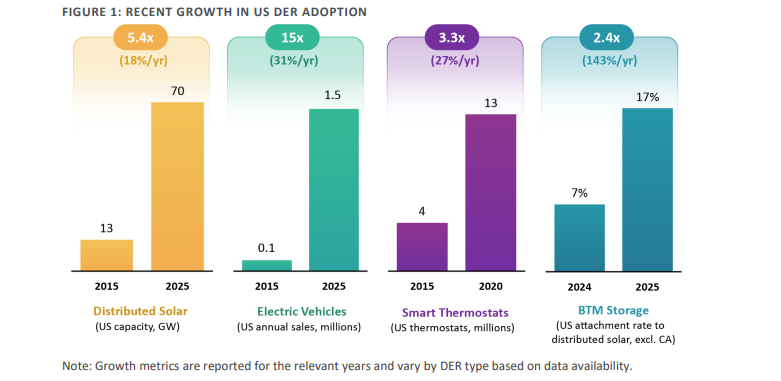
The report’s authors conclude that removing key policy barriers would more than quadruple US DER capacity, adding over 400GW by 2050 – equivalent to nearly one-third of the country’s entire current power generation fleet.
Try Premium for just $1
- Full premium access for the first month at only $1
- Converts to an annual rate after 30 days unless cancelled
- Cancel anytime during the trial period
Premium Benefits
- Expert industry analysis and interviews
- Digital access to PV Tech Power journal
- Exclusive event discounts
Or get the full Premium subscription right away
Or continue reading this article for free
DER nameplate capacity could grow from 8% of US installed capacity today to 18% by 2050, making DERs the fourth-largest resource in the US capacity mix.
This expanded capacity would reduce reliance on new gas generation, avoiding roughly 70GW, or 22%, of projected net gas additions – equivalent to around 175 gas-fired plants nationally. It would also shift approximately 105GW of utility-scale storage capacity to the grid edge through distributed storage and other forms of flexibility.
The report builds on Pew’s April publication, ‘Distributed Energy Can Unleash the Resilient, Affordable Grid of the Future,’ which outlined six policy recommendations to accelerate DER adoption.
Brattle’s analysis estimates that addressing three of those recommendations – incorporating DERs into distribution system planning, reducing permitting costs, and reforming interconnection processes – could alone deliver US$266 billion in avoided power system costs through 2050, accounting for an estimated 43% of cumulative national benefits.
On affordability, the report finds that DERs would enable a US$122-per-year reduction in average household electricity bills by 2050, in inflation-adjusted terms. Roughly 80% of the total identified value would be available for allocation between performance compensation for participating customers, downward pressure on rates for all customers, and potential incentives for utilities.
Managing demand uncertainty and decarbonisation
The report also highlights the planning flexibility DERs offer in the face of uncertain demand growth, particularly from data centres. In a scenario where anticipated load growth falls short of projections, greater reliance on DERs could reduce overbuild costs by US$33 billion between 2030 and 2040 – roughly 40%.
On decarbonisation, the authors note that without new policy intervention, reductions in US power sector carbon dioxide emissions are projected to stall around 2035.
Expanded DER deployment could help sustain decarbonisation momentum by facilitating greater integration of renewable generation, driving a 3% cumulative reduction in power sector carbon dioxide emissions over the study period.
In a separate scenario requiring a carbon-free generation fleet by 2050, DER flexibility could offset around 175GW of utility-scale capacity, lowering the incremental cost of decarbonisation by nearly 20%, or US$45 billion, in that year.
Methodology
The analysis combines long-term power system modelling with an assessment of opportunities to defer local distribution upgrades across 25 US regions, examining impacts on both the bulk power and distribution systems.
The report notes that benefits beyond its quantified estimates—including resilience and potential transmission benefits—could add further value.
The report can be accessed on the Brattle Group’s website.