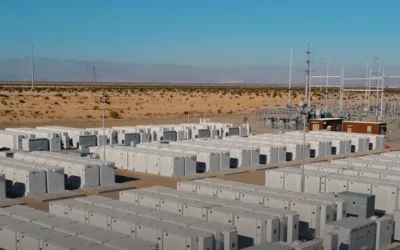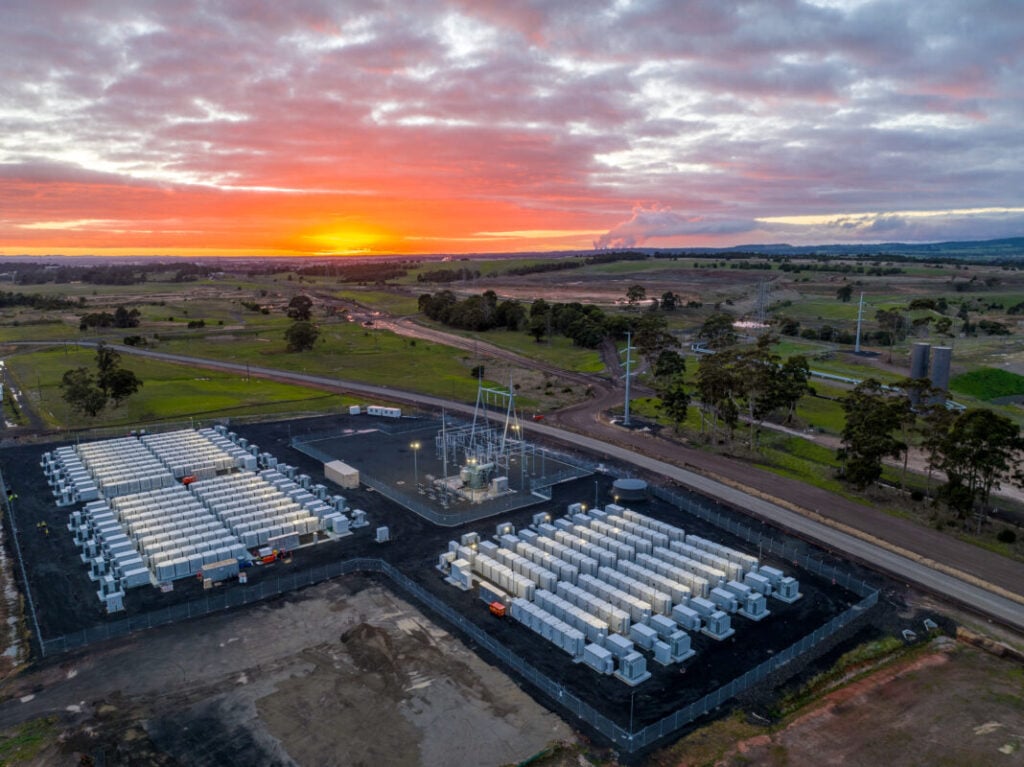
Battery storage systems such as the Hazelwood BESS (pictured), owned by Engie, continue to be seen as critical to support the rollout of inverter-based energy generation in the NEM. Image: Engie.
The Australian Energy Market Operator (AEMO) has published its 2026 Electricity Statement of Opportunities (ESOO), finding a clearer pathway to maintaining a reliable electricity supply across the National Electricity Market (NEM) over the coming decade.
However, it indicates that continued investment in system security services will be needed as the share of inverter-based resources grows.
AEMO is the body responsible for operating the NEM and forecasting the resources needed to keep it reliable and secure.
Published annually under the National Electricity Rules, the ESOO assesses whether sufficient generation, storage, transmission, and demand-side resources are expected to be available to meet consumer demand against reliability standards, providing an early signal to support investment, planning, and policy decisions across the sector.
Try Premium for just $1
- Full premium access for the first month at only $1
- Converts to an annual rate after 30 days unless cancelled
- Cancel anytime during the trial period
Premium Benefits
- Expert industry analysis and interviews
- Digital access to PV Tech Power journal
- Exclusive event discounts
Or get the full Premium subscription right away
Or continue reading this article for free
AEMO chief executive Daniel Westerman said the reliability outlook has improved compared with last year’s report, supported by record levels of new generation and storage and a strong pipeline of projects expected over the next decade.
“The report finds a significant amount of new capacity is expected to be delivered between now and the early 2030s, helping to replace retiring generation and support growing electricity demand,” Westerman said.
“Beyond 2030, the next wave of investment will be critical to maintaining reliability.”
Approximately 9.1GW of new generation and storage connected in 2025-26, more than double the volume connected the previous year, while the committed and anticipated development pipeline has grown to 40GW, more than half of total NEM capacity today.
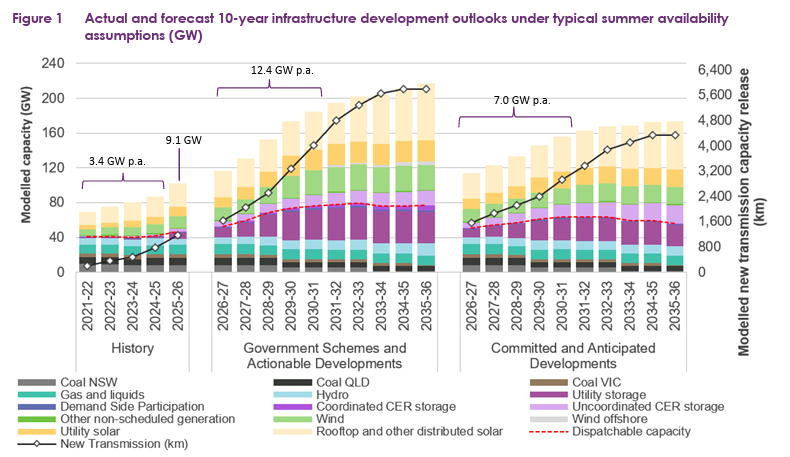
Around 15GW of coal and gas generation is scheduled to retire over the next decade, while electricity consumption is forecast to grow by more than 40% as homes, businesses, and industry electrify, and data centre demand expands.
Two reliability assessments show a widening gap between optimistic and conservative outlooks
The 2026 ESOO presents its findings through two separate reliability assessments, reflecting different levels of confidence in project delivery.
Under the more optimistic Government Schemes and Actionable Developments assessment, which assumes all committed, anticipated, and government-supported projects, along with actionable transmission developments, are delivered on schedule, AEMO forecasts no reliability gaps before 2033-34 in New South Wales, South Australia, and Victoria, and before 2034-35 in Tasmania.
Under the more conservative Committed and Anticipated Developments assessment, which applies commissioning delays based on recent experience and excludes projects that have not yet met AEMO’s formal commitment criteria, reliability gaps are forecast to emerge earlier: from 2030-31 in New South Wales and Victoria, from 2031-32 in South Australia, from 2032-33 in Queensland, and from 2033-34 in Tasmania.
This more conservative assessment forms the basis of AEMO’s official reliability forecast under the Retailer Reliability Obligation (RRO) framework.
AEMO noted that around 26GW of anticipated projects, those that have reached fewer delivery milestones than committed projects and face a greater risk of delay or non-delivery, play a significant role in avoiding a formal reliability gap trigger over the next three years.
Had these anticipated projects been excluded from the assessment entirely, AEMO said it would have needed to request the Australian Energy Regulator consider making reliability instruments in Queensland and New South Wales for 2029-30, coinciding with the closure of the Gladstone and Eraring power stations.
No forecast reliability gaps were identified for either the 2027-28 or 2029-30 assessment years under the RRO framework, meaning no reliability instruments have been requested at this stage.
Forecast reliability gaps are not the same as forecasts of power outages; AEMO describes them as an early signal that further investment or action may be needed to maintain reliability beyond the point identified.
Where genuine supply-scarcity risks do emerge within operational timeframes, AEMO said it retains tools, including the Reliability and Emergency Reserve Trader (RERT) mechanism, which allows it to procure additional reserves at short notice during periods of system stress.
Battery storage build-out continues at record pace, but energy adequacy risk is shifting the story
The ESOO is explicit that no single technology can meet the NEM’s future reliability needs alone, and that a diverse mix of renewable energy generation, storage, gas backup, transmission and consumer resources will be required as coal-fired generation continues to retire.
This diversity becomes increasingly important in winter, the report notes, as households and businesses electrify heating, driving stronger demand growth at a time when solar resource availability is naturally lower.
The scale of storage deployment underpinning AEMO’s improved outlook reflects a broader pattern already visible across the NEM this year.
The report’s finding that reliability now depends on a diverse mix of resources working together comes as battery storage contracts in Australia continue shifting away from rigid physical tolling arrangements toward more commoditised, interchangeable products.
That maturity is arriving alongside compressed returns. NEM-wide arbitrage spreads have narrowed sharply over the past year, and panellists at the Battery Asset Management Summit Australia 2026 in Sydney this week said battery storage investors are feeling the pinch as a result, with some attributing the pressure to coal closures being delayed beyond the original business-case timelines.
The ESOO’s own modelling assumes coal-fired generators retire on their announced closure dates while maintaining high availability until then, an assumption that, if it does not hold, could shift both the reliability outlook and the revenue conditions under which battery owners operate.
The Australian Energy Regulator’s own review of the NEM found the market is “transforming from one market into many different markets” within each region, with battery storage increasingly setting the wholesale price as coal’s role in the market recedes, a shift consistent with the growing storage capacity AEMO’s ESOO tracks.
On the residential side, the ESOO notes that consumer battery uptake has increased materially over the past year, supported by the federal government’s Cheaper Home Batteries Program, with 2.4GW/7.4GWh of household batteries added since the scheme launched on 1 July 2025.
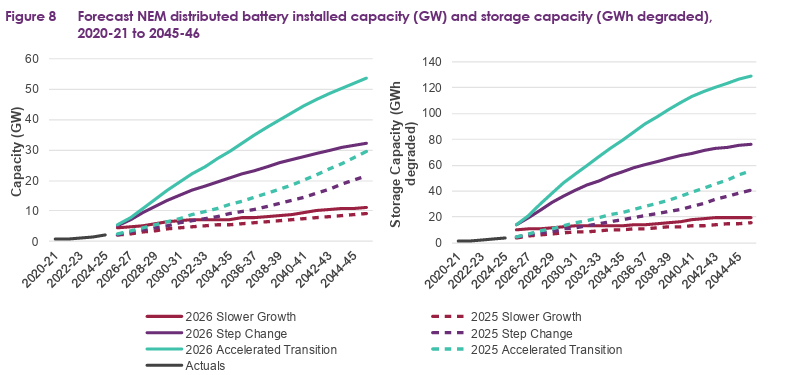
For every 1MW of new rooftop solar capacity installed over the past year, around 2.5MW and almost 8MWh of consumer battery storage systems have also been installed, and the average storage duration for residential batteries has increased to around 3-hours.
AEMO estimates only around 14% of consumer batteries are currently coordinated through virtual power plants (VPPs) or similar arrangements, a rate the report describes as slower than previously anticipated, despite growing pools of distributed battery capacity that could, in principle, participate in coordinated dispatch.
Minimum operational demand across the NEM continues to decline as rooftop solar uptake grows, though the report notes that rising home battery storage adoption and growing business and industrial loads, including data centres, are helping to moderate the pace of that decline.
AEMO’s report separately flags that maintaining system security, distinct from reliability, will require timely investment in grid-supporting capabilities and essential system services as inverter-based generation and load continue to grow, alongside the retirement of synchronous coal generation that has historically provided inertia and voltage support.
That requirement echoes ongoing efforts to build the evidence base for how battery storage can contribute to those services.
The University of New South Wales (UNSW) was recently awarded AU$6.52 million (US$4.24 million) in funding from the Australian Renewable Energy Agency to study how inverter-based resources, including grid-forming battery storage, interact with grid protection systems, addressing a gap AEMO’s own Transition Plan for System Security has identified around minimum system strength provision from grid-forming BESS.
AEMO said updated assessments of system security requirements and transition points will be provided in its 2026 Transition Plan for System Security.
Data centre electricity consumption in Australia to increase sevenfold
Data centre demand also features prominently in the 2026 ESOO’s forecasts, with consumption from the sector projected to grow nearly sevenfold, from around 5TWh in 2025-26 to 34TWh by 2035-36, equivalent to roughly 13% of forecast operational consumption, up from around 3% today.
AEMO’s forecasts considered 225 known data centre projects, though it noted more than 40% of proposed projects since 2025 have either dropped out of the pipeline or regressed in connection status, with more than 30% of cancellations occurring among projects previously classified as committed.
Total proposed data centre connection capacity across all development stages increased from 38GW to 67GW in AEMO’s 2026 assessment compared with the prior year. Currently, operating data centres are running at an estimated 27% of their maximum connection capacity, with AEMO projecting that a mature fleet would average 45-51% utilisation.
AEMO separately modelled a High Data Centre Growth sensitivity to explore how faster-than-forecast growth in the sector could affect investment needs beyond 2030-31.
Never miss an Australian energy storage story. Sign up for our Australia newsletter and get the latest project announcements, policy updates and market analysis delivered directly to you.