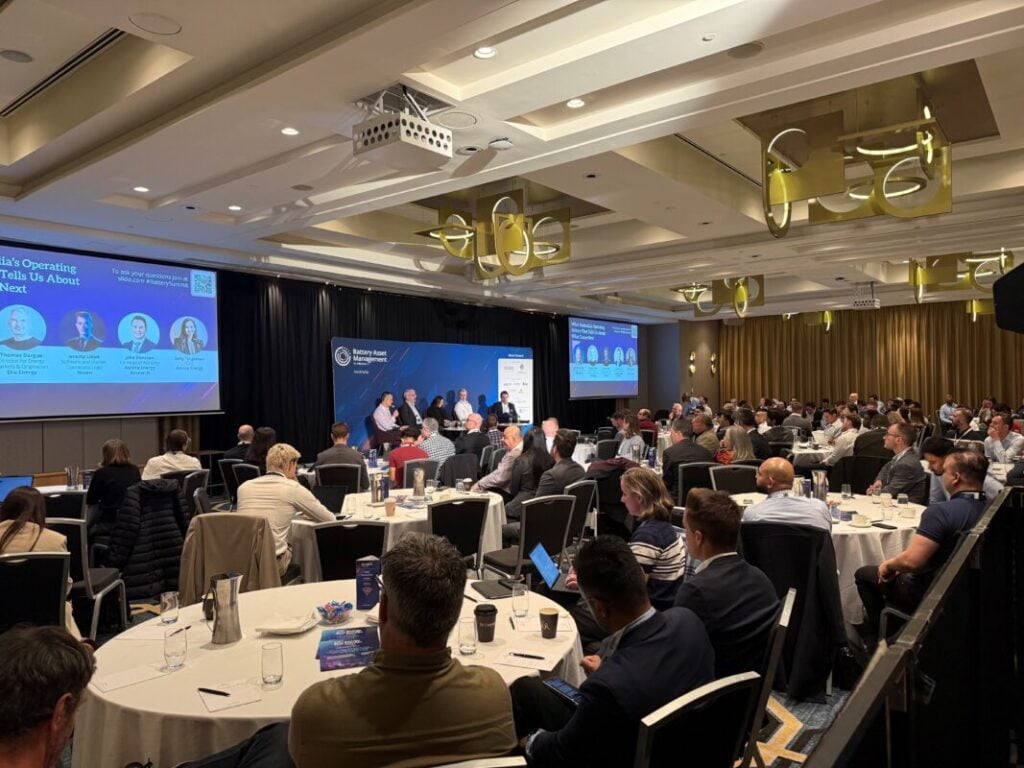
Australia’s grid-scale battery storage fleet has grown roughly fourfold in three years, and panellists at the Battery Asset Management Summit Australia 2026 in Sydney said that growth is reshaping how projects get financed, contracted and operated.
Speaking on the panel “What Australia’s Operating Battery Fleet Tells Us About What Comes Next,” Thomas Dargue, director for energy markets and origination at battery energy storage system (BESS) project developer and owner-operator Eku Energy, said spot prices and spreads are compressing sharply, forcing operators to work harder across a wider range of revenue streams.
“There’s a lot of pressure on ensuring that you have the right revenue strategies, both for now and into the future,” Dargue said.
“Being better at finding the different revenue opportunities that the particular batteries can provide across the whole range of services has become increasingly important.”
Try Premium for just $1
- Full premium access for the first month at only $1
- Converts to an annual rate after 30 days unless cancelled
- Cancel anytime during the trial period
Premium Benefits
- Expert industry analysis and interviews
- Digital access to PV Tech Power journal
- Exclusive event discounts
Or get the full Premium subscription right away
Or continue reading this article for free
That pressure is also changing how contracts are structured. Dargue said battery storage systems are increasingly treated as a commodity rather than a fixed physical asset.
“We start off with these physical tolls, where basically you build a battery, and you take the full market risk, and if the battery’s there, great. And if it’s not there, too bad,” he said.
“Nowadays, it’s much more of a commodity. We write contracts that are much more usable in the market, much more interchangeable.”
Dargue said the pool of buyers is also widening.
“We write contracts with people who probably weren’t seen as natural buyers of these long-term contracts before,” he said, describing the market as “a lot more sophisticated” than it was.
Sally Torgoman, CEO of Ascera Energy, said market sounding conducted on the company’s Riverina project is finding a similar shift in buyer profile.
“By far, we’ve just finished the market sounding where 70% of the parties we spoke to were not even parties that use the energy,” she said.
“To me, that has been a really fundamental change to knowing your customer, who you’re selling to, what they’re buying, and how you’re going to work with them.”
Specifically for Riverina, Torgoman said the project’s system strength contract is proving more durable than its ancillary services arrangements.
“System strength is a great one because it doesn’t cannibalise your general energy, so that means you can still sell your energy contract out but have this on top,” she said.
She contrasted this with Frequency Control Ancillary Services (FCAS), which she described as structurally reliant on penalising some participants to fund others.
“That market was fundamentally formed on the basis that you have to penalise somebody. In order for you to generate a pool of funds so that you can reward someone else. It’s not a model that you can replicate.”
Investor return expectations are rising as spreads compress
Torgoman said investor return requirements are shifting considerably as market conditions change.
“If I think about what a project like a Riverina would have been looking at, a project that’s 8-10% returns today, that project would be uninvestable, because our investors are expecting 13, 14%,” she said, attributing part of the increase to factors beyond the battery market itself, including the rising price of debt.
Jeremy Lloyd, software and market operations lead at Neoen, said ancillary services values are declining as more capacity enters the market.
“We’ve seen FCAS die. We’ve seen other kind of contracting opportunities dry up, and that will continue to change,” he said, describing a pattern in which each wave of new battery development pushes the value of existing ancillary revenue streams toward zero.
Jake Dunstan, co-head of advisory at Aurora Energy Research, said shifting coal retirement timelines remains one of the more disruptive factors relative to original business case assumptions.
“Coal extensions are probably the other one that jumps to mind in terms of things that weren’t in the business case that are changing,” Dunstan said, citing the Yallourn plant as “probably the largest example of where that timing has been fluid in the market.”
Household battery storage systems create an ‘operational visibility’ gap, but market impact may be overstated
Regarding the growth of household battery storage, Dunstan said the lack of real-time operational data on distributed battery storage systems poses an increasing risk to system planning.
“There’s a lot of 5MW projects and below that are operating today with zero transparency of what they’re doing on an interval basis,” he said.
“That obviously adds a lot of risk when you’re thinking about planning and operating a system.”
Asked whether AEMO’s voluntary scheduled resource programme can address that visibility gap, Dunstan said it is unlikely to be sufficient.
“There’s no natural incentive for some of those assets to provide visibility of their decisions,” he said.
“To get meaningful visibility requires some form of mandatory guide.”
Torgoman said her own view of the household battery threat to utility-scale business cases has shifted.
“I have to admit that the data that I have seen since that number of distributed batteries got installed is quite frightening for the utility business case,” she said, though she argued household battery storage systems are unlikely to directly substitute for utility-scale services.
“A customer at home is not going to provide system strength. They’re not going to provide arbitrage at times when the market needs it.”
Australia has become one of the major markets for the rollout of household battery storage systems. This has been spearheaded via the government’s Cheaper Home Batteries Program, which recently surpassed 500,000 installations.
On government intervention more broadly, Torgoman argued that suppressing price signals risks working against the transition it is meant to support.
“You need to have a view, and your view needs to be really defendable,” she said, arguing that coal retirements will eventually force price signals regardless of policy settings.
“There is something called science, and science is going to show us that these things cannot be operated.”
The summit’s first session delved into how battery storage investors are feeling pressure as arbitrage spreads narrow across Australia’s NEM, with panellists outlining that the compression stems partly from coal plant closures being delayed beyond original business-case assumptions.
Panellists also expressed broad scepticism about the Capacity Investment Scheme’s effectiveness, calling instead for regulatory certainty over further government intervention.
Never miss an Australian energy storage story. Sign up for our Australia newsletter and get the latest project announcements, policy updates and market analysis delivered directly to you.