Battery storage developers who built business cases on assumptions of faster coal plant closures are now absorbing the consequences of that timeline slipping.
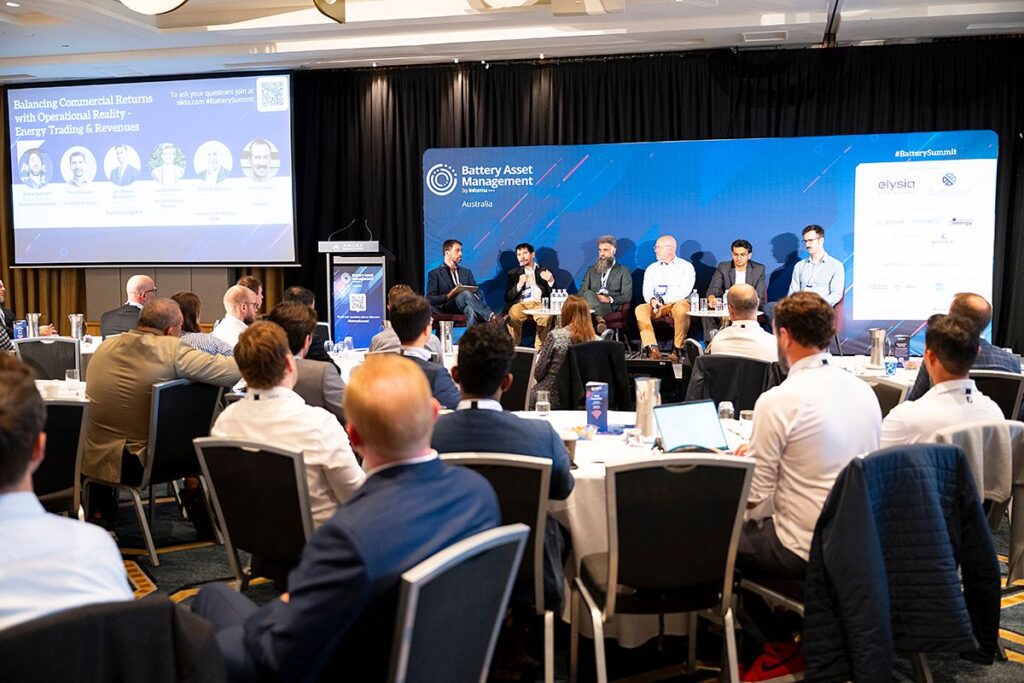
This is according to panellists speaking at the Battery Asset Management Summit Australia 2026 in Sydney today (25 August).
Speaking on the panel “Balancing Commercial Returns with Operational Reality – Energy Trading & Revenues,” Matt Grover, director of energy markets at Fluence, said any operator with a merchant BESS would be “feeling the pinch right now” as arbitrage spreads narrow and revenues fall.
Grover, whose team provides optimisation and bidding software for battery storage assets trading in the National Electricity Market (NEM), framed the compression as cyclical rather than structural.
Try Premium for just $1
- Full premium access for the first month at only $1
- Converts to an annual rate after 30 days unless cancelled
- Cancel anytime during the trial period
Premium Benefits
- Expert industry analysis and interviews
- Digital access to PV Tech Power journal
- Exclusive event discounts
Or get the full Premium subscription right away
Or continue reading this article for free
“Spreads have narrowed. Revenues are down right now,” Grover said.
“But the way I see that is largely a ‘right now’ problem. It is a short-term market cycle that will come back around, maybe not next week, but in the years ahead.”
Grover linked the pressure directly to coal generation timelines. “A lot of the people who are feeling pain right now probably built their business cases three years ago on an expectation of Eraring closing,” he said, referring to expected coal retirements that have since been pushed back.
Thomas Schmitz, general manager of energy markets at Aquila Clean Energy APAC, said the depressed revenue environment should not come as a surprise, given how battery storage systems function within the market.
“A battery is essentially the same function as a peaker,” Schmitz said, noting that peaking plants have historically operated at capacity factors of only 1-2%.
He argued the underlying problem sits with project finance structures rather than battery economics themselves, describing how developers “lock themselves into a condition where all of a sudden you have to generate at below cycling costs.”
Schmitz also cautioned against overreliance on projected Frequency Control Ancillary Services (FCAS) revenue in long-term financial models.
“I cannot even reconcile FCAS revenue that has happened probably to this end from the last month,” he said. “So, I don’t even know how you want to forecast it for 20 years.”
Panel divided on value of Capacity Investment Scheme, but aligned on need for regulatory certainty
The panel took an informal live poll of both panellists and the audience on several questions, including whether the federal government’s Capacity Investment Scheme (CIS) is working.
The response, from both the panel and the room, was overwhelmingly negative.
Dr Mahdi Behrangrad, head of the ESS/VPP business department at Pacifico Energy K.K., said government involvement in project structures can introduce complications beyond the initial support it provides.
Drawing on experience with Japan’s Long-Term Decarbonisation Power Source Auction (LTDA), Behrangrad said: “At the beginning, it sounds really attractive, but then you see the hidden agenda that comes and the politics that comes with it.”
Behrangrad argued the government’s role should be limited to setting direction rather than intervening in individual project outcomes.
“Focus on providing a North Star and certainty,” he said. “If my business model doesn’t work, let me collapse. It’s not their problem, it’s my problem.”
Schmitz agreed that a scheme like the CIS is not needed, arguing instead for consistent regulatory settings.
“We need regulatory certainty, and the market will flush out the developers that just take on too risky positions,” he said.
He is also critical of the proposed Energy Security Mechanism, arguing that its underlying premise, that developers can secure three-to-four-year forward contracts, does not hold in current market conditions.
“The whole premise is already a false premise,” Schmitz said.
“Having the government create an entity that starts trading in one of the most volatile commodity markets, putting taxpayers’ money at risk, and thinking that they can just trade out of the position, is just ridiculous.”
Kashish Shah, senior strategy lead at Wärtsilä Energy Storage, framed the CIS debate as a question of what policy should be trying to achieve.
“The objective of policy should be more visibility for the industry, rather than solving a particular market problem,” Shah said.
Contract structures diversifying as developers weigh flexibility against long-term risk
Panellists described a market moving away from simple, fixed contract structures toward more varied tolling and hybrid arrangements.
Behrangrad said the shift has accelerated over the past two to three years.
“Before 2022, almost 100% of the contracts received were of a physical type, but over the past two to three years, almost 30-40% of type of the contracts have changed toward a virtual type,” he said.
Behrangrad warns that oversimplified contract terms can leave money on the table by allocating risk to parties ill-positioned to manage it and separately flags a related problem: overly passive bidding behaviour among some asset owners.
“Some people are not marrying these two types of animals together,” he said, referring to a mismatch between parties comfortable with market risk and those focused purely on asset performance guarantees.
Schmitz said developers are being pushed to take on more risk directly, in part because financing structures increasingly assess risk at a portfolio rather than individual project level. He also drew a distinction between investor expectations and battery operating realities.
“You have two dynamics that just don’t match,” he said, comparing an infrastructure investor seeking steady 9% returns to expecting the trading behaviour of “a Formula One car”.
Tim Edmonds, head of advisory at Simply Energy NZ, said flexibility in performance guarantees and state-of-charge limits is becoming a live commercial issue.
Describing New Zealand’s seasonal price volatility, where average prices have ranged from NZ$8 (US$4.77) per MWh in summer to NZ$800 per MWh in winter, Edmonds said his company is negotiating lower state of charge (SoC) floors with suppliers to capture high-value periods.
“Coming right down to that 5% state of charge once or twice a year isn’t really going to affect that battery performance over time,” he said.
On the role of artificial intelligence (AI) in trading, Grover downplayed concerns that AI poses risks to market competition, arguing that generative AI models are ill-suited to the rule-based, explainable decision-making required by battery trading.
“Those types of AI models are really not fit for purpose for optimising a battery or trading an electricity market,” he said.
Shah added that AI’s practical role in his own work is largely confined to price forecasting rather than the optimisation process itself, which continues to rely on established operations research methods.
Schmitz cautioned against relying on AI-driven weather forecasting for tail-risk events, saying such models “are totally wrong” for major weather events despite being adequate for day-to-day forecasts.
On whether residential battery storage systems could eventually outcompete grid-scale storage, as distributed solar has done to utility-scale solar in parts of the NEM, Grover said the two are already competing for revenue, but expects utility-scale storage to retain an advantage as the grid becomes more dependent on forecastable, controllable resources.
Behrangrad is more sceptical that residential batteries can scale to a comparable role at all, citing the complexity of managing tens of thousands of individual customer relationships rather than any technical limitation.
“Rooftop solar is a passive asset, but a battery is very active,” he said. “It needs very active management and taking positions and judgments.”
Never miss an Australian energy storage story. Sign up for our Australia newsletter and get the latest project announcements, policy updates and market analysis delivered directly to you.