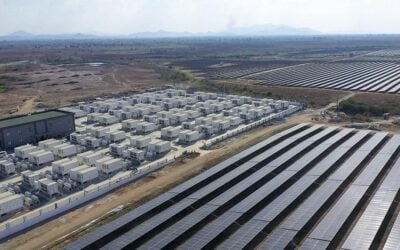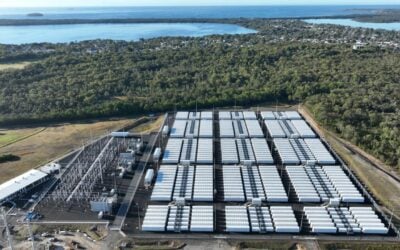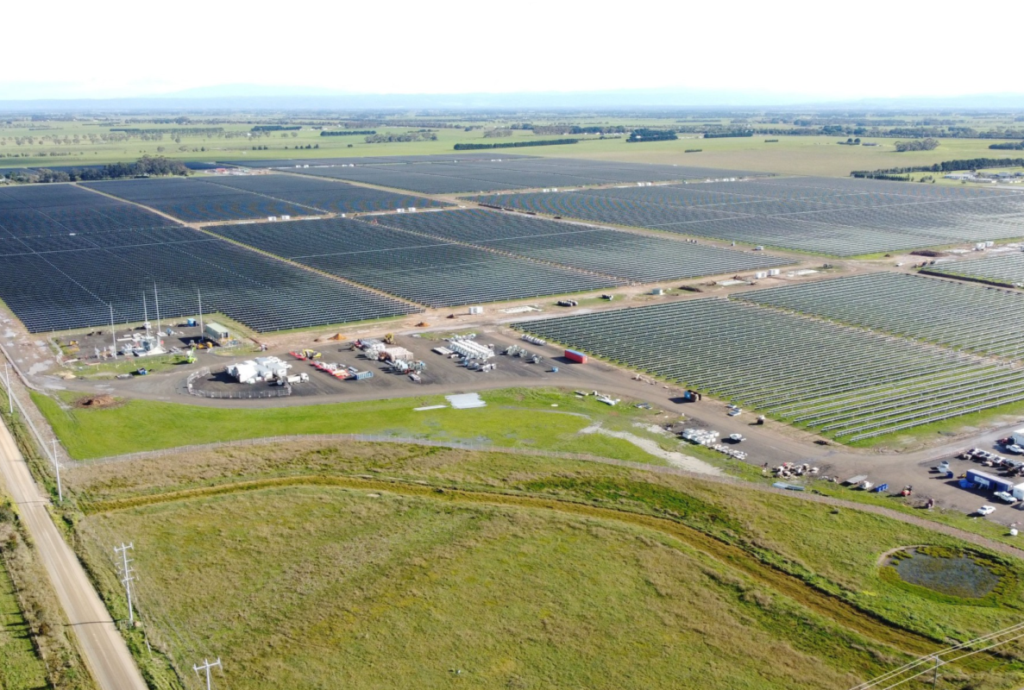
Octopus Australia has completed installation of the solar array at its Fulham Solar & Battery project in Victoria, with attention now shifting to construction of the site’s DC-coupled battery energy storage system (BESS).
The company confirmed via LinkedIn that the final solar module was installed in late June, bringing the total number of modules on site to 151,020 with a generation capacity of 80MW. Octopus Australia said the milestone marks a step forward as the project moves from construction towards commissioning.
The 64MW/128MWh BESS component is expected to arrive on site early in the second half of the year, according to the company, marking the next stage of delivery for the Gippsland project.
Fulham reached financial close and began construction in April 2025, backed by the Victorian government’s second Renewable Energy Target auction (VRET2). The project is valued at over AU$300 million (US$185 million), with equity contributions from Rest, the Clean Energy Finance Corporation (CEFC) and clients of Westpac Private Bank through Octopus’ managed funds.
Try Premium for just $1
- Full premium access for the first month at only $1
- Converts to an annual rate after 30 days unless cancelled
- Cancel anytime during the trial period
Premium Benefits
- Expert industry analysis and interviews
- Digital access to PV Tech Power journal
- Exclusive event discounts
Or get the full Premium subscription right away
Or continue reading this article for free
The site will house a 64MW/128MWh DC-coupled BESS, supplied by Wärtsilä. GRS, part of Gransolar Group, is the engineering, procurement and construction (EPC) contractor. Fulham is due to begin operations in 2027.
DC-coupling and portfolio optimisation
In a DC-coupled configuration, solar generation connects directly to the battery storage system via DC/DC converters, then is converted to alternating current for grid delivery. The approach reduces conversion losses compared with AC-coupled systems and allows batteries to charge more efficiently from the co-located solar array.
Fulham was Wärtsilä’s first DC-coupled hybrid project in the country, with Octopus Australia. The pairing has since scaled up considerably, with the two companies working together again on the larger 300MW Blind Creek Solar Farm and Battery in New South Wales, a 243MW/486MWh project that reached financial close in November 2025 with a AU$900 million price tag.
Earlier this month, Octopus Australia appointed Habitat Energy to optimise both the Fulham and Blind Creek projects, a combined portfolio of 380MW of solar generation and 307MW/614MWh of battery storage.
Habitat will co-optimise output across both sites using its forecasting and trading platform and has built digital twins of each facility to support pre-operational testing ahead of commissioning.
Sam Reynolds, chief executive of Octopus Australia, said at the time that the company’s strategy is to build portfolios where solar and battery storage systems operate as a single system, creating dispatchable power similar to that traditionally supplied by coal-fired generation.
DC coupling has become an increasingly common approach in the Australian market. Neha Sinha, product manager for energy storage systems at Wärtsilä Energy Storage, told ESN Premium that co-location with battery storage is becoming essential for solar developers as curtailment issues grow and coal plants are retired.
“It’s becoming clear that you need to be co-located with battery storage to maximise the potential of your system and to support the market demands,” Sinha said.
Octopus Australia’s broader pipeline extends well beyond Fulham and Blind Creek. The company describes its overall portfolio across wind, solar and battery storage as exceeding AU$16 billion, and in February 2026, acquired the proposed 1.2GW/4.8GWh Hanworth BESS in New South Wales.
Never miss an Australian energy storage story. Sign up for our Australia newsletter and get the latest project announcements, policy updates and market analysis delivered directly to you.
Solar Media (part of Informa Group) will host the Battery Asset Management Summit Australia 2026 on 25-26 August at the Amora Hotel Jamison in Sydney, bringing together asset owners, operators, trading teams and optimisers to address revenue strategy, lifecycle management and operational performance across Australia’s fast-growing battery storage fleet.
Readers of Energy-Storage.news can get 20% off their tickets using the code ESN20 at checkout. Find out more about the Summit on the official website.