
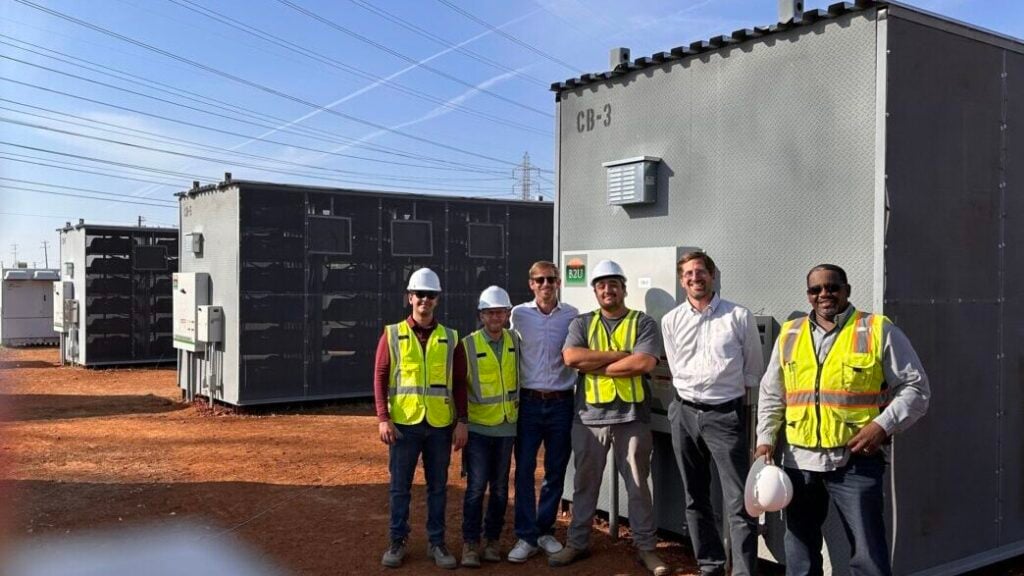
Energy-Storage.news Premium speaks with Freeman Hall, CEO of second-life BESS firm B2U Storage Solutions.
Hall says that second-life battery energy storage systems (BESS) can compete effectively with new battery prices whilst addressing growing concerns over recycling costs and supply chain geopolitics.
The CEO outlines how the repurposing sector has evolved from initial scepticism to becoming what he believes will be “the dominant second step for a lot of batteries” before eventual recycling.
The comments come as B2U announced a strategic partnership with South Korean battery giant LG Energy Solution (LG ES) in late September, enabling the US firm to repurpose BESS cells from LG ES for grid-scale applications.
Try Premium for just $1
- Full premium access for the first month at only $1
- Converts to an annual rate after 30 days unless cancelled
- Cancel anytime during the trial period
Premium Benefits
- Expert industry analysis and interviews
- Digital access to PV Tech Power journal
- Exclusive event discounts
Or get the full Premium subscription right away
Or continue reading this article for free
Repurposing economics versus new battery costs
Hall explains that the fundamental economics of repurposing rest on the problematic nature of battery recycling, which typically represents a net cost to battery owners rather than a revenue stream.
“The realities are that those batteries are a liability, and that they’re going to lead to cost to be dealt with in recycling, where they can be an asset if deployed properly and deployed well,” Hall says.
He notes that even for chemistries with higher material value such as nickel manganese cobalt (NMC), recycling remains a net cost once transportation expenses are factored in. For lithium iron phosphate (LFP) batteries, recycling costs are particularly high.
This dynamic means repurposers need only pay a modest premium over what recyclers can offer—which Hall characterises as “next to nothing”—to secure battery supply. He suggests repurposers could even be paid to take batteries given the expense of recycling LFP batteries.
“Can we compete with the China price for new battery prices? Of course we can. The capacity we’re deploying is way less costly to us as an input than a new battery,” Hall said.
He adds that geopolitical factors and industrial policy provide additional advantages, particularly regarding investment tax credits and foreign entity of concern (FEOC) restrictions that limit incentives for Chinese-manufactured equipment.
Addressing investor concerns
Hall acknowledges that capital providers remain cautious about second-life BESS, requiring proof of both safety performance and long-term reliability before committing funds at scale.
B2U has sought to address these concerns through an extensive operational track record. Founded in 2019, the company has deployed over 5,000 batteries across more than five years without incident, currently managing over 100MWh of capacity with plans to reach 150MWh shortly.
“We’ve got by far the longest and biggest data set for the effectiveness of repurposing over time,” Hall says, noting that this has enabled the company to develop financial products providing performance guarantees for its systems.
Matrix configuration
The company’s approach centres on utilising batteries in their native form wherever possible, preferring to work with complete electric vehicle (EV) battery packs as they come from vehicles rather than disassembling them.
B2U deploys batteries in a matrix configuration that allows individual units to be connected or disconnected without affecting overall system performance—especially helpful when working with batteries of varying capacities and states of health.
“In our matrix architecture, you can disconnect a battery when it has reached its upper guardrail or voltage level during a charge cycle, and not inhibit the other batteries that may still have a little bit more charge that they can take,” Hall explains.
The company monitors cell-level data in real time, tracking voltage, current and temperature at millisecond frequency to ensure batteries operate within safe parameters.
Hall characterises the repurposing sector as undergoing significant evolution, with “conventional wisdom” that batteries should proceed directly to recycling now being reconsidered.
He welcomed the entry of additional players into the space, including battery recycler Redwood Materials, which launched its Redwood Energy division and announced repurposing capabilities in 2025.
“This space is going to be the dominant second step for a lot of batteries. I think a high percentage of batteries in their first intended use, if they are larger scale and there’s sufficient volume, are going to be very good candidates for a repurposed application in a less demanding downcycle use case,” Hall says.
The B2U CEO notes that whilst different companies have pursued varying technical approaches—including Redwood’s “pack manager” system and other firms’ preference for replacing battery management systems (BMS)—the sector shares common goals in extracting residual value before eventual recycling.
LG ES partnership details
Hall provides further details on the recently announced partnership with LG ES, stating that it builds on a relationship dating back several years, during which B2U has purchased and deployed thousands of LG batteries from automotive applications.
The expanded agreement will enable B2U to work with a broader range of LG battery types, including stationary storage batteries and modules that may not meet specifications for primary applications but retain substantial utility.
Hall explains that the partnership will focus on “downcycling” high C-rate batteries designed for demanding applications such as frequency regulation or uninterruptible power supply systems (UPS), deploying them instead in lower C-rate grid storage applications.
The agreement will also encompass what Hall terms “B grade material”—batteries with characteristics such as wider voltage variance that fall outside specifications for LG’s primary products but remain healthy and functional.
“These are still very healthy, very useful batteries that just don’t quite meet the specs that they need to get assembled together and go into their larger solutions,” he says.
