
AI data centres have energy and power requirements demanding enough to potentially stretch lithium-ion beyond its versatile limits, writes Intertek CEA market intelligence consultant Aaron Marks.
Compared to traditional solar and energy storage developers, data centre developers have notably different priorities and requirements when it comes to procuring onsite power for their projects, opening up an opportunity for non-lithium chemistries.
The challenges data centres create for the grid – both the significant increase in overall load and rapid swings in demand – are a good fit for energy storage technologies. Few technologies can manage short-term surges of hundreds of megawatts. As upfront cost is no longer the most important parameter by default, there are opportunities for a wider range of storage technologies than just lithium-ion.
The challenges data centres create for the grid both the significant increase in overall load and rapid swings in demand – are a good fit for energy storage technologies. Few technologies can manage short-term surges of hundreds of megawatts. As upfront cost is no longer the most important parameter by default, there are opportunities for a wider range of storage technologies than just lithium-ion.
Try Premium for just $1
- Full premium access for the first month at only $1
- Converts to an annual rate after 30 days unless cancelled
- Cancel anytime during the trial period
Premium Benefits
- Expert industry analysis and interviews
- Digital access to PV Tech Power journal
- Exclusive event discounts
Or get the full Premium subscription right away
Or continue reading this article for free
To understand why data centercentre developers are thinking about power differently, it’s important to understand what is driving the cost of a data centercentre, and that is, unsurprisingly, computing hardware. There are numerous estimates of how much it costs to procure the necessary computing hardware stack for an AI data centercentre, which is heavy on graphics processing units (GPUs) to complete AI workloads.
These estimates range from US$20-40 million per megawatt, or to put it into a more typical power generation unit, US$20,000-40,000 per kilowatt. In comparison, the all-in cost for a typical battery energy storage system (BESS) is closer to US$1000/kW, or somewhere between 5% and 2.5% of a data centre’s compute cost for a given level of power consumption.
This doesn’t mean that the cost of power or cost of energy storage isn’t important, but when it’s a couple percent of your capex, spending more for a better aligned technology is less of a risk than if you’re a pure-play storage developer and the storage technology is the majority of your capex.
Early examples of diverse technologies and use cases
With more cost flexibility and more demanding performance requirements, data centre developers are seeking unconventional energy storage solutions for their energy management challenges. While lithium-ion batteries have incredible energy density and flexibility, data centre developers are often looking for large-scale and long-duration solutions which can more adequately compete with a conventional solution, typically diesel generators or gas turbines paired with onsite fuel storage.
Several projects that match this profile have emerged recently:
In June, Invinity Energy Systems announced that it would be building a 2.1GWh vanadium redox flow battery (VRFB) to pair with a data centre in Switzerland being developed by FlexBase, confirming the project’s EPC contract award shortly after, in August. The requirements of the data centre necessitated a large-scale project, and this capacity makes Invinity’s project the largest flow battery announced anywhere in the world.
Similarly, iron-air battery manufacturer Form Energy announced an agreement to provide 12GWh of BESS to AI data centre developer Crusoe. The 100-hour duration of iron-air systems makes for a much more favourable comparison to onsite fuel storage for outage coverage than lithium-ion BESS would be able to provide.
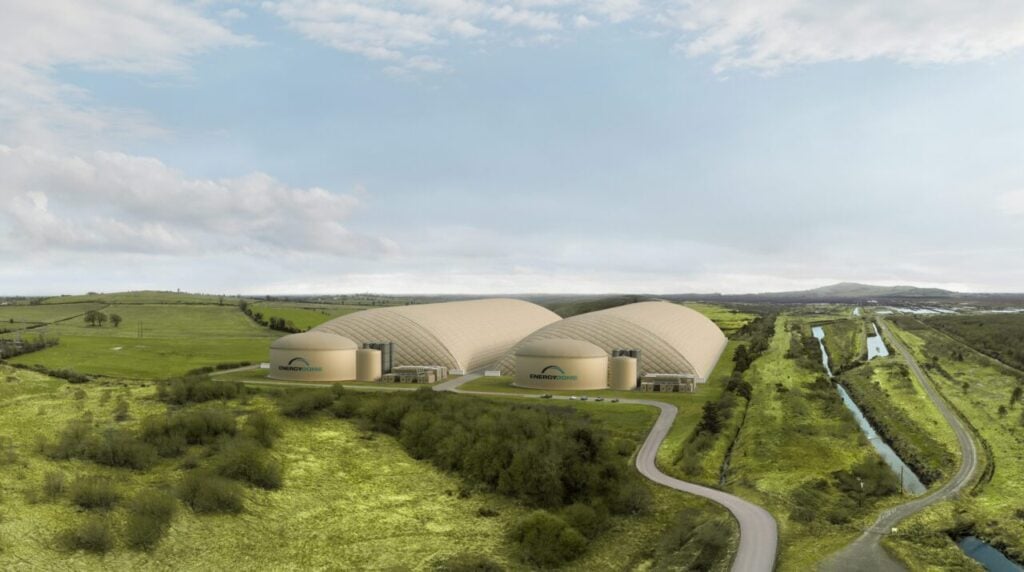
A conventionally powered data centre still needs backup, and Energy Dome has presented a unique solution by pairing its ‘CO2 Battery’ compressed-gas energy storage system with on-site gas turbines, using waste heat from the turbines to significantly improve the efficiency of the entire system. Mechanical energy storage systems, including compressed air and liquid air technologies, often struggle in comparison to electrochemical batteries when it comes to round-trip efficiency (RTE), but direct integration with existing generators has the potential to increase the utility of both generator and storage in a way that batteries can’t easily match.
The speed-to-power advantage
There is another key factor when it comes to deploying power for data centres, and that is simply speed.
Data centre construction is going at a breakneck pace, and power is often a significant timeline risk, be that from interconnection queues or procurement lead times for gas turbines or transformers.
While lithium-ion battery manufacturing continues to scale, so too does demand, with an ever-growing list of offtakers. In comparison, non-lithium technology providers often have readily available capacity. That makes them appealing partners for data centre developers who generally want storage capacity in the ground as quickly as possible.
In this way, even the modest uptake of long-duration storage technology can itself be an advantage if it means an opportunistic data centre developer can be first in line for procurement.
Technology selected by application
None of this is to say that lithium-ion batteries won’t see their slice of the pie of data centre energy storage demand; in addition to containerised BESS, we see many battery OEMs preparing battery backup unit (BBU) products that are tailor-made for data centre applications.
There are also new opportunities for grid-connected BESS to provide grid services on circuits and around nodes where data centres are located, and these projects will more likely align with typical energy storage economics.
Data centre developers have a whole host of different requirements and problems to solve, and already we see that they aren’t approaching energy storage the same way that solar and storage developers always have. It’s a great time to be a non-lithium manufacturer with capacity and short lead times.
About the Author
Aaron Marks is a battery energy storage expert on Intertek CEA’s Market Intelligence team. His background includes over a decade of experience in the electric power industry, focusing on storage cost, revenue, and operations analysis. Before joining Intertek CEA, Aaron worked as an energy storage research analyst at Wood Mackenzie, contributing to critical insights for the industry. His prior roles at PowerAdvocate and National Grid further enriched his knowledge of energy supply chain data analytics and corporate technology related to energy storage.
