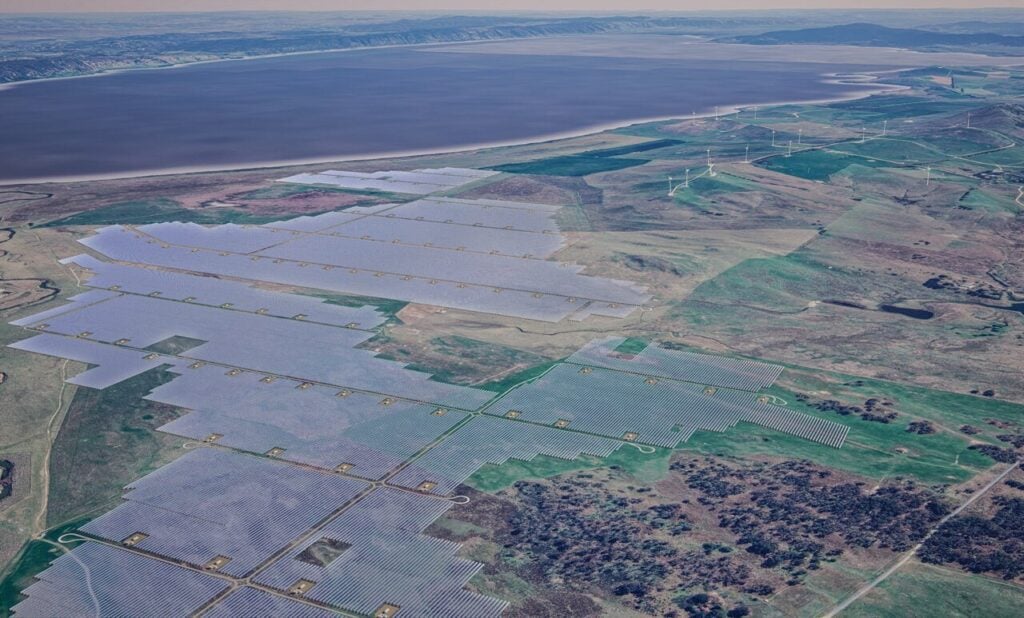
Habitat Energy has been appointed by Octopus Australia to provide optimisation services for a portfolio of two DC-coupled solar-plus-storage projects totalling 380MW of solar generation and 307MW/614MWh of battery storage.
The portfolio comprises the 80MW Fulham Solar Farm and 64MW/128MWh battery storage system in Gippsland, Victoria, due to begin operations in 2027, and the 300MW Blind Creek Solar Farm and 243MW/486MWh battery storage system near Bungendore in New South Wales, which is due to be operational in 2028.
In a DC-coupled configuration, solar generation connects directly to the battery via DC/DC converters, then converts to alternating current for grid connection, reducing energy losses and enabling the battery to be charged from the solar array more efficiently than an AC-coupled system allows.
The DC-coupled architecture at the heart of both projects reflects a broader trend in Australia’s utility-scale solar and storage market.
Try Premium for just $1
- Full premium access for the first month at only $1
- Converts to an annual rate after 30 days unless cancelled
- Cancel anytime during the trial period
Premium Benefits
- Expert industry analysis and interviews
- Digital access to PV Tech Power journal
- Exclusive event discounts
Or get the full Premium subscription right away
Or continue reading this article for free
Last year, Wärtsilä’s Neha Sinha told ESN Premium that co-location with battery storage is becoming a necessity rather than an option for solar PV plants in the NEM, as curtailment pressures mount and coal plant retirements accelerate.
“As we see more and more solar PV plants being deployed, as we see curtailment issues, as we see decommissioning of coal plants in favour of these systems, it’s becoming clear that you need to be co-located with battery storage to maximise the potential of your system and to support the market demands,” Sinha said.
Global battery storage and renewable energy trading and optimisation specialist Habitat Energy will co-optimise the solar and storage output across both sites using its proprietary algorithmic forecasting and trading platform, balancing weather patterns and price signals against asset, site and contractual requirements.
To prepare both sites for market entry, Habitat has developed digital twins of the Fulham and Blind Creek facilities.
The models enable Habitat and Octopus to conduct stress testing and pre-operational planning ahead of commissioning, with the aim of ensuring both assets are ready to participate in the National Electricity Market (NEM) from the day they come online.
Greg Billman, managing director of Habitat Energy Australia, said the work required a specialist skillset.
“Co-optimising solar and storage is the key to delivering affordable, reliable clean power but it requires a specialist skillset – one Habitat has honed in some of the world’s largest energy storage markets. We’re looking forward to bringing our tools and expertise to bear in partnership with Octopus Australia, who have rapidly established themselves as a leading force in Australia’s clean energy transition.”
Sam Reynolds, chief executive of Octopus Australia, said the arrangement reflected the company’s strategy of building portfolios where solar and batteries function as a single system.
“Renewable energy becomes far more valuable when you can decide not just how it’s generated, but when it’s delivered. Our strategy is to build portfolios where solar and batteries operate as one, creating the kind of firm, dispatchable power customers have traditionally relied on from coal-fired generation. Habitat’s optimisation capability helps us do exactly that, improving reliability, creating more value for our investors and delivering lower-cost electricity for customers.”
Expanding portfolios in a growing market
The appointment extends an existing relationship between the two organisations in Australia. Habitat Energy is part of Quinbrook Infrastructure Partners and currently manages 5.5GW of storage and renewable energy assets globally across Australia, the UK and the United States.
In Australia, its contracted portfolio includes the 250MW/500MWh Williamsdale BESS in the Australian Capital Territory (ACT), which was the ACT’s largest battery storage project when Habitat was appointed to optimise it in December 2024, and the 100MW Mannum BESS in South Australia.
The Williamsdale BESS is operated by Eku Energy, a Macquarie-backed battery storage developer, and provides system strength services and fast-acting frequency control ancillary services to the NEM in grid-forming mode.
The Blind Creek project has been a development Octopus Australia has been advancing for several years.
As previously reported by Energy-Storage.news, Octopus Australia reached financial close on the AU$900 million (US$630 million) Blind Creek Solar Farm and Battery in November 2025, with Wärtsilä supplying the DC-coupled battery storage system and SMA providing the inverter technology.
The financing structure included investment from Hostplus, Rest Super, the Clean Energy Finance Corporation, Westpac Private Bank and APG, the Dutch pension fund manager.
Octopus Australia’s broader portfolio and pipeline extends well beyond the two projects now contracted to Habitat.
In February 2026, Octopus Australia acquired the proposed 1.2GW/4.8GWh Hanworth BESS near Bannaby in New South Wales, which the company described as Australia’s largest planned battery project at the time of acquisition.
The company describes its overall portfolio and pipeline as exceeding AU$16 billion across wind, solar and battery storage.
Habitat’s relationship with the Octopus group also extends to the US, where Habitat Energy was appointed in February 2025 to optimise a 50MW/100MWh tolled BESS in the ERCOT market for Octopus Energy US, leveraging the battery storage system to hedge Octopus’ retail load exposure while participating in ERCOT’s wholesale and ancillary services markets.
The Australian appointment is considerably larger in scale and introduces the additional complexity of co-optimising variable solar generation alongside dispatchable storage within a single integrated system.
Never miss an Australian energy storage story. Sign up for our Australia newsletter and get the latest project announcements, policy updates and market analysis delivered directly to you.
Solar Media (part of Informa Group) will host the Battery Asset Management Summit Australia 2026 on 25-26 August at the Amora Hotel Jamison in Sydney, bringing together asset owners, operators, trading teams and optimisers to address revenue strategy, lifecycle management and operational performance across Australia’s fast-growing battery storage fleet.
Readers of Energy-Storage.news can get 20% off their tickets using the code ESN20 at checkout. Find out more about the Summit on the official website.