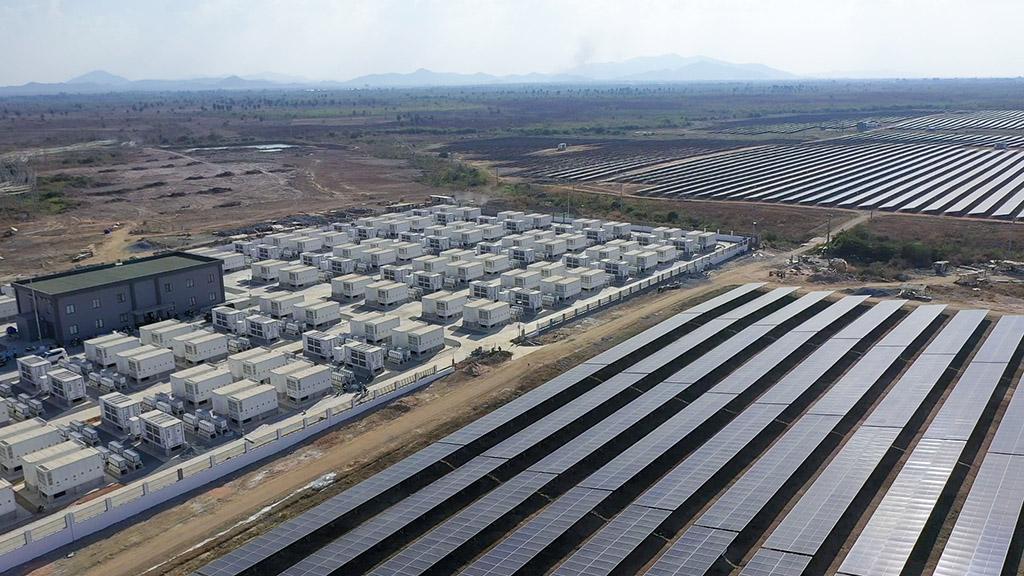
The ASEAN Centre for Energy (ACE) and the International Energy Agency (IEA) say the main obstacles to battery energy storage system (BESS) deployment in Southeast Asia are policy and market rules, not technology.
“The principal constraints on variable renewable energy (VRE) integration are often policy and regulatory rather than technical,” the joint report says, referring to variable renewable energy (VRE) such as wind and solar.
The white paper was prepared to support the energy priority of the Philippines’ 2026 ASEAN chairship. ACE is the ASEAN energy body based in Jakarta, and the authors are Tharinya Supasa and Monika Merdekawati of ACE and Peerapat Vithayasrichareon of the IEA.
The report puts the region’s VRE capacity at 53.7GW in 2024, rising to about 231GW by 2030, or roughly 28% of installed capacity and 21% of generation across its three ASEAN scenarios.
Try Premium for just $1
- Full premium access for the first month at only $1
- Converts to an annual rate after 30 days unless cancelled
- Cancel anytime during the trial period
Premium Benefits
- Expert industry analysis and interviews
- Digital access to PV Tech Power journal
- Exclusive event discounts
Or get the full Premium subscription right away
Or continue reading this article for free
Member states expect VRE to supply between 5% and 50% of generation by 2030, and the ASEAN Renewable Energy Long-term Roadmap suggests storage capacity could grow about fivefold from 2024 levels.
Most countries remain in the IEA’s first two phases of VRE integration through 2030, which entail minor to moderate system impacts, while Vietnam is already in the third phase.
The report sorts the 11 countries into three groups by integration phase and the maturity of their frameworks.
The Philippines and Singapore are “transformational,” Cambodia, Indonesia, Malaysia, Thailand and Viet Nam are “enabling,” and Brunei, Lao PDR, Myanmar and Timor-Leste are “foundational.”
Market structure and grid rules lag behind deployment plans
Single-buyer market structures, in which one utility purchases from all generators, still dominate most ASEAN countries, the report says.
That makes long-term power purchase agreements (PPAs), capacity payments and regulated procurement central to BESS investment.
“Commercialising BESS projects requires revisiting power purchase agreements,” it says, and it points to full tolling as one structure that can support early-stage business models.
Liberalised markets work differently. “Liberalised electricity markets in the Philippines and Singapore allow BESS to access multiple revenue streams,” the report says.
The Philippines’ wholesale market launched a reserve market in 2024, runs five-minute dispatch and settlement, and its fourth Green Energy Auction was the first to target renewable energy and integrated energy storage capacity, awarding 20-year contracts for 1.19GW of renewable energy projects with at least four hours of storage in 2025. Meanwhile, Singapore reached a 200MW storage target for 2025 two years early in 2023.
Elsewhere, the report finds that grid codes in several countries have yet to set BESS performance requirements for grid-support services, and that delays in obtaining grid connections are constraining development in many jurisdictions.
Ownership and asset classification are also unsettled, since a BESS can be treated as generation when it discharges and as load when it charges. The report recommends that ASEAN member states set clear rules on asset classification, ownership and network charges.
Pimpa Limthongkul, director at the National Energy Technology Center and president of the Thailand Energy Storage Technology Association, told the Energy Storage Summit Asia 2026 in July that “so many” regulatory reforms are needed to make storage bankable. The report cites a draft power development plan for 2026 to 2050 that lists 14.5GW of new BESS by 2037.
Energy-Storage.news reported an earlier 2024 draft that listed 10,485MW/26,010MWh by 2037. Wattanapong Kurovat, director-general of the Energy Policy and Planning Office, said at the same event that Thailand is creating a more flexible and competitive market environment, citing direct PPAs.
The country’s market is an enhanced single-buyer model in which the Electricity Generating Authority of Thailand is the main offtaker for large-scale storage.
Vietnam’s revised power plan targets up to 16.3GW of BESS by 2030, and its Circular 62/2025/TT-BCT sets a regulated PPA framework with capacity and energy payments, though permitting is not yet defined.
Indonesia’s PLN plan for 2025 to 2034 sets 6GW of utility-scale BESS and 3.6GW of solar plus BESS by 2035, but legacy take-or-pay PPAs constrain flexibility.
For Cambodia, the report estimates about 2GW of storage is needed for a 42% VRE share by 2030, against a target of 200MW. The report’s estimates of storage needed come from its ASEAN scenario modelling and are not national targets.
Finance and climate risk shape the commercial case
The report names high capital costs, limited revenue visibility and foreign exchange risk as the key investment barriers.
In the Philippines, the market with the most multi-revenue access, Ayala Corporation’s renewable energy platform ACEN lent PHP9 billion (US$144 million) to subsidiaries in September, including funding for a 500MW/1,000MWh BESS in Zambales. The report puts operational and pipeline storage in the Philippines at about 1,000MW.
Physical risk adds to the commercial case. Alan Yau, CEO of developer Verdant Energy, also told the Energy Storage Summit Asia 2026 event that “climate risk is no longer an abstract concept to us anymore”, and said extreme heat accelerates replacement schedules. Samata Masagee, a partner at law firm Clyde & Co, said BESS insurance costs more than other renewable energy insurance products because of limited long-term loss data.
Data centres add to the demand side. The report says regional data centre power demand is projected to quadruple from 2.6GW in 2025 to 10.7GW by 2035.
The report’s near-term recommendations, for 2026 to 2028, include an ASEAN technical guideline for BESS, safety standards aligned with IEC 62933, IEC 62619, and IEC 62477, and the integration of storage into national planning.
From 2028, it points to revenue stacking across energy, reserve and ancillary markets, renegotiating legacy take-or-pay PPAs where appropriate, and concessional finance.