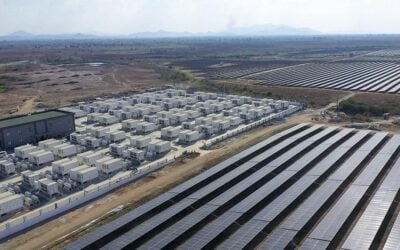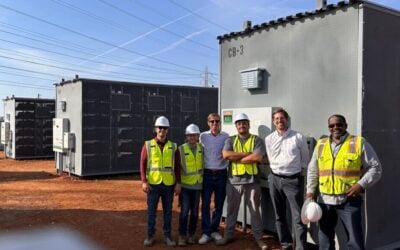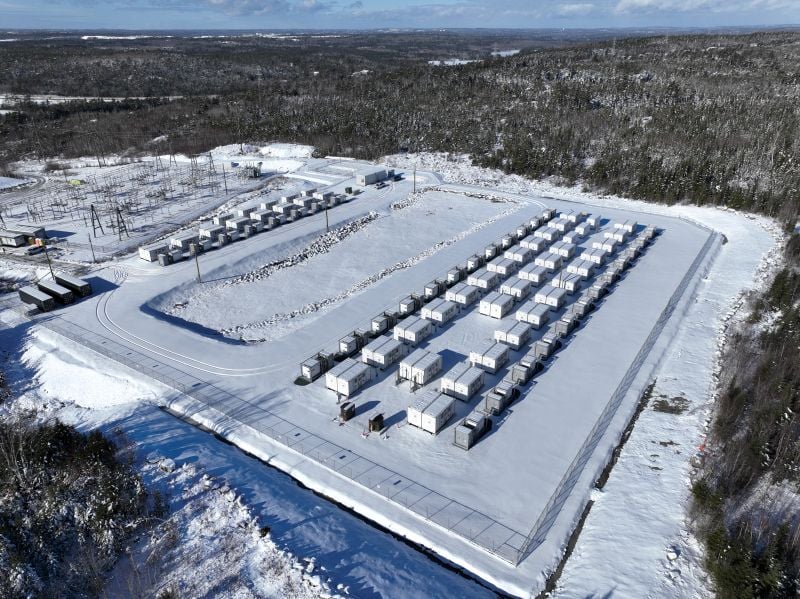
Nova Scotia Power has inaugurated three 50MW/200MWh battery energy storage systems (BESS) in Bridgewater, Waverley and White Rock, now Atlantic Canada’s largest battery storage facilities.
The Government of Canada invested CA$109 million (US$79 million) for pre-development work, installation and grid modernisation upgrades tied to the projects, part of Natural Resources Canada’s Electricity Predevelopment Program.
The Canada Infrastructure Bank (CIB), a federal Crown corporation that provides debt financing for infrastructure projects, provided a further CA$138.2 million loan.
Nova Scotia Power, the province’s monopoly electric utility, expects the combined 150MW/600MWh portfolio to support the province’s shift away from coal-fired generation and strengthen grid reliability during peak-demand periods and outages.
Try Premium for just $1
- Full premium access for the first month at only $1
- Converts to an annual rate after 30 days unless cancelled
- Cancel anytime during the trial period
Premium Benefits
- Expert industry analysis and interviews
- Digital access to PV Tech Power journal
- Exclusive event discounts
Or get the full Premium subscription right away
Or continue reading this article for free
All 13 Mi’kmaw communities in Nova Scotia are participating as equity partners in the project through the Wskijinu’k Mtmo’taqnuow Agency (WMA), an organisation representing Mi’kmaw economic interests in the province.
The Canada Infrastructure Bank said the arrangement marks the first clean energy project backed by its Indigenous Equity Initiative.
Vivek Sood, president and CEO of Nova Scotia Power, said the completion of all three sites reflected years of planning, engineering and community engagement.
“These projects strengthen the reliability of the electricity system for our customers while enabling the continued growth of renewable energy across the province,” Sood said.
Crystal Nicholas, president and general manager of the WMA, said the equity structure gives Mi’kmaw communities a direct stake in the province’s energy transition.
“Inclusion in such projects opens pathways toward economic reconciliation and ensures that traditional Indigenous values are considered in major project development,” Nicholas said.
Nova Scotia Utility and Review Board regulators approved the three-site portfolio in 2024, following amendments the province made to its Electricity Act in 2023 specifically to accelerate energy storage deployment.
Those amendments allowed Nova Scotia Power to run competitive solicitations to procure battery storage resources, a legislative change that paved the way for the Bridgewater, Waverley and White Rock sites to proceed to construction.
Nova Scotia has estimated it will need between 300MW and 400MW of energy storage by 2030 to help meet its target of 80% renewable energy and a full coal phase-out by that date.
In 2022, more than 70% of the province’s electricity still came from coal, natural gas and other fossil fuels, with renewables, including hydro, wind, tidal and solar, contributing around 23%.
Nova Scotia already hosts more than 300 commercial wind turbines, including five wind farms that are majority-owned by Mi’kmaw communities, and Chinese wind turbine manufacturer Envision Energy has separately signed a partnership agreement to explore a 300MW hybrid wind-plus-storage project near Sydney, Nova Scotia.
Provincial utilities across Canada are moving on battery storage through different procurement models
Nova Scotia’s approach, a utility-led build supported by direct federal investment and an Indigenous equity structure, sits alongside distinct battery storage strategies emerging in other provinces.
In Ontario, the Independent Electricity System Operator’s (IESO) Long-Term 1 and Long-Term 2 procurement rounds have driven the country’s largest battery contracting activity to date, including the 250MW/1,000MWh Napanee BESS, developed by a joint venture between Ameresco and Atura Power, which began commercial operations in May 2026 roughly five weeks ahead of schedule and under its CA$600 million budget.
Ontario’s storage build-out has been driven partly by the scheduled 2026 closure of the 2,100MW Pickering Nuclear station.
Trade association Energy Storage Canada has recommended the province establish a dedicated procurement track for behind-the-meter and distribution-connected battery storage, arguing that existing compensation structures undervalue the grid services smaller, faster-to-deploy battery assets can already provide.
British Columbia is taking a more centralised approach. BC Hydro, the province’s Crown-owned utility, is advancing what it describes as the first major battery storage project in the province, a facility of at least 100MW planned for a site near Duncan on Vancouver Island, which the utility intends to own and operate directly rather than procure through a long-term contract with a private developer.
BC Hydro has identified up to 500MW of potential battery storage capacity across the province under its Powering Growth plan.
Federally, the Nova Scotia investment is part of the government’s broader CA$4.5 billion Smart Renewables and Electrification Pathways Program, which supports grid modernisation, storage and renewables deployment across every Canadian region, and follows the government’s May 2026 launch of a national strategy aimed at doubling the country’s grid capacity by 2050.