Update 08/10: EPRI has clarified that failure rates declined 98% and global BESS deployment surpassed 300GWh of new installations in 2025.
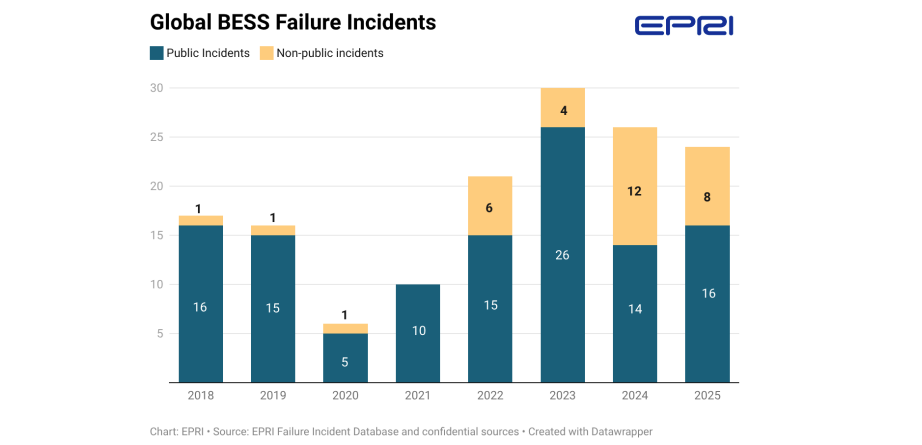
Annual battery energy storage system (BESS) failures per-deployed-GWh declined 98% globally between 2018 and 2025, as installed BESS capacity grew exponentially.
The takeaway comes from the US Electric Power Research Institute’s (EPRI’s) new report, titled Risk Factors and Failure Statistics of Lithium-Ion BESS, released on 5 October.
The findings come as global BESS deployment surpassed 300GWh of new installations in 2025, with cumulative installed capacity worldwide expected to exceed 7,000GWh by 2035.
Try Premium for just $1
- Full premium access for the first month at only $1
- Converts to an annual rate after 30 days unless cancelled
- Cancel anytime during the trial period
Premium Benefits
- Expert industry analysis and interviews
- Digital access to PV Tech Power journal
- Exclusive event discounts
Or get the full Premium subscription right away
Or continue reading this article for free
EPRI’s analysis, which draws on real-world data from its BESS Failure Incident Database, found that the failure rate of BESS units is now comparable to that of large oil-filled transformers, another utility asset that experiences infrequent fire events.
The report notes that many principles of incident command, site control, and emergency response used for transformer fires are also applicable to BESS incidents.
For all recorded failure incidents involving utility-scale BESS, there was no report of fire spreading beyond the facility perimeter. The vast majority of incidents—93%—resulted in no injuries or fatalities, and no member of the public experienced acute injury due to a BESS arc flash, fire, or explosion.
Notably, following the 2019 BESS fire incident in Surprise, Arizona, which injured four firefighters, and subsequent dissemination of lessons learned, there have been no reported injuries or fatalities in the US related to BESS failures.
Incident risk = likelihood + severity
The report emphasises that whilst failure incidents remain rare, understanding their risks is essential to support continued improvements in BESS safety. EPRI characterises risk as the combination of the likelihood of an incident and the severity of its consequences.
Several design factors emerged as significant influences on risk levels. Indoor BESS facilities are overrepresented in failure incidents and sustain more damage on average when incidents occur. The report identifies propagation prevention—both within units and between units—as a critical component of BESS risk management, recommending fire walls or other barriers to segment large indoor facilities and limit propagation.
As regular readers of Energy-Storage.news are sure to recall, 2025’s Moss Landing Energy Storage Facility fire demonstrated the greater potential of indoor BESS designs to catch fire and spread.
As energy storage consultant Aaron Marks of Clean Energy Associates (CEA) noted in a guest article for ESN last year, Moss Landing represented a unique configuration, having been constructed inside the turbine hall of the former Moss Landing power plant—a repurposing of existing infrastructure that remains unmatched by any other BESS facility.
However, it is important to note that even with proper suppression methods, issues can still arise after the fire. As ESN reported earlier this week (7 October), US energy holding company and project developer-owner NextEra Energy agreed to suspend operations at two BESS facilities in Long Island, New York, due to possible water contamination from the fire suppression agent used during a 2023 incident.
Detailed statistical analysis revealed that failure rates decrease with system age and with more recent vintages, as newer designs incorporate improved safety performance. EPRI recommends safety reviews and retrofits of early-vintage systems to ensure they include the latest codes, designs, and practices.
The report found that cell chemistry as a risk factor was challenging to disentangle from increased integrated unit design maturity and improved industry understanding of manufacturing, integration, and operation of BESS. Consequently, researchers could not conclude that cell-level chemistry in isolation was a risk factor for system-level BESS failures.
EPRI stresses that identifying data-driven thresholds for implementing precautionary measures is necessary to avoid excessively burdening communities, whilst increased transparency from failures remains essential for continued improvement in BESS risk and safety.
In 2024, EPRI published a joint study with Pacific Northwest National Laboratory (PNNL) which stated that BESS failure incidents had decreased by 97% between 2018 and 2023.
EPRI’s latest report can be accessed and downloaded from its website.