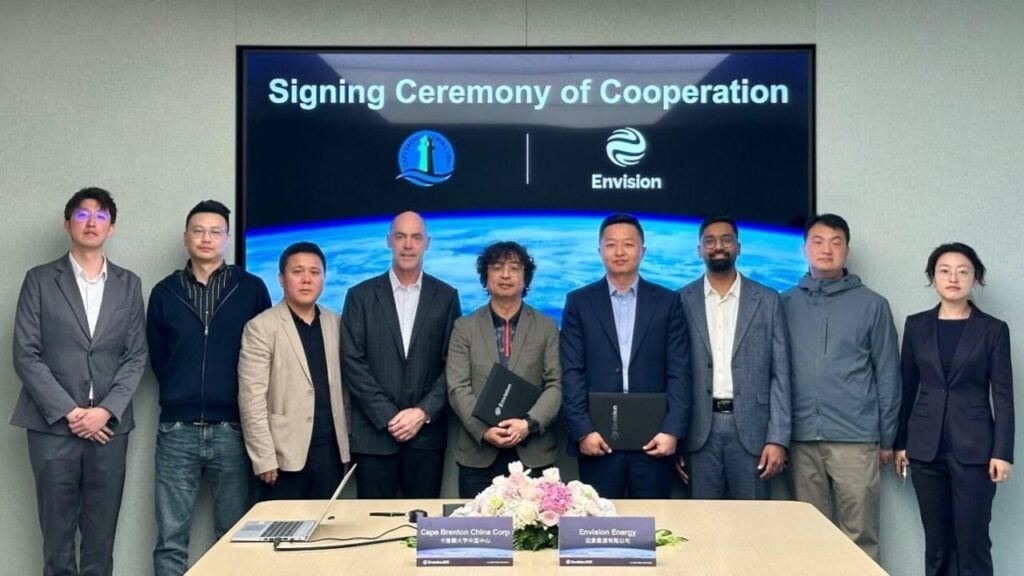
Chinese renewable energy solutions provider Envision Energy will explore renewables opportunities in Sydney, Nova Scotia, Canada, with Nova Scotia-based Cape Breton China Corp.
Announced 11 May, the companies signed a strategic partnership agreement, with plans to develop a 300MW hybrid wind and battery energy storage system (BESS) project.
Per Envision, the agreement establishes a project centered on high-quality renewable energy that combines wind generation with ESS. The coordinated wind-storage hybrid approach is designed to enhance grid flexibility and stability, helping to advance regional clean energy integration and accelerating Eastern Canada’s shift toward decarbonisation.
Envision states it will also collaborate with regional partners to develop green energy training and education initiatives spanning wind power, energy storage, future energy systems, and net-zero industrial parks.
Try Premium for just $1
- Full premium access for the first month at only $1
- Converts to an annual rate after 30 days unless cancelled
- Cancel anytime during the trial period
Premium Benefits
- Expert industry analysis and interviews
- Digital access to PV Tech Power journal
- Exclusive event discounts
Or get the full Premium subscription right away
Or continue reading this article for free
These programmes seek to strengthen local capabilities, nurture green energy talent, and promote “a more resilient and sustainable clean energy ecosystem.” This effort expands the partnership beyond infrastructure delivery to encompass “long-term ecosystem” building.
According to the Canadian government, Nova Scotia takes advantage of its naturally windy environment by building wind farms to phase out coal and reduce greenhouse gas (GHG) emissions.
In 2022, more than 70% of the province’s electricity was generated from coal, natural gas, and other fuels, such as diesel. Approximately 23% was generated from renewable resources including hydro, wind, tidal and solar.
Notably, Nova Scotia has over 300 commercial wind turbines and five wind farms majority-owned by Mi’kmaw communities.
The 150MW/600MWh portfolio will be sited at separate interconnection points to the grid, each asset with 50MW output to NS Power’s grid.
They are expected to significantly contribute to Nova Scotia’s estimated need for around 300MW-400MW of energy storage by 2030, which will help the province reach its 80% renewable energy policy target and coal power phaseout by that date.
In 2023, Nova Scotia made amendments to its Electricity Act with the goal of accelerating the deployment of energy storage. The amendments allowed NS Power to hold competitive solicitations to procure BESS resources.
Envision, one of the world’s biggest wind turbine manufacturers, is still a relatively recent entrant to the BESS space, but in H1 2025, it grew to become the seventh largest BESS supplier globally, according to market intelligence firm Rho Motion.
In October 2025, the company launched its Gen 8 Scalable Platform BESS solution, which uses Envisions’s 750Ah-plus lithium-ion battery cell and can be combined in configurations of 12MWh or more.
The company declared mass production of the world’s largest 790Ah prismatic wound cell, unveiled its inaugural sodium-ion storage cell, and commissioned the world’s first 100% green power direct-supply AI data centre, setting new standards for end-to-end energy solutions.