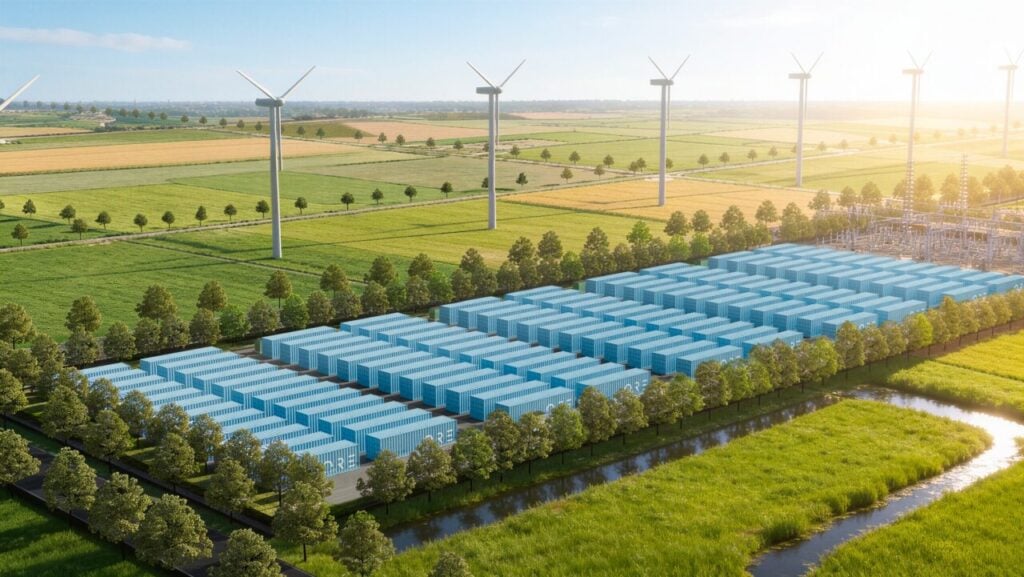
Energy storage startup Ore Energy has signed an agreement with a utility in the Netherlands to deploy up to 1,000MWh of multi-day-duration iron-air batteries.
The tech company, headquartered in the Dutch capital Amsterdam, announced the deal with energy and telecoms utility supplier Budget Thuis this morning. Budget Thuis has committed to a 400MWh first phase to be delivered in 2028, Ore Energy said.
Ore Energy’s battery technology is based on iron, water and air, and is configurable for discharge durations of 24-hour to 100-hours, packaged as a megawatt-hour scale unit in a 40-foot enclosure.
The company claim this makes it a good fit for the utility to store wind energy, which is an increasingly significant contributor to the Dutch electricity generation mix, over multiple days and dispatch it when needed.
Try Premium for just $1
- Full premium access for the first month at only $1
- Converts to an annual rate after 30 days unless cancelled
- Cancel anytime during the trial period
Premium Benefits
- Expert industry analysis and interviews
- Digital access to PV Tech Power journal
- Exclusive event discounts
Or get the full Premium subscription right away
Or continue reading this article for free
Aytaç Yilmaz, Ore Energy CEO, said that with renewable energy already being curtailed at times of overabundance in Europe, “wasting electricity that costs billions to generate,” grids are currently dependent on fossil fuels to fill the gaps.
“Short-duration batteries alone can’t fix this. They shift solar by a few hours, but wind-heavy European grids need storage that works across days, not hours,” Yilmaz said.
Similarly, Budget Thuis CEO Annemarie Buitelaar said that the iron-air technology will enable the utility to “store clean electricity when it is abundant and deliver it when it is most valuable.”
The Ore Energy technology is “especially compelling because it is designed for the long-duration use cases that conventional batteries are not built to cover, with a cost structure suited to multi-day storage,” Buitelaar said.
“For us, this is about reducing exposure to volatile fossil fuel prices while giving customers access to cleaner and more predictable electricity over time. Ore Energy has demonstrated the technology and has the expertise to deploy it, which is why we are committing to 1GWh across our portfolio, starting with a 400MWh first phase.”
A few days ago, European utilities’ association Eurelectric published analysis by consultancy AFRY that showed the viability of non-lithium long-duration energy storage (LDES) technologies as a flexibility option for the continent’s grids, including reducing the curtailment of variable renewable energy (VRE) generation, is improving. Its publication followed repeated calls from energy storage and renewable energy groups for European Union (EU) Commissioners to focus more on LDES technologies in energy system modelling.
Iron-air can be for wind what lithium-ion has been for solar PV, CEO claims
Ore Energy is currently one of two startups globally known to be commercialising an iron-air battery, the other being US-headquartered Form Energy.
As noted in an Energy-Storage.news deep-dive analysis article on three 100-hour duration multi-day storage (MDS) technologies published in March, on paper, various metrics and specifications of the two companies’ technology that they have made publicly available look relatively similar.
Both have a theoretical energy density of 1,200Wh/kg, are designed for discharge times of up to 100 hours with a planned system life of ~20 years and come in at similar costs: Form Energy has cited costs of US$15-20 per kWh and Ore Energy EU16 (US$18.50) per kWh.
Form Energy is further ahead of Ore Energy in its commercialisation and rollout, having revealed details of its technology for the first time in 2021. Ore Energy was founded in 2022.
Energy-Storage.news’ coverage of Form Energy has included the company’s recent 30GWh utility deal in Minnesota for a Google data centre campus and a 12GWh agreement with data centre builder Crusoe, following the construction of its first pilot project, also in Minnesota, and its first factory, Form One, in West Virginia. Form also announced its first overseas project in March, planned in Ireland.
Meanwhile, Ore Energy recently completed a grid-connected 100-hour long-duration energy storage (LDES) pilot project with EDF at the utility and power generator’s EDF Lab les Renardières in France.
This was its second pilot, following an initial project in the Netherlands, and the company said at the time that it was exploring options to build a manufacturing facility either in Germany or its home country.
In announcing the agreement with Budget Thuis, Ore Energy CEO Yilmaz highlighted that the non-lithium, cobalt-free technology can be made “using a supply chain that Europe controls.”
“We’ve shown our iron-air chemistry works in a European utility setting, and this deployment is the next step in commercialisation: meaningful volume, tied to a real project, with an energy supplier that understands what multi-day storage means for its business,” Yilmaz said.
“We believe iron-air will become as important for wind as lithium-ion has been for solar.”