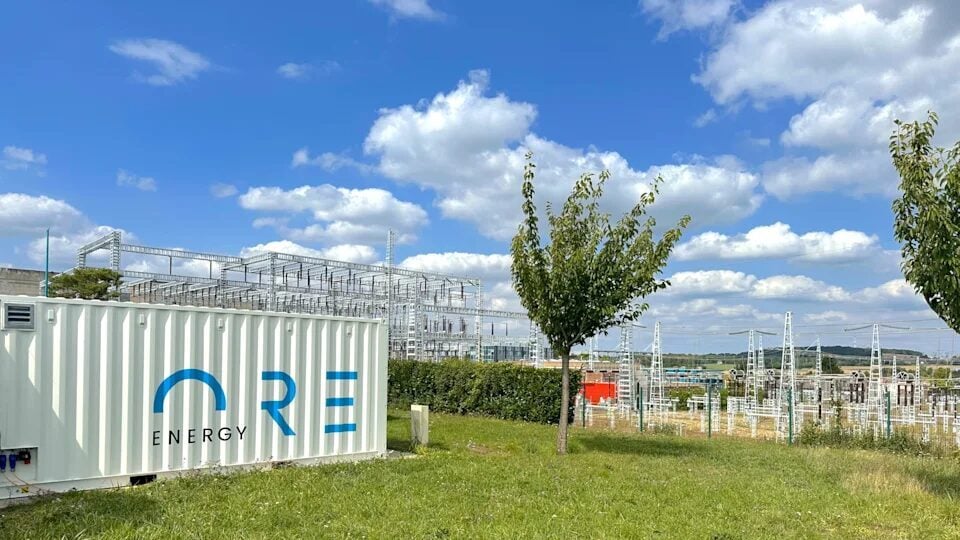
Netherlands-based iron-air long-duration energy storage (LDES) startup Ore Energy has completed a grid-connected pilot of its 100-hour iron-air LDES system at EDF Lab les Renardières in France.
The pilot builds on Ore Energy’s recent grid-connected installation in Delft, the Netherlands, which the company says showcases the potential for integrating iron-air systems into existing European distribution networks.
Responding to Energy-Storage.news’ request for comment, a spokesperson for Ore stated of the project:
“The EDF pilot was structured as a feasibility and operability evaluation, focused on how a multi-day iron-air system behaves in a live utility environment over extended discharge periods. The emphasis was on system behaviour, control, and integration.”
Try Premium for just $1
- Full premium access for the first month at only $1
- Converts to an annual rate after 30 days unless cancelled
- Cancel anytime during the trial period
Premium Benefits
- Expert industry analysis and interviews
- Digital access to PV Tech Power journal
- Exclusive event discounts
Or get the full Premium subscription right away
Or continue reading this article for free
They continued, “By contrast, the earlier Netherlands project focused more narrowly on proving that an iron-air system could be safely and reliably connected to the grid and operated as intended. The key difference is the move from ‘can this connect and run?’ to ‘how does this behave over multi-day timescales under real-world utility conditions?’ This also meant a larger overall system configuration and more cycles with varied charge/discharge characteristics.”
Ore stated that the pilot was the first of its kind in Europe, and demonstrated the company’s iron-air LDES technology’s ability to deliver multi-day energy storage.
As part of the EU’s Storage Research Infrastructure Eco-System (StoRIES)-supported pilot, Ore Energy installed its modular iron-air battery system to gather real-world operational data under grid conditions.
It demonstrated the ability to store and discharge energy for about four days (100 hours). Over several months, the system was tested with different load profiles and seasonal changes to evaluate charge/discharge cycles, responsiveness, and compatibility with standard grid management methods. The data collected supports the StoRIES initiative’s goal of exploring LDES solutions for multi-day renewable energy balancing.
Ore Energy claims its systems are designed to maximise renewable energy storage and distribution for reliable grid power during windless, sunless periods. Its iron-air system uses iron, water, and air to drive a reversible oxidation process.
During charging, excess renewable electricity converts iron oxide into metallic iron, storing energy for up to four days. When discharged, iron is re-oxidised by oxygen and water, releasing electricity as it rusts again.
These systems rely on abundant resources, with no rare earths or critical minerals, “enabling a 100% European supply chain from manufacturing to end-of-life.” Full-scale systems use modular 40-foot containers that deliver multiple MWh of multi-day storage.
Ore’s spokesperson noted, “The French project was not designed as a performance optimisation or benchmarking exercise, and EDF is not publishing detailed performance metrics such as round-trip efficiency (RTE), degradation rates, or dispatch profiles from the pilot. What can be said is that the system operated as intended over the assessment period, providing EDF with the data needed to evaluate technical feasibility and operational characteristics of iron-air storage in a real utility setting.”
Additionally, speaking to how the technology compares to lithium-ion on cost-per-kWh and on levelised cost of storage (LCOS), they said:
“Ore Energy is not publishing project-specific cost or LCOS figures at this stage. That’s in part because it varies greatly depending on the context, use case, and geography. That said, Ore will be able to achieve an LCOS significantly lower than lithium-ion storage systems at long-duration.”
They continued, “At a directional level, iron-air systems are not designed to compete with lithium-ion on short-duration applications (<12 hours). Their value proposition is in longer-duration storage, where lithium-ion costs scale linearly with duration and become less economical. Because iron and air are abundant, low-cost materials, iron-air systems are widely modelled as having lower marginal cost per additional hour of storage beyond the 8–12 hour range. That’s the segment this technology is designed to address.”
Ore Energy is not the first or only company to utilise iron-air technology.
Form Energy, established from MIT labs and led by ex-Tesla Energy executive Mateo Jaramillo, asserts that its battery can be produced inexpensively with abundant materials, providing a practical ‘multi-day’ energy storage solution for the grid.
The company broke ground on its first project in Cambridge, Minnesota, US, in 2024 and last year opened a factory in West Virginia.
In that same year, developer FuturEnergy Ireland announced its intentions to build Europe’s first iron-air BESS.
The company, a joint venture between two state-owned entities—forestry business Coillte and electricity generation, transmission, and distribution company ESB—filed a planning application for the Ballynahone Energy Storage project with Donegal County Council. The County Council has granted permission for the project, which will be situated next to Trillick Substation, near Buncrana in County Donegal.
Another company, US startup Noon Energy, recently launched a 100-hour+ demonstration project after emerging from stealth mode, having teased its capabilities before revealing its chemistry and technology design principles, much as Form Energy did previously. Noon Energy specifically uses a reversible solid oxide fuel cell battery, which its CEO and co-founder, Chris Graves, spoke to ESN Premium about in an exclusive interview earlier this month.
Ore’s spokesperson highlighted the difference of the company’s technology, “Ore Energy’s approach to system architecture and modularity (including how iron-air cells are packaged, daisy-chained, and controlled within a containerised system to achieve higher MWh capacity) is unique, complemented by a portfolio of granted and pending patents covering aspects of chemistry, mechanical design and electronics. Ore is also the only iron-air LDES company operating in Europe.”
Additionally, they pointed out that Ore Energy’s systems are manufactured in-house at the company’s headquarters in Amsterdam. Ore is exploring options in Germany and the Netherlands for its “first-of-a-kind” manufacturing facility, planned to start operations in 2027.
The upcoming Energy Storage Summit 2026 in London, will take place 24-25 February at InterContinental London – The O2. Use the discount code ESN20 for a 20% discount, while ESN Premium users can get 30% off.