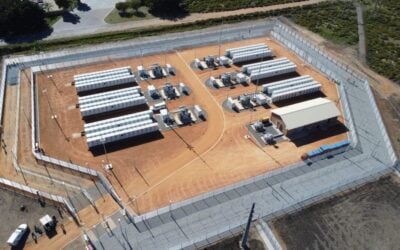
State-owned electric utility Hanoi Power Corporation (EVNHANOI) has begun pilot operation of five battery energy storage systems (BESS) at substations in Hanoi, Vietnam.
EVNHANOI, a regional subsidiary of the national power utility Vietnam Electricity (EVN), said last week (21 July) that it had completed the installation and energisation, and had begun operating the systems connected to the 110kV grid.
Each system has 10MW output and 20MWh of energy storage capacity, for a total of 50MW/100MWh. EVNHANOI said it is the first grid-connected large-scale BESS deployment in Hanoi, the national capital.
The utility will use the portfolio’s operational data to evaluate and adjust technical models and explore options for additional battery additions to its network. It will provide peak shaving and frequency regulation ancillary services.
Try Premium for just $1
- Full premium access for the first month at only $1
- Converts to an annual rate after 30 days unless cancelled
- Cancel anytime during the trial period
Premium Benefits
- Expert industry analysis and interviews
- Digital access to PV Tech Power journal
- Exclusive event discounts
Or get the full Premium subscription right away
Or continue reading this article for free
Parent company EVN inaugurated its first 50MW/50MWh BESS pilot in northern Vietnam in 2024.
“The commissioning of BESS is not intended to replace existing power sources, but rather to add a technical tool that helps the power system be more proactive in responding to load fluctuations, while also creating a foundation for researching modern grid operation models in the future,” deputy director of EVNHANOI’s project management board, Pham Huu Manh, said.
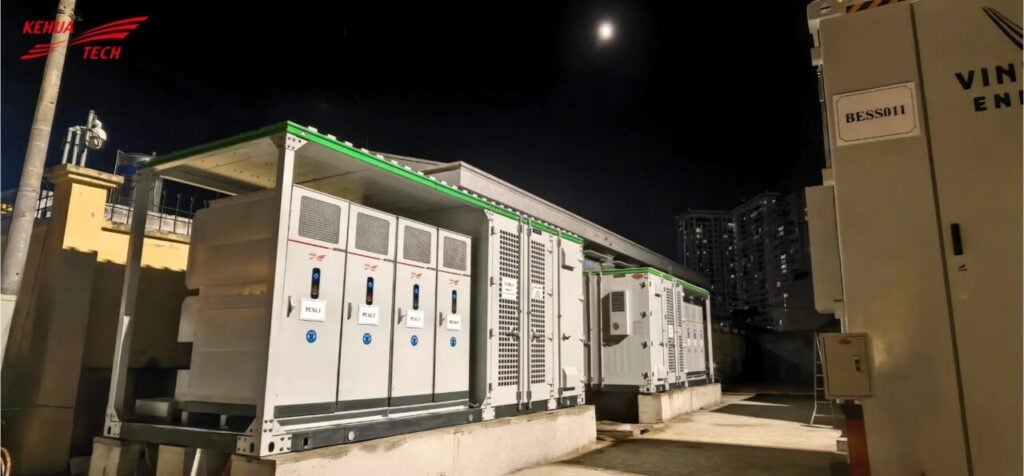
The project’s battery storage equipment was supplied by the energy storage arm of Vietnamese electric vehicle (EV) company VinFast, which, in turn, is a subsidiary of Vietnam’s largest trading conglomerate VinGroup.
VinFast Energy integrates and markets BESS solutions. It entered a partnership with Japanese conglomerate Marubeni in 2023 to work on BESS projects in Vietnam, and in late 2024, the pair put into operation a 1.8MW/3.7MWh BESS project in Nha Trang, Khanh Hoa province.
In 2022, Chinese battery manufacturer Gotion High-Tech broke ground on Vietnam’s first lithium iron phosphate (LFP) battery gigafactory, to make cells for VinGroup’s EV and BESS businesses.
Chinese power electronics group Kehua Digital Energy supplied its power conversion system (PCS) technology to the new 100MWh portfolio. Kehua said in a separate announcement that it supplied its BCS1250K-C-HUD series PCS. The last of the five projects was successfully energised on 5 July, Kehua said.
Kehua claimed the design of the BCS1250K-C-HUD at the sites includes several layers of safety protection to reduce the risk of copper bar overheating while a modular design simplifies installation and maintenance.
National plan requires 10GW to 16GW of energy storage by 2030
The project’s start of operation comes as Vietnam is poised to accelerate its battery storage deployment.
Last year, the government approved the national Power Development Plan VIII (PDP8). The new plan replaced an energy storage target of 300MW set in 2023, with a target of between 10GW and 16.3GW, to be deployed by 2030.
As climate and energy strategy expert Sunita Dubey wrote in a Guest Blog for Energy-Storage.news in September last year, the Ministry of Industry and Trade (MOIT) took “decisive action on the regulatory front” to turn that multi-gigawatt vision into reality.
These actions included a framework for EVN to invest in battery storage and regulations put in place for the integration of BESS into renewable energy projects.
This was soon followed early this year with another move that Dubey said would be a gamechanger: Vietnam introduced a two-part tariff structure for BESS participation in electricity markets.
In other words, BESS assets would have a dual-revenue mechanism that recognised both a Capacity Charge—payment for availability—and an Energy Charge—additional compensation for electricity discharging to the grid.
Dubey explained the tariff structure in another Guest Blog published in February, writing that the timing is “critical” for Vietnam.
“The country faces increasing renewables curtailment, rapid solar and wind integration challenges, and the need to align with its PDP8 Revised commitments,” Dubey wrote.
At Energy Storage Summit Asia 2026, held in Bangkok, Thailand, at the beginning of July, the audience heard that Vietnam is one of ASEAN’s early leaders in energy storage adoption. This is because the Philippines and Vietnam are the first in the region to allow BESS assets to participate in ancillary services markets, and other governments and regulators across ASEAN have been urged to follow their example, while opening up other market opportunities to enable value or revenue stacking across multiple applications.