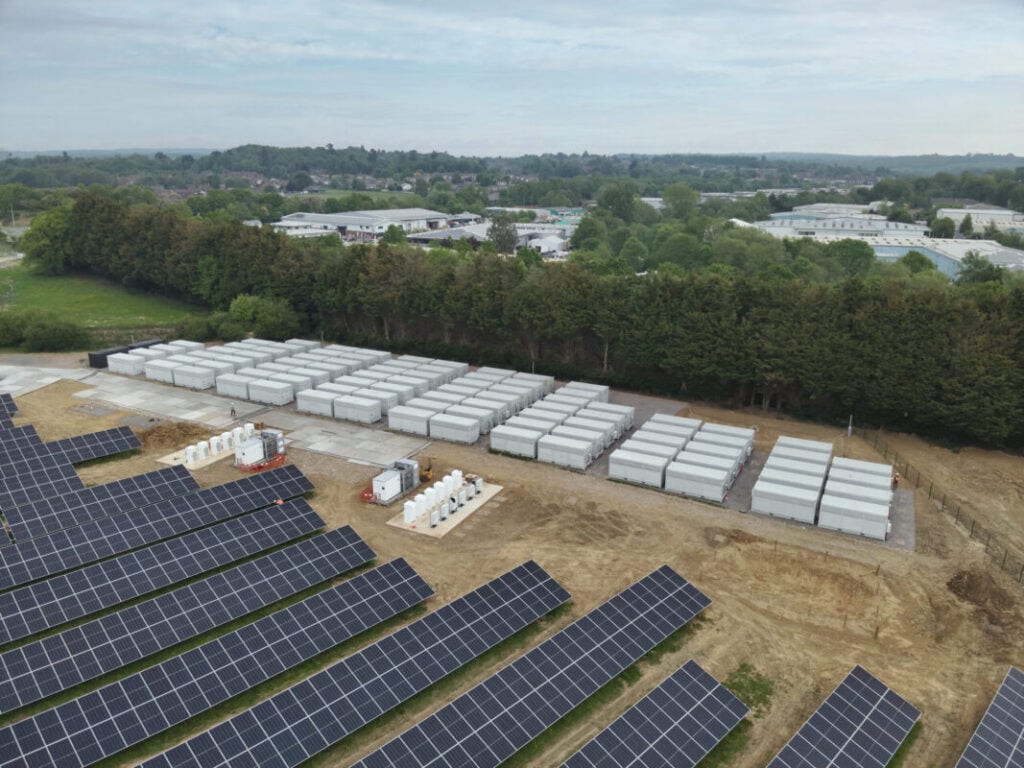
Long-duration energy storage (LDES) technologies are becoming increasingly viable options to add flexibility to the European electricity network, according to a new report.
Prepared for European utilities’ trade association Eurelectric by consultancy AFRY and published earlier this week (15 June), the report, ‘LDES market overview: What is the outlook for innovative LDES in Europe?’ examines commercially available technologies capable of providing discharge durations from 8 hours to multiple days (multi-day).
That includes electrochemical, mechanical, thermal, and chemical technologies, although pumped hydro energy storage (PHES) was excluded because it is an established technology rather than an emerging and innovative one.
Rising renewable energy penetration and changing patterns of electricity demand mean that European grids need greater system flexibility resources, such as energy storage, to shift energy from when it is generated to when it is needed.
Try Premium for just $1
- Full premium access for the first month at only $1
- Converts to an annual rate after 30 days unless cancelled
- Cancel anytime during the trial period
Premium Benefits
- Expert industry analysis and interviews
- Digital access to PV Tech Power journal
- Exclusive event discounts
Or get the full Premium subscription right away
Or continue reading this article for free
Lithium-ion (Li-ion) is currently the cheapest option for delivering this flexibility, even over multiple hours, but other technologies, including flow batteries, compressed air energy storage (CAES) and molten salt thermal storage, are catching up, albeit gradually.
AFRY found that the business case for LDES is strengthening, with its ability to reduce renewables curtailment, ease network congestion, and provide long-term flexibility to a decarbonised power system converging with its falling costs.
System-level variable operating costs could fall by as much as €250 million (US$286.54 million) per year for every gigawatt of long-duration storage deployed.
From analysis across a number of different European countries, the report found that every megawatt of LDES installed could prevent the curtailment of between 2.5MWh and 3.5MWh of variable renewable energy (VRE) generation.
LDES can offer different services across a range of markets, from intra-day arbitrage of solar to redispatch to balance network supply and demand to direct co-location with renewable assets and other applications.
The report offers a market overview and a deep-dive analysis of the drivers of energy storage at 8-hour, 12-hour, and multi-day durations, with a specific focus on the electricity markets in Great Britain (GB), Germany, the Iberian Peninsula, Finland, and Greece.
Broad takeaways include that wind-dominated systems will be better suited to longer-duration storage (>24 hours), while solar PV-dominant grids will, at least initially, be better suited to 8-12-hour-duration storage.
Solar-rich Spain and Portugal in Iberia will therefore see the business case for up to 12-hour storage stack up sooner. Germany and GB’s grids find greater value in 24-hour+ storage sooner.
Finland is something of an outlier among the case studies, as it already has a high installed base of pumped hydro energy storage (PHES), which could limit opportunities for newer technologies in the short term, though regulatory or market changes could create a stronger business case in the future.
Read the full 122-page report (links to PDF).
Utility group’s position could be influential
While the modelling and analysis work is interesting and valuable, much of what the report covers will likely already be familiar to industry participants who regularly read Energy-Storage.news.
What is perhaps more interesting to this industry audience is that the work comes from the traditionally conservative utility sector, which would ultimately host these energy storage resources on its networks, or even deploy and own them.
Eurelectric represents the interests of more than 3,500 utility companies across the European power sector involved in generation, distribution and supply. That includes 34 national electricity associations and major electricity companies across 32 different countries.
“Europe’s energy transition needs technologies that can cover the increasing need for flexibility in the power system,” Eurelectric secretary general Kristian Ruby said.
“It is encouraging that a business case is beginning to emerge for innovative long-duration energy storage with substantial system benefits: less curtailment, lower operating costs, reduced congestion and greater security of supply,” Ruby said.
Its report comes shortly after a group of trade associations in clean energy, energy storage and adjacent industries sent an open letter to European Union (EU) Commissioners, urging them to “acknowledge the clear role of long-duration energy storage.”
The EU has, in recent years and after lengthy lobbying and advocacy from industry and academics, finally recognised energy storage as a vital flexibility tool for the grid with a strong part to play in decarbonisation, renewable energy growth, energy security and grid stability.
However, LDES itself has essentially been excluded, and this could be symptomatic of a “lack of proper modelling,” Jacopo Tosoni, policy expert at trade association Energy Storage Europe.
Energy Storage Europe (formerly EASE) was one of the signatories to the open letter, sent in May and addressed to EC Commissioner for Energy & Housing Dan Jørgensen, Executive VP for a Clean, Just and Competitive Transition Teresa Ribera and Commissioner for Industry, SMEs and the Single Market Stéphane Séjourné.