CATL’s energy storage division represented 19.23% of the Chinese battery manufacturer’s total revenue in the first half of 2026.
The company has released its interim 2026 report, including figures up to the end of June. CATL’s total revenue for the six-month period was RMB276.9 billion (US$40.89 billion).
Of this, 69.38% came from its electric vehicle (EV) battery systems business (RMB192.1 billion), while 19.23% of revenue came from its energy storage system (ESS) battery systems division.
For ESS, this represented a jump from the equivalent period in 2025, when the division’s six-month revenue, at RMB28.4 billion, accounted for 15.88% of the total.
Try Premium for just $1
- Full premium access for the first month at only $1
- Converts to an annual rate after 30 days unless cancelled
- Cancel anytime during the trial period
Premium Benefits
- Expert industry analysis and interviews
- Digital access to PV Tech Power journal
- Exclusive event discounts
Or get the full Premium subscription right away
Or continue reading this article for free
More than two-thirds of CATL’s business is still in China, accounting for 68.54% of revenue, with the remaining 31.48% from overseas markets.
Net profit for the first half of 2026 was RMB43.284 billion, which was a year-over-year increase of 41.98%.
ESS battery systems were also more profitable for CATL than EV battery systems in both H1 2025 and H1 2026. The company’s total gross profit stood at RMB66.26 billion at the end of H1 2026, with a gross profit margin of 23.93%. This was a slight decline from 25.02% gross profit margin from RMB44.76 billion gross profit a year before.
EV battery systems registered RMB39.6 billion gross profit and a 20.63% gross profit margin in the most recent period, a slight decline from 22.41% margin to RMB29.49 billion gross profit in H1 2025.
ESS battery systems’ margin also declined, but it remained higher at 23.96% gross profit margin from RMB12.76 billion in H1 2026. This was down from 25.52% margin from RMB7.25 billion in the first six months of last year.
Overseas sales were more profitable than domestic sales, with a gross profit margin of 29.97% in H1 2026 for international sales, compared with 21.16% from China.
CATL upped its R&D spend by 12.7% year-over-year, from RMB10 billion in H1 2025 to RMB11.38 billion this year.
Growth rate of BESS sales has ‘strongly pulled ahead’
CATL’s interim report quoted statistics from research firms to underline its position as a market leader in both EV and BESS, including a 40.2% global market share of EV batteries between January and May 2026, according to SNE Research and a global No.1 position in BESS battery shipments from January to June, according to ICCSINO.
According to Benchmark Mineral Intelligence, CATL was 2025’s top BESS cell supplier, holding a 20% share of the global market ahead of Hithium and EVE Energy, which tied in second with 12% each.
CATL was joint fourth as a BESS integrator, with 6% of the market. Leader BYD took a 13% share.
Charlotte Gisbourne, analyst at Solar Media Market Research, which produces the quarterly Battery StorageTech Bankability Ratings Report, noted the growing share of stationary energy storage as a proportion of revenue for CATL.
In 2025 financial results, Gisbourne said, among companies active in both EVs and ESS, those with a higher share of ESS revenue “tended to have a higher revenue growth.”
This is especially the case with the Chinese EV market seeing a slight slowdown, in light of government incentives for EV purchases being lessened, such as the removal of full tax exemptions.
In the 2025 financial year, growth of EV battery sales exceeded ESS, but in H1 2026, the growth rate of energy storage sales has “strongly pulled ahead,” Gisbourne told Energy-Storage.news today.
CATL also has greater vertical integration and value chain involvement in the BESS space than in EV. Whereas for full-electric and hybrid vehicles, it manufactures battery cells, modules, enclosures, and packs across a variety of chemistries. In the ESS space, the company also makes fully packaged turnkey solutions, as well as battery cells and packs.
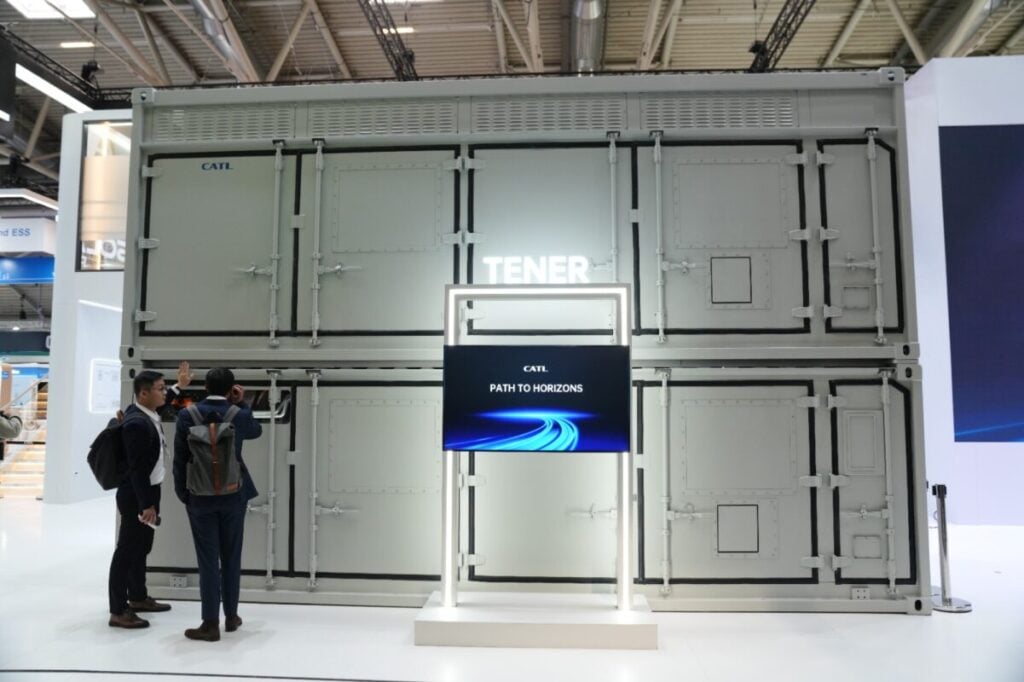
The company has continued to roll out new BESS products, including a range of liquid-cooled battery cabinets and the TENER energy storage system suite. The TENER range includes the 6.25MWh TENER lithium-ion (Li-ion) BESS, the 9MWh TENER Stack ‘ultra-large capacity’ system and sodium-ion (Na-ion) versions.
CATL has been highly active in commercialising the emerging Na-ion battery chemistries, a space in which Chinese rivals such as BYD and Envision are also investing heavily.
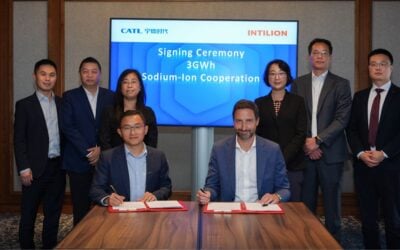
A 60GWh framework supply deal was announced a few weeks ago with Chinese system integrator HyperStrong, which CATL described at the time as a “turning point in the industrialisation of sodium-ion batteries.” CATL claimed in its new interim report that the sodium-ion TENER BESS is the first field-proven station-level Na-ion battery storage solution in the world.
The manufacturer highlighted the prospects for both of its main business lines, noting overall growth in demand for EV and ESS batteries globally despite pullbacks in some regions. One region that was not mentioned in materials seen by Energy-Storage.news was the US, where a policy-driven slowdown in EV demand has been offset by continued growth from the ESS sector.
However, the Trump administration’s rules on foreign entity of concern (FEOC) companies originating in China mean that BESS projects availing of investment tax credit (ITC) incentives will not qualify if they use Chinese-made cells. This has led Chinese cell producers to focus more of their efforts on markets outside the US, such as Europe and the Middle East.
CATL issued its financial results release to the Hong Kong Stock Exchange (HKEX) on Friday. The company listed its H-Shares with HKEX in May last year. There is a current trend for China-headquartered energy storage companies to obtain a secondary HKEX listing in addition to listings on mainland Chinese exchanges, which provides them with greater visibility to global investors.