
Welcome to the first edition of In Case You Missed It (ICYMI), a recap of last week’s biggest news stories in energy storage.
Every Monday, we’ll be highlighting a mix of news stories from the most-read to the almost-overlooked, illuminating as many corners of the industry as we can, to help you set up for the week ahead.
Most read stories
Nvidia selects three BESS solutions for new AI facilities qualification programme
Love it, hate it, or try to make friends with it before it fires us all: whatever your personal outlook, there’s no getting away from the transformative impact of AI. The sector’s biggest mover, Nvidia, now has a reference programme for products and solutions that have completed category-specific qualification requirements for building AI factory infrastructure under the Nvidia DSX programme.
It just goes to show how central battery storage is to the digital economy of the future: battery energy storage systems (BESS) were among the first two categories in the DSX Ready accreditation.
Try Premium for just $1
- Full premium access for the first month at only $1
- Converts to an annual rate after 30 days unless cancelled
- Cancel anytime during the trial period
Premium Benefits
- Expert industry analysis and interviews
- Digital access to PV Tech Power journal
- Exclusive event discounts
Or get the full Premium subscription right away
Or continue reading this article for free
Fluence and Eve Energy agree 206GWh battery supply deal
Coming just a few days after Fluence cut its guidance and warned of losses due to manufacturing delays in the US, the system integrator and Chinese battery maker Eve Energy announced what is, on paper, the biggest BESS cell deal ever seen.
Likely to be for Fluence’s non-US project pipeline, it’s important to note that the deal covers an initial 16GWh of capacity in 2027. The remainder is a reservation for the 2028-2031 timeline.
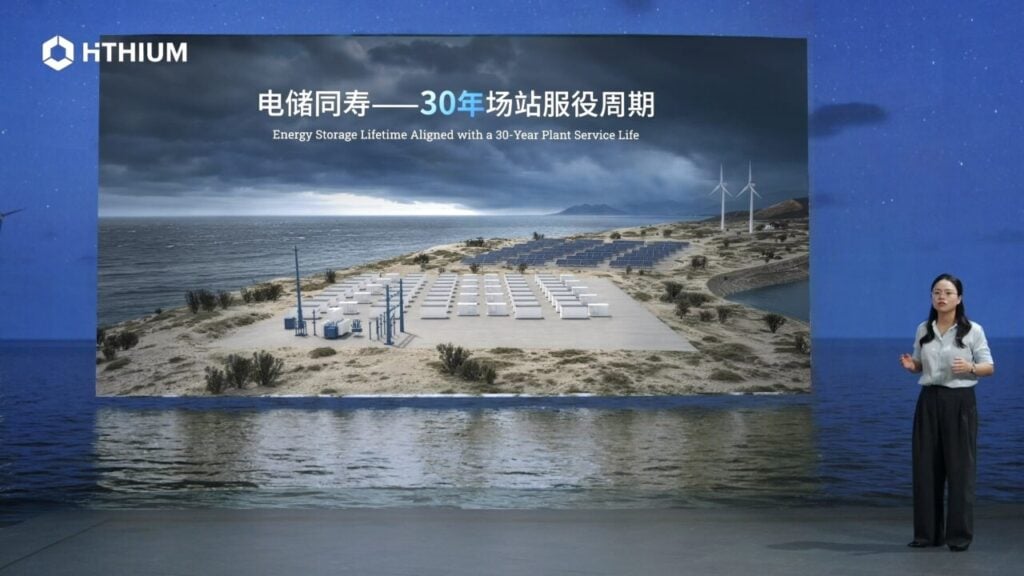
Hithium unveils 20,000-cycle sodium-ion cell and 4MWh BESS
LFP’s continuing dominance is evident in the scale of the Fluence-Eve deal. At the same time, interest in sodium-ion (Na-ion) as a complementary or alternative technology grows. All eyes were on Hithium’s launch as the Chinese battery manufacturer’s research institute director, Dr Aileen Wang, introduced the ∞Cell N785Ah and the battery energy storage system (BESS) ∞Power N4.0MWh.
“We did not just follow lithium-ion. We wanted to explore where lithium-ion has yet to go, to see whether electrochemical energy storage could operate over a much longer timeframe,” Wang said.
Google-backed pilot demonstrates hourly carbon accounting for US BESS using granular certificates
Regular readers will be aware of Google’s interest in non-lithium alternative energy storage technologies, including pilots for carbon dioxide-based storage from Energy Dome and Eos Energy Enterprises’ zinc hybrid cathode batteries.
The search engine giant has also just trialled the capabilities of Li-ion BESS to store energy generated during hours of surplus renewable generation and output it during hours of greater fossil fuel generation.
Data centre buildout uplifting US BESS market outlook, Wood Mackenzie says
The US has just seen another record-breaking quarter for energy storage deployments, with the buildout of data centres providing an uplift to the market, according to Wood Mackenzie.
The latest edition of the firm’s quarterly US Energy Storage Monitor found 5.4GW/18.9GWh was installed in Q2 2026 across all market segments, including 4.7GW/17.6GWh of utility-scale projects. Wood Mackenzie has forecast that US energy storage installations will grow by over 50% in megawatt terms over the next five years, as low costs propel storage into new regions and use cases.
Other news picks
NYSERDA picks eight projects for New York utility-scale energy storage programme
Results are in for New York’s first solicitations for large-scale energy storage resources, with 950MW of bids selected by the New York Energy Research and Development Agency (NYSERDA).
NYSERDA selected eight projects through the first of three annual requests for proposals (RfPs) to be issued by 2027, each seeking a gigawatt of ‘Bulk’ grid-connected energy storage assets.
Selected bids were announced 23 September, along with the results of NYSERDA’s 2025 solicitation for land-based renewable energy projects, which awarded contracts to 13 projects, totalling 719MW of generation capacity.
RWE and Giga Storage move to construction on gigawatt-hour Netherlands and Belgium batteries
RWE has taken a final investment decision (FID) on 400MW/1.1GWh BESS in the Netherlands with construction to start in due course, while Giga Storage has started building its 2.8GWh Green Turtle project in Belgium. Both are set to be commissioned in early 2028.
21GWh BESS deployed globally in August: One-fifth in Saudi Arabia, European activity soars
Nearly 21GWh of grid-scale BESS came online globally last month, of which around a fifth was in Saudi Arabia while the majority was in China.
The latest figures are out from Benchmark Mineral Intelligence, which we report as part of a monthly series for ESN Premium.
They show that grid-scale battery energy storage systems (BESS) entered commercial operation last month globally totalling 6,516MW/20,855MWh of capacity.
Some 61% of that was in China, 19% was in Saudi Arabia, 11% was in Europe while just under 5% was in South and Central America. See a full table of the figures further down.
The monthly activity brings the total year-to-date (YTD) figure of commission BESS capacity to 177GWh, a year-on-year increase of 35%.
US power conversion manufacturers in spotlight: Power Electronics builds Houston factory, Heron Power lands RWE pilot
Spain-headquartered Power Electronics has opened a new factory in Houston, Texas, as the US market increasingly looks to build domestic content supply chains.
Power Electronics, which provides solar inverters and power conversion systems (PCS) for battery storage, as well as solutions for the data centre and e-mobility industries, held a ground-breaking celebration 24 September.
Limited access to technologies that can expand and enhance the grid was identified by Drew Baglino, founder and CEO of Heron Power, as a bottleneck to meeting rising electricity demand.
The former Tesla senior VP of powertrain and energy engineering hopes his new power electronics startup will be able to produce up to 40GW of its Heron Link integrated power conversion solution annually from a factory in Morgan Hill, California, by late 2027.
In its latest announcement, 21 September, Heron Power said RWE Americas will pilot the deployment of Heron Links at a renewable energy and storage project in Texas.
UK regulator looks to cut down BESS interconnection backlog with extra financial commitment
UK energy industry regulator Ofgem said it is minded to approve the introduction of a financial commitment for BESS in an attempt to reduce the oversupply of the projects awaiting a grid connection.
There is about 90GW of battery energy storage (BESS) capacity either operational or in the reformed connections queue, almost three times the 29GW that the government is targeting as part of its Clean Power 2030 target.
The Oversubscribed Technologies Commitment Fee (OTCF) would require projects to demonstrate a minimum level of financial commitment starting at £3,000 per MW (US$3976.30 per MW) and rising to a maximum £25,000 per MW if the queue remains significantly oversubscribed.
