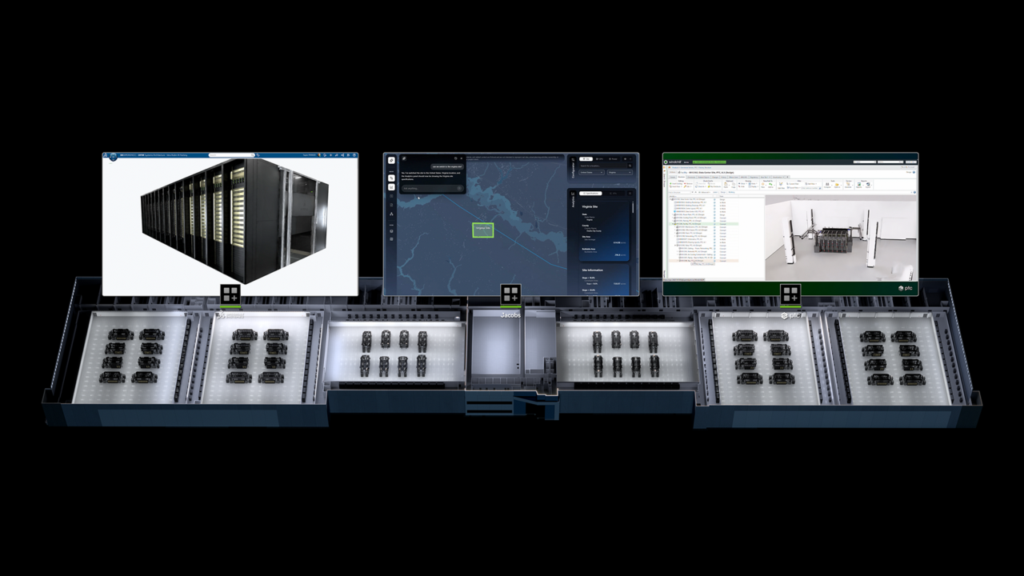
Nvidia’s new qualification programme for products and solutions that meet its reference design requirements includes three battery storage solutions.
Graphics processing unit (GPU) manufacturer and global stock market darling Nvidia launched Nvidia DSX Ready, a programme for artificial intelligence (AI) factory builders, earlier this week (21 September).
The idea is that organisations can identify products and solutions that have completed category-specific qualification requirements for building AI factory infrastructure under the Nvidia DSX programme. Nvidia DSX AI factories are co-designed as unified products which are optimised for lowest token cost and energy efficiency, according to the company.
Battery energy storage systems (BESS) are one of two initial categories, along with cooling distribution units (CDUs). Nvidia has not yet indicated the number or types of other categories that will follow. The company did say DSX Ready will apply to factory design and operations across compute, networking, power, cooling, facilities and software.
Try Premium for just $1
- Full premium access for the first month at only $1
- Converts to an annual rate after 30 days unless cancelled
- Cancel anytime during the trial period
Premium Benefits
- Expert industry analysis and interviews
- Digital access to PV Tech Power journal
- Exclusive event discounts
Or get the full Premium subscription right away
Or continue reading this article for free
BESS solutions from Hitachi Energy, LG Energy Solution (LG ES) and Tesla are the first on the list.
LG ES said its BESS met applicable DSX Ready requirements for AC energy storage solutions and can help customers bring power online faster while addressing the critical power management challenges of AI facilities, including AI load smoothing, voltage ride-through and power reliability enhancement.
LG ES talks up domestic content advantage, Hitachi Energy touts power electronics
LG ES head of energy storage system (ESS) battery division Chang Beom Kang said the selection “validates the strength and competitiveness of our BESS products.”
The company talked up the competitive advantage it presently holds in the US as one of the first to market with domestic content BESS products, including lithium iron phosphate (LFP) cells, which enable LG ES and its customers to avail of tax credit incentives.
LG ES said its 2.5MW/5.1MWh modular battery blocks enable scalable deployments and rapid capacity expansion, while the integrated AC solution is also grid-forming (GFM). Its architecture is designed to meet UL and NFPA standards.
“Building on our differentiated local manufacturing capabilities and technology leadership, we will further expand our digital infrastructure business and accelerate growth in this rapidly evolving market,” Chang Beom Kang said.
Hitachi Energy said that as AI factories train and deploy advanced AI models, they are driving increased electricity demand growth and greater complexity in power system operations. BESS can be a flexible energy platform that supports power continuity, quality and operational flexibility even as AI factories respond to changing load conditions and grid requirements, the company said.
“As AI factories continue to scale, customers need power systems that can be deployed, integrated, and expanded quickly while maintaining reliability and resilience,” Hitachi Energy’s head of grid & power quality solutions and service, Marco Berardi, said.
Hitachi Energy noted that its qualification includes its power conversion systems (PCS) and power plant controller (PPC), two capabilities the company enhanced with the acquisition of the Spanish power electronics manufacturer Eks Energy.
Nvidia noted that passing the qualification does not replace site-level engineering or imply site-level stability.
The company selected three CDUs as DSX Ready, from providers LG Electronics, LiquidStack and Vertiv.