Data centre buildout is uplifting the US battery energy storage system (BESS) outlook across all market segments, according to market research firm Wood Mackenzie.
Wood Mackenzie released its Q3 2026 US Energy Storage Monitor report on 23 September, which predicted US energy storage installations will grow over 50% in megawatt terms over the next five years, as low costs propel storage into new regions and use cases.
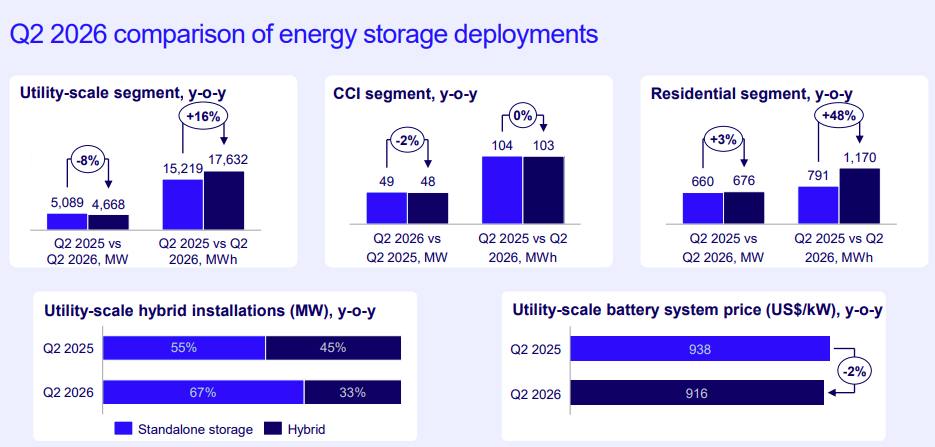
According to the report, the US BESS market installed a record 5.4GW/18.9GWh in Q2 2026, even as installed power fell 7% year-over-year.
Extended-duration utility-scale and residential BESS fuelled MWh expansion even as MW installations weakened. Utility-scale projects reached 4.7GW/17.6GWh in Q2, representing an 8% year-over-year decline in MW capacity as major markets approach saturation.
Try Premium for just $1
- Full premium access for the first month at only $1
- Converts to an annual rate after 30 days unless cancelled
- Cancel anytime during the trial period
Premium Benefits
- Expert industry analysis and interviews
- Digital access to PV Tech Power journal
- Exclusive event discounts
Or get the full Premium subscription right away
Or continue reading this article for free
The community-scale and commercial and industrial (CCI) segment deployed 48MW, reverting to typical installation volumes following what the firm noted as California’s exceptional Q1 performance tied to the net metering programme, NEM 2.0 grandfathering cutoff.
Residential installations recorded their third straight quarterly decline in Q2, dropping 15% to 676MW due to tax credit phase-outs, consumer uncertainty, and difficulties navigating the third-party-ownership (TPO) shift.
Wood Mackenzie’s total US Q2 installation numbers are a little lower than those reported a few weeks ago by the US Energy Storage Market Outlook (ESMO), a rival report from trade association Solar Energy Industries Association (SEIA) with research firm Benchmark Mineral Intelligence. According to the latest edition of ESMO, Q2 2026 saw 6.7GW/20.2GWh of energy storage deployed across all market segments between March and the end of June.
Installation forecast
As previously noted, Wood Mackenzie said US BESS installations will grow over 50% in MW terms over the next five years as low costs propel storage into new regions and use cases.
Utility-scale storage is projected to expand at an 8% average annual rate over the next five years, driven by the need to balance increasing large loads and renewable generation.
Wood Mackenzie reported that project durations continued to increase in Q2 2026 with the deployment of a long-duration energy storage (LDES) project in California designed to meet state mandates and utility-contracted storage assets in Texas.
In June, REV Renewables and its parent company, US energy sector developer and investor company LS Power, commissioned the first 8-hour duration BESS in California, the Tumbleweed Energy Storage facility, installed in Kern County.
The CCI segment is expected to grow 27% between 2026 and 2031 as deployment spreads beyond California into emerging markets including Maryland and Texas.
CCI segment expansion in Hawaii, New Mexico, and Texas partially mitigated the overall decline, whilst New York and Massachusetts continued to rank among the segment’s top-performing markets.
This month, Massachusetts’ Department of Energy Resources (DOER) announced it was distributing approximately US$40 million in funding to 36 BESS projects through its Advancing Massachusetts Power Energy Storage Grant Programme.
Residential storage is forecast to decline 4% in 2026 before resuming growth from 2027 through 2031, averaging 9% annual expansion during that period.
The top five markets—California, Texas, Puerto Rico, Arizona, and Illinois—represented 88% of storage capacity installed in Q2, though all five markets experienced quarter-over-quarter declines. Notably, Puerto Rico saw the largest absolute contraction, dropping from 129MW in Q1 to 73MW in Q2.
Distributed energy resource (DER)-focused company Sunrun and Tesla recently announced that residential BESS in California discharged more than 580MW of peak power to the state’s grid on the evening of 9 September via a joint virtual power plant (VPP).
In July, FranklinWH Energy Storage, a San Francisco Bay Area-based manufacturer of home energy management and BESS, announced it was selected to participate in two VPP programmes in Texas.
In April, the Puerto Rico Energy Bureau (PREB) approved a motion from Tesla, Sunrun, and residential solar installer SunStrong Management to auto-enroll participants in an emergency capacity resource programme created by the Governing Board of the Puerto Rico Electric Power Authority (PREPA).
Residential energy storage startup Base Power, which in August announced a US$1 billion Series D financing at a US$13 billion post-money valuation, expanded to Illinois in June, installing BESS for customers of utility ComEd.
Market implications
According to Wood Mackenzie’s report, data centre buildout uplifts the US storage outlook across all segments, noting that storage can provide needed capacity faster, cheaper and more reliably than gas alone.
The firm stated that as hyperscalers increasingly encounter grid-connection constraints, utility-scale storage will facilitate faster power access for data centres, either through on-site deployment to manage asset loads or at the system level to address evolving grid requirements.
The value proposition of distributed storage is expanding beyond customer-focused benefits to encompass grid services, as the industry positions VPPs as a “key enabler of load growth.”
Over 130GW/534GWh of utility-scale BESS will be deployed between 2026 and 2031. The utility-scale segment will experience stagnation in 2026 and 2027 as the industry adjusts to shifting supply chain dynamics. Wood Mackenzie forecast US cumulative installations to reach 207GW/715GWh by 2031, upping the firm’s previous estimates. Meanwhile, the authors of ESMO at SEIA and Benchmark predicted US cumulative installs will reach 683GWh by 2030.
Growth will resume in 2028, with the market expanding at an 11% average annual growth rate through 2031 as domestic cell manufacturing scales up. The recovery will be driven by storage deployed to manage large loads, accelerated renewable installations in advance of the 2030 production tax credit (PTC) expiration, and state-level incentives.
In August, Energy-Storage.news Premium spoke with Raafe Khan, energy storage and emerging markets head at the consultancy Camelot Energy Group, who stated around the convergence of BESS of data centres, “Even if data centres were to slow down for whatever reason, I don’t think BESS would be as disproportionately impacted as, let’s say, gas generation.”
In Wood Mackenzie’s Q2 2026 US Energy Storage Monitor report, the firm withdrew its previous expectation of a near-term market contraction, citing a record number of projects commencing construction in late 2025 to secure the ITC, offsetting the shortfall from reduced activity during the middle of the year.