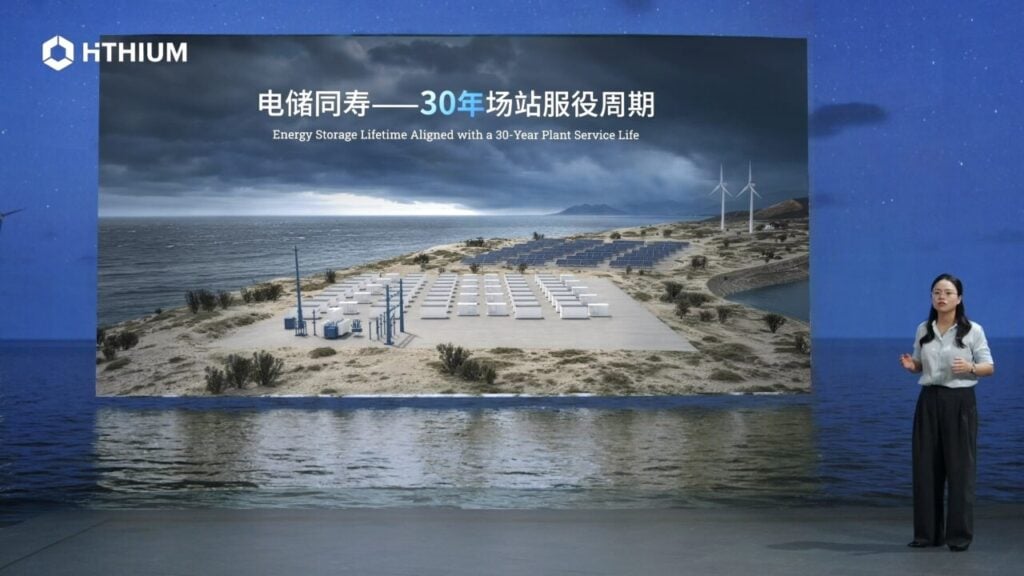
Hithium hosted a launch yesterday for its new sodium-ion (Na-ion) battery cell and energy storage system product line, promising a 30-year expected operational lifetime.
In a pre-recorded video streamed live on LinkedIn, the Chinese battery manufacturer’s research institute director, Dr Aileen Wang, introduced the ∞Cell N785Ah and the battery energy storage system (BESS) ∞Power N4.0MWh.
Wang said the sodium-ion battery team at Hithium was tasked several years ago with building a battery that could redefine energy storage. Having observed that lithium-ion (Li-ion) cost curves were beginning to flatten, sodium-ion was seen as a potential new driver of growth.
“We did not just follow lithium-ion. We wanted to explore where lithium-ion has yet to go, to see whether electrochemical energy storage could operate over a much longer timeframe,” Wang said.
Try Premium for just $1
- Full premium access for the first month at only $1
- Converts to an annual rate after 30 days unless cancelled
- Cancel anytime during the trial period
Premium Benefits
- Expert industry analysis and interviews
- Digital access to PV Tech Power journal
- Exclusive event discounts
Or get the full Premium subscription right away
Or continue reading this article for free
The ∞Cell N785Ah is designed for a 20,000-cycle service life and supports storage durations between 2-hour and 8-hour. It is fully compatible with Hithium’s 1,000Ah lithium-ion manufacturing platform and could therefore enter scaled mass production quickly, the company claims.
The ∞Power N4.0MWh BESS that the cell powers features an original sodium-ion architecture. It comprises a stacked cell design with a dedicated battery management system (BMS) that Hithium claims can estimate state of charge (SoC) to within 2.5% accuracy. It is compatible with 800V—1500V power conversion systems (PCS).
Wang said that several challenges had to be overcome in creating the long-lifetime Na-ion battery storage solution, starting with materials. Cathode impurity phases were difficult to control, high specific capacity and fast anode kinetics were difficult to combine and interfacial side reactions and film formation mechanisms in the electrolyte were not fully understood.
Hithium worked with partners to develop a high phase-purity, high compaction-density, low-resistivity sodium iron phosphate pyrophosphate (NFPP) cathode material, increasing conductivity by three orders of magnitude and raising phase purity to 97%.
That enabled the company to reduce battery costs and increase its energy density.
For the anode, Hithium developed a hard carbon material with fast sodium-ion transport channels and abundant sodium storage sites, which Wang claimed “combines ultra-low expansion with high-rate performance,” while “substantially extending calendar life.”
Hithium developed a sodium-ion-specific formulation for the battery’s electrolyte, using micro-bonding and targeted repair mechanisms. Ion diffusion in the electrolyte was improved, and the desolvation barrier was lowered by using low-viscosity, wide-liquid-range, weakly coordinated solvents.
Meanwhile, a dense solid electrolyte interphase (SEI) layer of high reduction potential sodium salt additives on the anode surface suppresses electrolyte decomposition and consumption, while significantly reducing gas generation and improving lifecycle reliability.
In cell-level manufacturing, Wang explained that Hithium developed three core capabilities: an ultra-thick electrode coating to offset sodium-ion’s energy density disadvantages, long-life structural components that can handle expansion and contraction for over 20,000 cycles and large-format cell stacking technology to overcome manufacturing bottlenecks in Na-ion technology.
With this, Hithium aims to use many of the same manufacturing processes as its lithium-ion battery lines, while using abundant materials uncoupled from global lithium battery supply chains.
Li-ion OEMs embrace promise of Na-ion
Hithium’s launch is perhaps the latest indication of progress in the commercialisation of sodium-ion batteries for stationary BESS applications, driven largely by China’s big lithium-ion battery OEMs.
In fact, the company claimed to be the first to market with a Na-ion cell designed specifically for utility-scale BESS, launching the ∞Cell N162Ah NFPP battery in December 2024.
It has been followed by sodium-ion product launches from Chinese players including CATL, BYD, HiNa and Envision, as well as non-Chinese startups such as Peak Energy (US) and Phenogy (Europe). An April 2026 ESN Premium article compared and analysed differences between the early players’ Na-ion products, based on public announcements.
CATL, which signed a 60GWh sodium-ion battery supply deal with Chinese system integrator HyperStrong in April, held the global launch of the sodium-ion version of its TENER BESS unit at Intersolar Europe in Germany in June.