There is no shortage of capital to invest, but energy storage developers in the Middle East face familiar questions as the market takes shape.
At Energy Storage Summit Middle East 2026 at the beginning of this month, a panel of financiers and investors discussed what it will take to get the market, which has already rapidly become one of the world’s fastest-growing, to the next level.
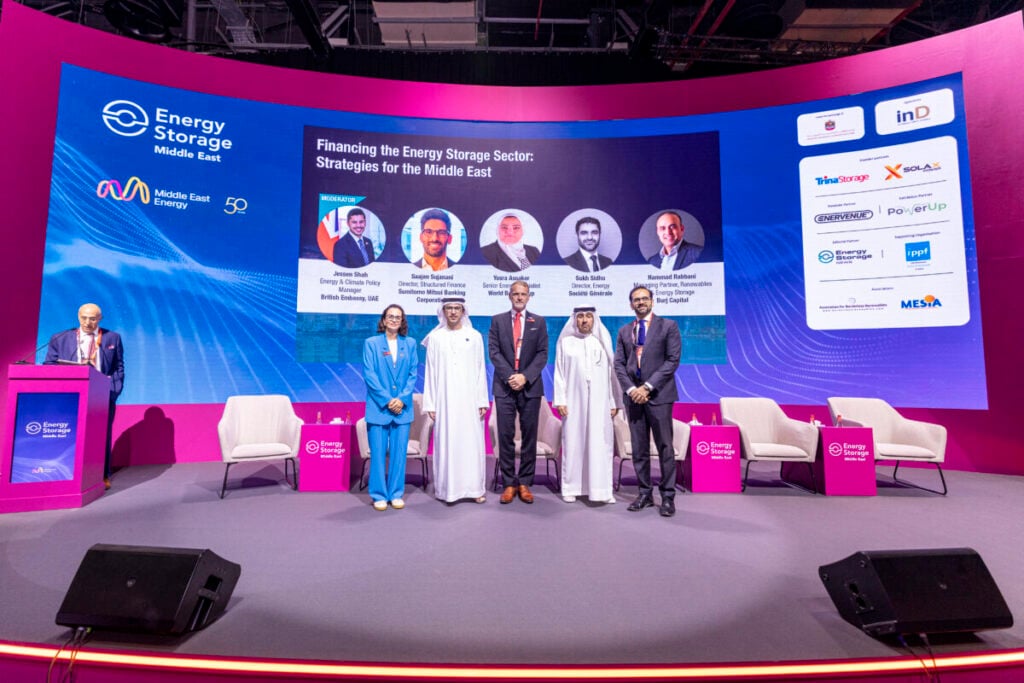
The panel discussion, Financing the Energy Storage Sector: Strategies for the Middle East, looked at what it will take to move Middle Eastern energy storage project pipelines “from ambition through to financing, construction and operation,” in the words of moderator Jessen Shah, energy & climate policy manager at the British Embassy in the UAE.
“We all know that storage is essential to renewable integration, grid stability, and energy security, but the discussion has now moved beyond whether those technologies work,” Shah said.
Try Premium for just $1
- Full premium access for the first month at only $1
- Converts to an annual rate after 30 days unless cancelled
- Cancel anytime during the trial period
Premium Benefits
- Expert industry analysis and interviews
- Digital access to PV Tech Power journal
- Exclusive event discounts
Or get the full Premium subscription right away
Or continue reading this article for free
“Now, it’s fundamentally about the revenue certainty, risk allocation, and, of course, the bankability of these projects.”
There is no shortage of capital looking at the energy storage sector, but questions remain over the appropriate levels of revenue certainty and risk allocation to attract that capital to invest at scale. Transactions must become repeatable rather than remaining bespoke, Shah said.
The Middle East region’s markets are diverse and offer distinct advantages, from Gulf nations, which have “deep pools of capital” and central procurement models, to other countries that see energy security and economic development as drivers for energy storage adoption.
The key is to translate strong regional demand and investor interest into a pipeline of “consistently bankable, financeable, and crucially, repeatable” projects, according to Shah.
The Middle East does not lack bankable projects or available capital, but the early-stage energy storage market still lacks maturity, Sukh Sidhu, director of energy at the bank Société Générale, said. Energy storage is still “starting out,” relative to renewable energy, which has had a decade or so of maturation.
Sidhu characterised the financing landscape today as a “scale-up issue,” but noted that with the benefit of lessons learned across the industry, the scaling up of energy storage in the Middle East could happen “far quicker” than has been seen in renewables.
Hammad Rabani, managing partner at investment group Burj Capital, said there is no shortage of capital in the Middle East.
“It’s more about converting a huge pipeline of opportunities into bankable projects,“ Rabani said.
“There’s a strategic requirement for battery energy storage to address intermittency in the system, but unless there is a visibility or predictability of the cash flow coming in, and bankable counterparties on the other side… those strategic opportunities cannot be converted into bankable projects.”
Familiar call: recognise energy storage as an asset class
Yosra Assaker, senior energy specialist at World Bank Group, said that although it is logical to consider renewable energy and energy storage development as closely linked, it’s important that regulators recognise standalone energy storage as a separate asset or infrastructure class.
In a perspective that has been voiced in many emerging energy storage markets around the world, Assaker noted that batteries are often still treated as though they are supply or generation assets. In fact, she said, standalone battery energy storage system (BESS) technology should be in a separate category “that has its own characteristics and its own financing needs and needs to deal with its own circumstances.”
The World Bank Group expert added that the “real value of storage” in providing grid flexibility is not being effectively captured, monetised and “embedded in the regulations.”
In other words, developers must be given the ability to stack revenues across different applications. These regulatory changes will require the modernisation of grid codes to recognise storage as a distinct asset category, Assaker said.
However, some things may not change in the near term: while Société Générale’s Sukh Sidhu agreed that regulations must capture the specific characteristics unique to energy storage, he said Gulf nations’ single-buyer procurement models have adapted to embrace renewable energy as well as thermal generation and are now doing the same in energy storage.
The independent power producer (IPP) framework was developed for conventional power producers and has since undergone an “amazing shift” toward renewable energy over the last decade. Now, Société Générale is seeing the development of both standalone and hybrid energy storage projects in the region, Sidhu said.
Yet, while regulations will evolve to recognise the benefits of storage, Sukh Sidhu said it is unlikely the Middle East will adopt fully liberalised electricity markets with the same range of revenue streams available as seen in more mature energy storage markets.
“The IPP framework offers the most cost-effective way to develop large-scale projects, energy storage, or other types, and we’ve seen this from a levelised cost of energy (LCOE) perspective for renewables, as an example. It has worked, and it probably will continue to work very well,” Sidhu said.
Sidhu said there is a “very strong” pipeline for energy storage assets in the Gulf Cooperation Council (GCC) countries but at the same time there are “one or two challenges” on the liquidity side.
One is the creeping impact of prevailing interest rates being higher now than over the past few years. Higher base rates mean projects are more expensive to develop, and investors must consider the opportunity cost.
Secondly, there is “an abundance” of infrastructure projects competing for the same liquidity pool under the IPP model, creating some scarcity.
BESS should be viewed more as an infrastructure asset than a technology asset class, in the opinion of Saajan Sujanani, director of structured finance at Sumitomo Mitsui Banking Corporation.
From observing the development of projects in both Europe and the Middle East, Sujanani said that standardisation of contractual frameworks can create repeatable, scalable models.
While the Middle East will likely develop different models from Europe, which tends to have more merchant market exposure, “capacity-based, availability-based payment structures” are critical for lenders in the region to be able to assess the viability and bankability of projects, Sujanani said.