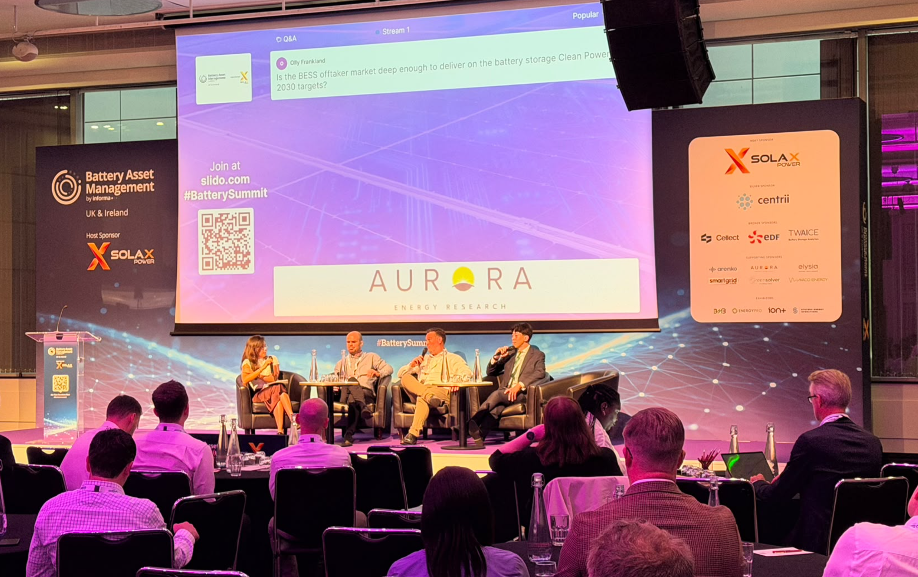
Bankability & offtake and regulatory & system reform were the key talking points on the opening panel of the Battery Asset Management Summit UK & Ireland 2026, which runs today and tomorrow (13-14 October).
Gordon Hayward-Grant, deputy director of long duration energy storage (LDES) at regulator Ofgem, opened the event with a presentation on the LDES cap-and-floor scheme, covered by by our sister site Solar Power Portal.
Offtake and route-to-market
Developers, investors and analysts discussed the big picture challenges in the industry on the ‘From Promises to Performance: What the First Decade of GB BESS Has Taught Us’ panel.
Peter Clifton, director of the state-owned National Wealth Fund (NWF), indicated doubts on whether there are adequate route-to-market offerings in the market for the future, at the right price.
Try Premium for just $1
- Full premium access for the first month at only $1
- Converts to an annual rate after 30 days unless cancelled
- Cancel anytime during the trial period
Premium Benefits
- Expert industry analysis and interviews
- Digital access to PV Tech Power journal
- Exclusive event discounts
Or get the full Premium subscription right away
Or continue reading this article for free
“Tolls and floors have done very heavy lifting so far but are they creating enough value?”, he asked on the panel discussion.
“We need to see these things presenting value, we need more depth and more competition so that they present more value for equity investors.”
NWF has invested in battery energy storage system (BESS) projects and pipelines from owner-operators Fidra Energy and Eelpower, as well as liquid air energy storage firm Highview Power.
Aurora Energy Research senior associate Victor Yip said the discussion on offtake and route-to-market ultimately boils down to a somewhat philosophical question: “Who is the natural owner of the risk of these projects?”
Mike Ryan, commercial director for owner-operator Constantine Energy Storage, added that it’s important to remember these tools are debt-raising tools, “not risk mitigation tools”.
Electricity market reform
The discussion then moved on to the ever-present challenge of regulatory and system reform. The Review of Electricity Markets Arrangement (REMA) was the key regulatory topic the industry was thinking about up until its zonal pricing component was dropped last year.
Clifton said one upside of the investment uncertainty created by REMA was that it actually created room for players like NWF and others to come into the market. But it is a challenge when trying to build a business case, he said.
“There is no point investing on the basis of curtailment signals in Scotland if that is going to be dampened by a reform,” he said.
Constantine’s Ryan said that ultimately to be in BESS you need to be comfortable with that risk.
“Regulatory reform will go on forever. If you are in this space you have to get comfortable with this as a known risk,” he said.
Part of that is that lots of the industry has come from the solar sector, which had a comparatively more stable reform environment.
Yip said that since the zonal pricing of REMA was dropped, there’s actually been a bit of an excess of reforms aimed at effectively creating some sort of locational price signal. This is via the new Strategic Spatial Energy Planning (SSEP) and reforms to Transmission Network Use of System (TNUoS) Charges.
Echoing the sentiment, Ryan said that the current period of reform actually felt a bit less joined up than previous ones.
Another regulatory topic that came up was reforms to the balancing mechanism (BM) following complaints about BESS being ‘skipped’ in favour of gas (skipping relates to bids being overlooked without clarity as to why).
Ryan pointed out that even before BESS, gas operators would complain about being skipped in favour of other bids as well, so it wasn’t necessarily anything that new.
But, he said: “BESS has managed to achieve a serious attempt at reform of the BM, which no one had achieved before that. NESO is trying to understand the skips and be more transparent about it.”
Yip added: “All these reforms and discussions have shown that NESO is willing to change its priorities.”
The panel was moderated by Sarah Lightfoot, head of development for owner-operator Root Power.