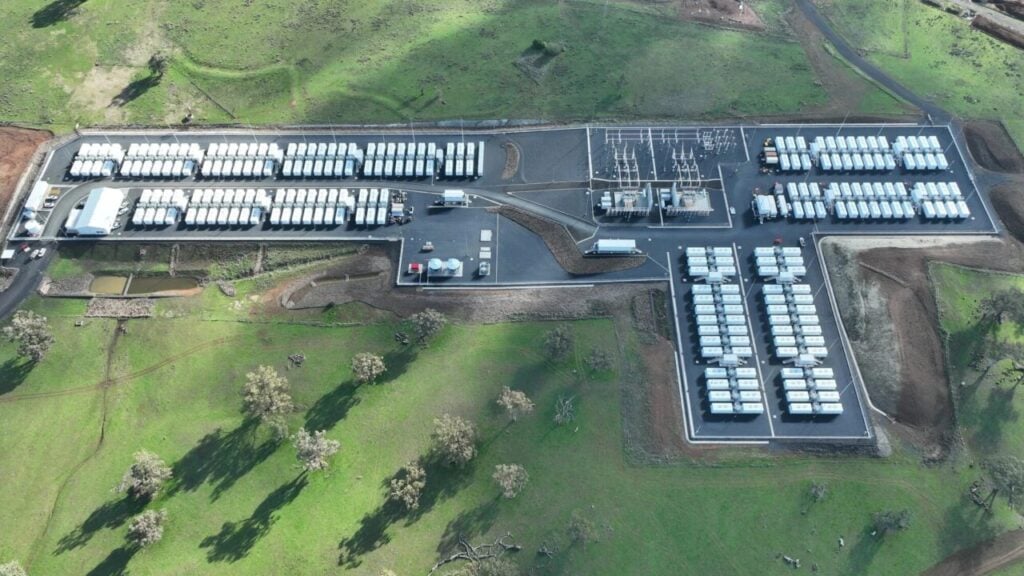
Battery energy storage systems (BESS) in Australia’s New South Wales (NSW) earned an estimated AU$5.63 million (US$3.88 million) in two hours during an “extreme” price event on 12 October, as wholesale electricity prices peaked at AU$23,107/MWh.
The estimate comes from Franz David Schaefer, a senior analytics specialist at energy retailer EnergyAustralia, who set out the figures in a LinkedIn post.
Prices averaged AU$7,415/MWh from 14:10 to 16:05, he said, and swung between about AU$700/MWh and AU$23,000/MWh from one interval to the next.
NEMPulse, an independent open-data dashboard that tracks dispatch, revenue and bidding for grid-scale batteries in the National Electricity Market (NEM), classified the event as “extreme”.
Try Premium for just $1
- Full premium access for the first month at only $1
- Converts to an annual rate after 30 days unless cancelled
- Cancel anytime during the trial period
Premium Benefits
- Expert industry analysis and interviews
- Digital access to PV Tech Power journal
- Exclusive event discounts
Or get the full Premium subscription right away
Or continue reading this article for free
Schaefer said the New South Wales battery storage systems earned about AU$47,000 per minute, compared with AU$9.1 million for the entire NEM BESS fleet in the previous week.
It was also more than double Victoria’s best day of the third quarter, at AU$2.42 million. The peak sat just under the market price cap, the maximum spot price in any interval, which the Australian Energy Market Commission (AEMC) set at AU$23,200/MWh for 2026-27, up from AU$20,300/MWh the year before.
Schaefer said WattClarity, a NEM market data site run by Global-Roam, put the spikes down to sudden jumps in NSW demand, at nearly 500MW in a single interval.
10 New South Wales battery storage systems dispatched
ACEN Australia’s New England BESS earned the most across a single site, with AU$1.21 million from its first unit, which fell from 96% to 45.1% state of charge, and AU$613,020 from its second unit, which fell from 45.5% to 19.3%. That is about AU$1.82 million across both.
ACEN Australia is the local arm of the Philippines-based renewable energy platform ACEN.
The Waratah Super Battery, which had recently been brought online, followed with AU$994,990, ahead of Eraring’s first unit with AU$935,470 and Akaysha Energy’s Orana BESS with AU$865,950.
Eraring’s second unit, still in commissioning, added AU$116,960 from a state of charge of just 7%.
Smaller earners included Limondale (AU$282,810), Riverina Energy Storage System 1 (AU$279,090), Smithfield (AU$251,350) and the Quorn Park Solar Hybrid (AU$108,580).
Wallgrove was charging at the time, yet still recorded AU$201,970, with 64.5MW committed to frequency control ancillary services (FCAS). You can find a breakdown of the revenue by BESS below. Note that battery storage systems that stood idle or were offline during the event have not been represented in the graph below.
This includes the Riverena Energy Storage System 2 (idle), Williamsdale BESS (idle), Darlington Point Energy Storage System (idle), Liddell BESS (idle), Capital BESS (idle) and the Queanbeyan BESS (offline).
Of the 17 NSW BESS listed in the data, 10 discharged, one was charging and six sat idle, with a seventh offline. The idle group included the Liddell BESS, which held a 95.3% state of charge and 497MW of availability but had 104.2MW committed to FCAS.
Schaefer said in the post: “Some of that will be contracts or network obligations, but probably not all of it.”
He also cautioned that the figures are estimates based on dispatch targets, not metered output, and could move significantly once settled.
How much a battery storage system captures in an event like this depends on how much energy it holds when prices rise.
Speaking previously to ESN Premium, Sahand Karimi, CEO of BESS optimiser OptiGrid, said after South Australian prices reached the then-AU$20,300/MWh cap twice on one evening in June: “Some decisions look obvious after the event. They rarely are in real time.”
In that event, NEMPulse estimated that four of 15 tracked battery storage systems discharged for roughly AU$324,000. Karimi said a BESS can only capture extreme prices “if it still has energy available”, and that the battery storage systems, which had discharged heavily earlier in the evening, had little left when the cap arrived.
Such events matter more as the fleet grows and everyday spreads narrow. Data from the Australian Energy Market Operator (AEMO), which runs the NEM, showed NEM-wide battery storage system price spreads fell 85% in a year to AU$51/MWh in the second quarter of 2026, as grid-scale BESS output passed 9,000MW.
AEMO estimated net BESS revenue at AU$57.5 million for the quarter, down from AU$130.5 million a year earlier, although that is a net figure and differs from Schaefer’s estimate of revenue in the New South Wales window.
AEMO’s first-quarter report showed BESS tripling their daily load shifting, with energy arbitrage making up 97% of battery storage revenue and frequency control services 3%. That reliance on arbitrage leaves revenue exposed to a small number of high-priced intervals, as this event showed.
Never miss an Australian energy storage story. Sign up for our Australia newsletter and get the latest project announcements, policy updates and market analysis delivered directly to you.