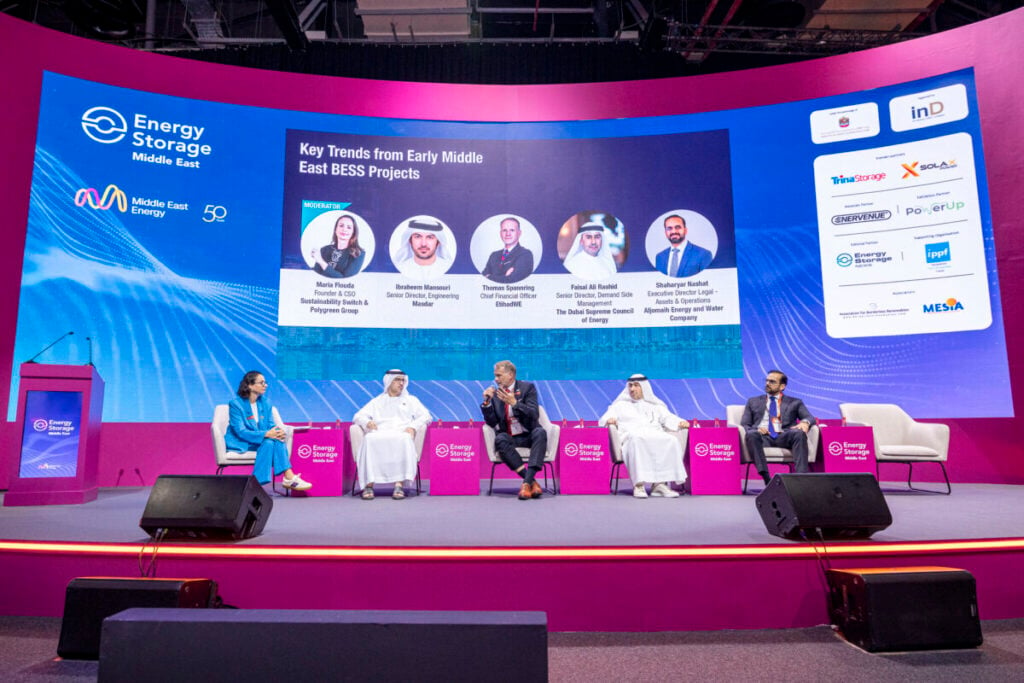
Dubai is planning to build 1,000MW of lithium-ion battery storage, expandable to 2,000MW and delivering 6,000MWh of capacity, according to panellists speaking on the “Key Trends from Early Middle East BESS Projects” panel at Energy Storage Summit Middle East 2026.
Dr Faisal Ali Rashid, senior director of demand side management at the Dubai Supreme Council of Energy, said the project is expected to be completed between 2027 and 2029 and would likely be the largest battery storage facility in the region.
“There are challenges when it comes to battery storage, including upfront investment,” Rashid said.
“Even though the price is decreasing, but we know that there are challenges.”
Try Premium for just $1
- Full premium access for the first month at only $1
- Converts to an annual rate after 30 days unless cancelled
- Cancel anytime during the trial period
Premium Benefits
- Expert industry analysis and interviews
- Digital access to PV Tech Power journal
- Exclusive event discounts
Or get the full Premium subscription right away
Or continue reading this article for free
Rashid said Dubai’s battery storage programme began as a 1MW pilot in 2010, and that the planned facility would support round-the-clock power supply as UAE solar capacity, already above 2,500MW, continues to grow toward 2030 and beyond.
Ibraheem Mansouri, senior director of engineering at Masdar, discussed the company’s Abu Dhabi round-the-clock (RTC) project, which combines 5.2GW of solar generation with 19GWh of battery storage to deliver 1GW of continuous power supply, representing around US$6.1 billion of investment.
Mansouri said the engineering challenges of the project fell into two categories, one involving system-level integration between solar and storage, and the other involving component-level risks such as thermal runaway.
“It’s not very battery storage now, starting to become a common, so you can go and buy the containers and store them, but the most important is how you integrate, how you ensure that each system talks to each other,” Mansouri said.
The inaugural Energy Storage Summit Middle East 2026 conference took place at Dubai World Trade Centre at the beginning of September, hosted by our publisher Solar Media (part of the Informa Group) as part of the Middle East Energy Dubai event.
Financing structures still built around gas turbine assumptions
Thomas Spannring, chief financial officer at EtihadWE, said battery storage presents a different bankability challenge to conventional generation assets because its long-term performance, unlike that of mature technologies, cannot be reliably predicted at the point of financial close.
“When I do a gas turbine, I know exactly what that is going to be worth in 20 years,” Spannring said.
“But for batteries, we cannot make that assumption.”
Spannring also pointed to supply chain concentration as a financing risk, noting that battery technology is sourced almost exclusively from China.
“Is this bad? It’s not. We want to expand our collaboration with China as a vendor technology partner. It’s certainly on top of our agenda, and it’s also helpful from a financial perspective to bring costs down,” Spannring said.
“But that is a risk element as well because you need spare parts, you need replacements, and if and when you depend only on one country exclusively, this is something that you need to have on top of your mind.”
Spannring said utility control over dispatch in major Gulf markets such as the UAE and Saudi Arabia was viewed favourably by lenders, describing it as “already a tick in the box.”
He said a capacity and availability-based commercial model remained preferable to a merchant model in the region, given the absence of a transparent, liquid energy exchange with prices that vary between peak and base load.
“Merchant models do work, but then you need to have a full market environment with transparent market prices,” Spannring said.
“Those elements to that extent are not here. We are not having that.”
Battery storage contracts need flexibility that thermal power agreements do not, says developer
Shaharyar Nashat, executive director of legal, assets and operations at Aljomaih Energy and Water Company, said standard EPC contract structures, typically wrapped over two years and based on static performance ratios fixed at the commercial operations date, do not account for the non-linear degradation curves specific to battery storage.
“Battery energy storage is more akin to infrastructure, as opposed to our production projects, and that’s simply just the nature of what battery energy storage is,” Nashat said.
“The impact on those degradation curves comes from ambient conditions, the state of discharge, the state of charge,” he said.
“So, it’s unlike what we’re used to in terms of thermal power plants or renewable energy plants.”
Nashat said contracts needed greater flexibility in indexation mechanisms, degradation curves, and payment structures, based on availability and capacity rather than production, to account for potential shifts in battery chemistry and pricing over a project’s lifetime.
“There has to be flexibility to allow for that,” Nashat said.
“When we have that flexibility, that’s when you’re going to see more developers step up, more lenders step up, and these projects become a lot more attractive and feasible in the long run.”
Mansouri said lessons learned from existing assets included the importance of long-term service agreements with battery suppliers to allow for replacement and augmentation, as well as site-specific design failures observed in the field.
“We have seen some basic design that’s not being taken into consideration properly,” Mansouri said.
“One example is you have the inlet of the battery storage facing the outlet of another one, which means that actually it’s generating more heat to the other battery storage.”
Mansouri also pointed to a heat island effect from large-scale battery deployments, which he said could raise ambient temperatures around installations by two to five degrees if not accounted for in HVAC and cooling system design.
Responding to an audience question about the environmental impact of decommissioning battery storage plants, Mansouri said the industry was still in its early stages on the issue, drawing a comparison with existing electronic waste regulations.
“There are a lot of discussions about how you can give the battery a second life,” Mansouri said.
“There are discussions about how we can utilise, for example, the battery storage component within electric vehicles for stationary battery storage.”
Nashat added that battery chemistry itself continues to evolve, citing US-based companies developing biopolymer peptide batteries as an example of ongoing innovation in the sector.
“Earlier, we saw lithium-ion batteries as the game changers,” Nashat said.
“Then came lithium polymer, and now there are companies which are now showing that even peptides, biopolymer peptides, can be used for battery storage purposes.”
Asked what single action would most accelerate regional storage development over the next five years, Nashat called for unified regional principles around battery storage that developers, investors, lenders and contractors could align behind.
Spannring said utility-scale renewable energy projects should be systematically linked with battery storage from the outset, alongside greater deployment of decentralised storage to address localised peak load rather than relying solely on centralised, utility-scale assets.
Mansouri pointed to building regional technical capacity, noting Masdar had sent 12 UAE nationals to work with the RTC project’s original equipment manufacturer for up to a year, and to greater use of artificial intelligence in dispatch forecasting and digital twin modelling.