
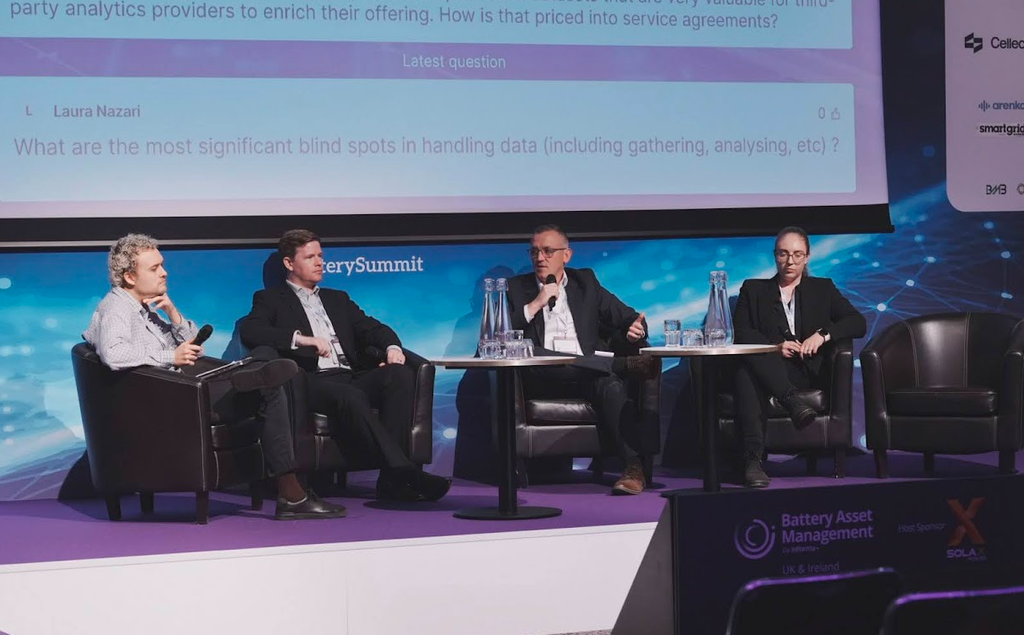
Dan Taylor, director of engineering at optimisation and asset management provider Arenko, speaks to Energy-Storage.news about all things data in battery energy storage systems (BESS): how to approach it, how to get it, standardise it, third-party analytics and ultimately how to ensure your data work translates into actionable insights and operational improvements.
The topic was dissected on the ‘Data That Earns Its Keep: From Monitoring to Operational Intelligence’ panel discussion (pictured above) at the Battery Asset Management Summit UK & Ireland 2026 earlier this week. Taylor was going to be on the panel but due to scheduling changes couldn’t make it, so he kindly gave us this interview as an alternative.
Getting and standardising data
To start with, at what point in the project lifecycle should your data and analytics strategy be defined?
“At all points really, starting at the very beginning—but accepting that your strategy must change as your project matures and portfolio grows,” Taylor says.
Try Premium for just $1
- Full premium access for the first month at only $1
- Converts to an annual rate after 30 days unless cancelled
- Cancel anytime during the trial period
Premium Benefits
- Expert industry analysis and interviews
- Digital access to PV Tech Power journal
- Exclusive event discounts
Or get the full Premium subscription right away
Or continue reading this article for free
“The things you need to know during commissioning and design are very different to the things you’ll need to know two years into trading. New markets and a changing grid mean constant change. Your data strategy is a living thing that needs to change constantly.”
BESS produces more data than solar PV, and there is a wider variety of technology deployed, posing a challenge from a data collection and standardisation standpoint. Projects may have many different contractors and suppliers. Taylor says the firm’s Iris on-site box can help with this challenge by capturing data from the site itself with its own meters.
When it comes to data standardisation, considering all the above, he agrees it’s a big challenge.
“This is a big lift! One of the most important components of our platform is the Asset Model, which standardises the inner workings of a battery asset across a wide range of vendors and site designs. Building this is a big deal, and I would argue a non-negotiable step on the analytics journey,” he says.
“However, it’s not a one-off. As new projects, vendors and markets come along, your asset model will need constant change and growth—ours is pretty mature, after a decade, but I’d guess we ship one or two changes a week.”
There is also the question of frequency and volume of data and how much is actually needed. While it might appear sensible to collect everything you can and ‘use it later’, Taylor recommends a more considered approach.
“Depends on the use case,” Taylor explains. “You might not need cell temperatures every 50 milliseconds, but you do need that data rate for frequency, setpoint and so on. We collect over 7 billion rows of data from our ~40 asset portfolio and that is by no means an easy thing to do.”
“The temptation is always to ‘fetch everything because you might need it later’—after all, you can’t go back and get it if you never collected it to start with—but that can get very expensive very fast! The reality is a very considered design approach, driven by real domain knowledge. Also some pretty solid data engineering knowledge, if you don’t want to give all the money you save to a cloud vendor!”
Third-party analytics
This was a major talking point on the panel discussion at the event. Many audience questions touched on it: how you choose one, how you assess the usefulness of it and how you compare and integrate it into your own data.
Taylor says bringing it in is always an option, but it’s key to understand the different use cases.
“Third-party analytics is less biased and usually cheaper than building it yourself—but it lacks the flexibility you need to really dig into bespoke issues quickly. The sweet spot, in my opinion, is a blend of third-party analytics for things you can buy, with access to data when you need it for focussed analysis,” he says.
When it comes to assessing the usefulness and return on investment of those third-party analytics, Taylor says the key is whether or not it makes you a better asset manager, and that the approach is the same in the case of assessing investments into your own internal data capabilities.
Taylor: “If the savings you make outweigh the cost of the platform, it’s worth it! This is the exact same metric you should use to assess a data platform you build and run yourself. If the cost of the platform outweighs the monetary value you derive from it, is it a sensible investment?”
“One of the hardest things to measure with data is the performance of a data team, data platform or data product. It’s harder with a team of real people, off the back of an internal programme of work than with an external vendor with a clear price list.”
“Most projects will deliver a step change in performance, then things will just ‘stay good’. The problem is that it’s impossible to prove the counterfactual—how would things have looked without the data function in place. In eCommerce you can use A/B tests, holdout groups and so on—but as we know, no two BESS assets are ever identical, and not optimising one to prove your optimisation works is often too high a price to pay.”
“You must continually assess the performance of your data team/data platform though. It is no less a cost/benefit tradeoff than a product you buy off the shelf.”
What can data and analytics do to improve BESS operations?
The firm’s Nimbus platform trades and asset manages 1.5GW of assets, and Taylor says you need to be ruthless to assess how its data is supporting real-time trading decisions.
“A mixture of statistical accuracy and reliability measures (is the model good enough) needs to be coupled with deep knowledge of the industry, markets and individual assets themselves. Sometimes, a promising model will simply not deliver results and the best choice is to walk away and try something else,” he explains.
“Real time ups the ante here—I’d guess it costs 10x to do something in real time (i.e. sub-second), compared to batch (hourly, daily etc). On the other hand, real time applications feel 10x cooler.”
“The temptation is to favour the real time approach because it feels more compelling. There are true real time use cases—for example, managing headroom/curtailment on co-located assets is something which is better done immediately—but many other tasks simply don’t need the complexity—for example, 20 state of health calculations per second!”
“Derive it back from the outcome. How often would you make a change based on the data?”
How to ensure a holistic view, not hyper-focussing on one KPI
We then ask Taylor how to ensure your data term (third-party or internal) gives you a holistic view on BESS operation, rather than being hyper-focused on one KPI?
“Data, at the end of the day, is a tool, not an outcome in its own right. If you don’t already have an idea of the outcomes you want to see, I would strongly advise you not to build a data platform yet! Your primary role remains that of an asset manager. Data is a way to make that job easier,” Taylor says.
“The outcome you need isn’t ‘perfect data’, it’s a better asset management function, better assets and thus higher revenue. The data product or platform earns its keep by giving you the tools you need to do your job.”
“I’d always recommend a blend of third-party data and home grown solutions, always keeping an eye on the most cost effective way to deliver revenue, and never getting hung up on ‘perfection’”.
