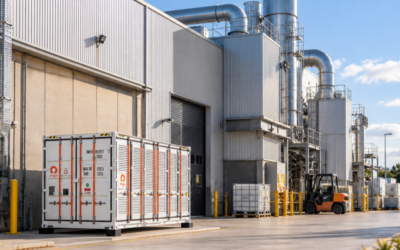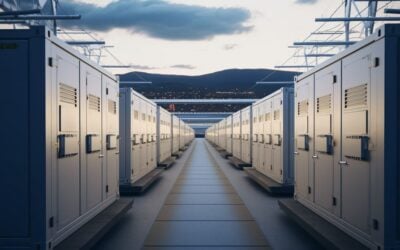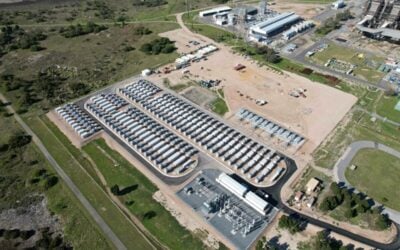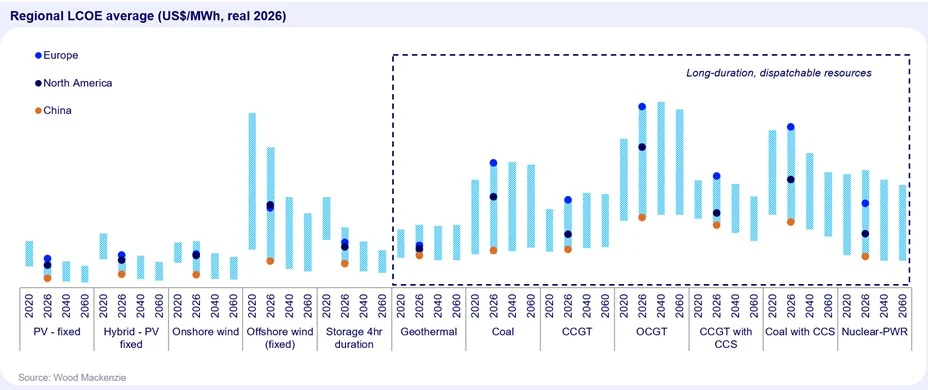
Battery storage of 4-hour duration is less expensive than open-cycle gas turbines in the 43 markets in which both technologies were modelled, according to a new report from market research firm Wood Mackenzie.
Released 8 October, the new report from Wood Mackenize on levelised cost of electricity (LCOE) showed that in the Middle East and Africa, where utility-scale solar is leading at US$37/MWh, the cost of 4-hour duration storage is forecast to fall a further 33% to US$80/MWh by 2035, “displacing gas peaking on cost across every gas market in the region.”
China remains the global battery energy storage system (BESS) cost benchmark at more than 55% below the rest of Asia Pacific average, an example of how the country’s manufacturing scale is redrawing the global cost map.
North America
According to Wood Mackenzie, tax credits remain a key competitive advantage for storage, helping to offset some of the pressure from foreign entity of concern (FEOC) restrictions and ongoing supply chain constraints.
Try Premium for just $1
- Full premium access for the first month at only $1
- Converts to an annual rate after 30 days unless cancelled
- Cancel anytime during the trial period
Premium Benefits
- Expert industry analysis and interviews
- Digital access to PV Tech Power journal
- Exclusive event discounts
Or get the full Premium subscription right away
Or continue reading this article for free
That said, costs are expected to spike once investment tax credit (ITC) support begins phasing out from 2038. Longer term, however, new BESS cell chemistries, hardware commoditisation and a growing domestic supply chain are forecast to pull storage LCOE down by 10% by 2060.
Meanwhile, gas generation investment is heading into a supply deficit through the late 2030s, as data centre-driven load growth keeps thermal capital costs high — a dynamic that, in turn, strengthens the long-term economic case for renewables and BESS.
Solar faces nearer-term cost pressure from a wave of tariffs, anti-dumping and countervailing duty (AD/CVD) measures, and new Section 232 import restrictions, with distributed generation the most exposed segment. Utility-scale solar has some protection via 168GW of safe-harboured capacity, though module prices are still projected to climb roughly 5% a year through 2030.
Residential and commercial solar face a tougher outlook, with module prices expected to rise 6% in 2027 and a further 14% in 2028.
Onshore wind, by contrast, is set to see LCOE fall 16% by 2060 on the back of steady capex and opex gains, even as near-term policy uncertainty and possible Section 232 effects on turbine pricing cloud the outlook.
Latin America
In Latin America, BESS deployment is accelerating across the region, propelled by mandates attached to renewable projects alongside standalone procurement aimed at shoring up grid stability. Wood Mackenzie expects storage costs to fall 42% by 2060 as the market matures and regulations catch up.
Notably, while many Latin American countries have implemented storage and renewables mandates accelerating deployment, Valentina Meneses, energy practice co-director at Americas Market Intelligence (AMI), recently spoke with Energy-Storage.news ahead of Energy Storage Summit Latin America, which takes place later this month in Santiago, Chile, about how a lack of regulation remains a consistent challenge for the region.
“The next step is to ensure that these regulatory advances translate into clear ground rules for understanding how business can be conducted in each of the countries—thereby providing clarity and instilling confidence in developers, investors, and so on,” Meneses stated.
Single-axis tracking solar PV holds its place as Latin America’s cheapest generation source heading into 2026, with costs set to drop by 38% over the next 35 years. Brazil, Chile and Mexico benefit from a built-in cost edge thanks to exceptional solar resources and strong capacity factors.
Onshore wind is following a similarly steep downward path, with regional average LCOE dropping almost 21% by 2030 — from US$73/MWh to US$58/MWh — as expanding Chinese turbine manufacturers sharpen price competition and bigger machines boost energy output.
Offshore wind remains more of a longer-term opportunity, with cost parity against combined-cycle gas not expected until the early 2040s — though early project activity in Brazil and Colombia is already helping local supply chains take root.
Asia-Pacific
China sits well ahead of the pack on BESS costs — its benchmark LCOE runs more than 55% below the rest of the Asia-Pacific (APAC) average of US$134/MWh, a reflection of its vertically integrated, large-scale manufacturing base.
That competitive pressure is expected to drag the rest of the region’s average storage cost down to US$92/MWh by 2036, although Japan, Australia and the Philippines will stay pricier due to import tariffs, higher installation costs and local-content manufacturing rules.
Utility-scale solar still leads on cost competitiveness across Asia Pacific, yet the gap between markets is enormous. The most expensive solar market in 2026 costs over 200% more than the cheapest, a divide which is forecast to widen further to 250% by 2030 even as every market sees improvement.
Outside China, the firm reported offshore wind costs will stay elevated near-term, with real declines only kicking in from the early 2030s as supply chains develop and turbines grow larger.
Onshore wind is fast becoming one of the region’s cheapest power sources, although prices still vary more than sixfold between its most and least affordable markets. As Chinese turbine makers expand their footprint and bigger-capacity models enter service, wind is expected to close in sharply on coal across South and Southeast Asia.
Europe
BESS installation costs ticked up roughly 2% — the first rise in three years — after cell prices bounced back around 10% from their 2025 low amid firmer demand and climbing lithium prices.
Wood Mackenzie still expects capex to fall 12% by 2031, though that decline will slow once lithium prices roughly double in 2029 as oversupply clears and demand outpaces new mining and refining capacity.
Solar PV remains Europe’s cheapest power technology, with flat-mounted LCOE projected to decline 22% by 2060 as capital expenses ease and technology advances — even after a 14% jump in capex during 2026 tied to pricier PV modules.
Onshore wind capex, meanwhile, is shrinking by around 2.5% annually for the rest of the decade as manufacturers draw on financial strength to compete for rising demand. Beyond 2030, improving capacity factors take over as the main lever pushing costs down, eventually reaching US$60/MWh by 2060.
Europe continues to carry the highest fossil-fuel generation costs of any region in the study, with carbon costs projected to overtake fuel costs by 2030. Offshore wind, meanwhile, should start getting cheaper from the 2030s onward as supply chains settle and turbine prices ease, aided by competitive contracts-for-difference (CfD) auctions that give developers clearer demand signals.
Middle East and Africa
Grid-scale BESS has now firmly undercut gas peaking plants on cost throughout the region. Four-hour storage averages US$120/MWh in 2026 and is set to fall a further 33% to US$80/MWh by 2035, locking in its role as the key enabling technology for integrating solar and wind.
In practice, Wood Mackenzie explained that this means storage is now beating open-cycle gas turbines on cost in every gas-reliant market in the region — a genuine inflection point for how power systems are planned across the Gulf and the wider African continent.
The Middle East and Africa continue to offer some of the world’s lowest renewable energy costs heading into 2026, led by utility-scale solar. Single-axis tracker installations average US$37/MWh regionally, a figure expected to drop to US$24/MWh by 2035 — with Saudi Arabia and the UAE on course to dip below US$20/MWh as early as 2033.
The sharpest improvement in this latest update comes from onshore wind, as increasingly competitive Chinese turbines take hold across the region. Egypt and Morocco stand out for particularly low costs, helped by capacity factors between 40% and 45%.
Ahmed Jameel Abdullah, principal analyst at Wood Mackenzie stated of the report as a whole, “Gas turbine shortages and rising fuel volatility are driving up peaking costs, while expanding battery manufacturing continues to push storage costs down.”
In August, a report from climate consultancy Ember used hourly electricity data to examine how solar’s record global share in H1 2026 is reshaping power systems across daytime hours. It continued by comparing BESS deployment with solar growth across countries and profiled the leading markets already delivering solar during non-sunny hours.
Ember also released a report this month stating that insufficient progress has been made towards the Energy Storage and Grids Pledge, endorsed by dozens of countries at COP29 in October 2024, to target 1,500GW of energy storage deployment by 2030.