CATL, the world’s largest lithium-ion OEM, has given more details around its new battery energy storage system (BESS) product, Tener, including the company’s claims its cells will not degrade in the first five years of operation.
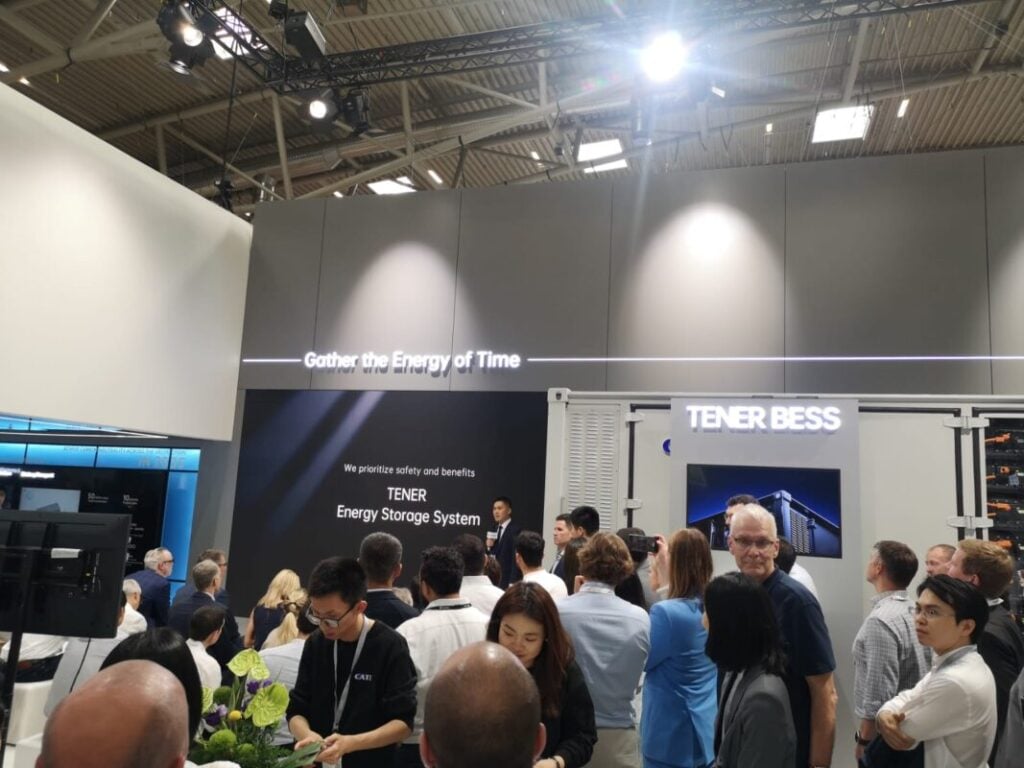
The China-based company gave technical details and market comments to Energy-Storage.news during a presentation and media workshop at the ees Europe event, held in parallel with Intersolar Europe at the Smarter E clean energy conference and trade show in Munich, Germany today (19 June).
CATL announced the new grid-scale BESS product in April this year, with two significant claims about its performance. The first was an industry-leading energy density of 6.25MWh of energy storage capacity per 20-foot container. The second was the the battery cells would suffer zero degradation for the first five years of operation.
In a Q&A with journalists, CATL executives Hank Zhao, CTO of ESS Europe, and Kevin Tang, director of ESS Europe, explained how it achieved – or claims to have achieved – the second, which had been a topic of lively discussion throughout the industry.
Try Premium for just $1
- Full premium access for the first month at only $1
- Converts to an annual rate after 30 days unless cancelled
- Cancel anytime during the trial period
Premium Benefits
- Expert industry analysis and interviews
- Digital access to PV Tech Power journal
- Exclusive event discounts
Or get the full Premium subscription right away
Or continue reading this article for free
It is a by a combination of pre-lithiation, or lithium compensation, combined with reducing the consumption of lithium-ions during battery cycles themselves, they said. This was speculated by industry sources shortly after the announcement, as covered in our follow-up piece (Premium access).
The benefit of this to the end-consumer is a higher throughput on the BESS during those first years, and the ability to push out augmentation of a BESS to seven or eight years after deployment, rather than three or five. All this means a more cost-effective deployment, they added.
Rolls-Royce, via its power systems business, is among the first system integrators to announce a partnership with CATL to deploy projects using Tener, saying today that it would use it for projects in the EU and the UK.
In response to questions from Energy-Storage.news around why it had applied the zero-degradation battery technology to grid-scale BESS and not electric vehicles (EVs) Tang and Zhao said that the underlying technology had been used in some vehicle applications, though not passenger vehicles.
The reason it has been applied to BESS first is that that market demands more improvements around long lifetime for the batteries, compared with the EV segment. Demands for such lifetime-improving tech could be applied to EV batteries, but would be done in line with customer demand, the executives said.