
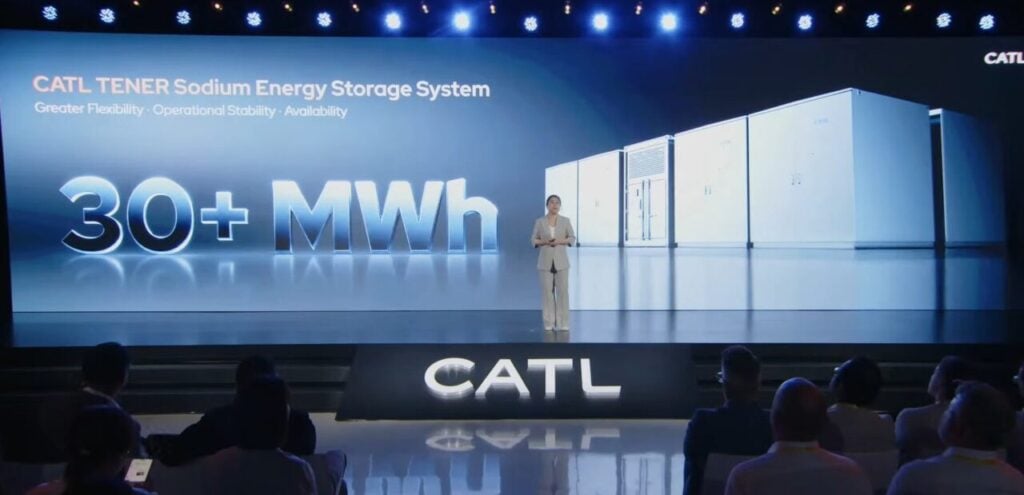
In this deep-dive, we go through and analyse all of the technical features and claims of CATL’s new sodium-ion grid-scale BESS product, including its ‘millisecond-level self-healing‘.
In April 2024, CATL launched the first Tener energy storage system. This first iteration was a lithium-ion-based BESS that was stated by CATL to be the ‘world’s first mass-producible energy storage system with zero degradation in the first five years of use’. This first Tener BESS came with a 6.25MWh capacity.
Now, just over two years on, CATL has now officially launched the Tener sodium-ion energy storage system in Germany in June. It was described by CATL as ‘the world’s first real-world validated sodium-ion energy storage solution’. This new sodium-ion BESS has now reached commercial maturity and is ready for production to start being scaled. It’s expected that the Tener sodium-ion BESS shipments will reach 1GWh by the end of this year in China, with global shipping beginning in 2027.
Sodium-ion BESS has long been seen as a key part of future energy storage support, in part due to the large power demand surges from AI data centres that requires a lot of storage backup, and in part due to the abundance and low cost of sodium when lithium prices continue to skyrocket. They can also be used in colder parts of the world because of their low temperature performance. As lithium gets scarcer and more expensive, sodium-ion BESS is likely to place a larger role in securing the energy grid and CATL’s latest announcement could be a key step towards that future.
Try Premium for just $1
- Full premium access for the first month at only $1
- Converts to an annual rate after 30 days unless cancelled
- Cancel anytime during the trial period
Premium Benefits
- Expert industry analysis and interviews
- Digital access to PV Tech Power journal
- Exclusive event discounts
Or get the full Premium subscription right away
Or continue reading this article for free
Here, we look at this new sodium-ion BESS in more detail. Note that the company has not revealed the sodium-ion chemistry it is using for the BESS, but the most common for energy storage is sodium iron phosphate pyrophosphate (NFPP)
Operational stability: 25-30 year service life (15,000 cycles at 25°C) with >92% capacity retention at -20°C
The Tener is stated to have a long operational stability with 25–30-year service life and comes with a 30-year warranty. There is a high configuration flexibility with the system, with decoupled energy and power blocks, that allows it to be used for 1, 2, 4, 6, and 8-hours at full rated power depending on the specific requirements of the installation.
Each Tener configuration has a 30+MWh rated capacity, which means that 1GWh site can be built with 34 configurations. Each of the 8 modules making up these configurations are 42 tonnes, with 3.75MWh of capacity and two cooling units.
CATL states that a lot of the improvements in energy density of the sodium BESS are at a system level rather than cell level, although improvements continue to be made here as well.
The Tener sodium module and configuration is compatible with lithium iron phosphate (LFP) batteries. There’s no need for changing enclosures, redesigning projects, or repeating certification processes, and a lithium-based system can increase the capacity of each unit to 50MWh.
In terms of its cycle life, the sodium-ion Tener has different rated cycle life values depending on the temperature environment it is going to be used in. The BESS is rated for 15,000 cycles at 25°C and over 10,000 Cycles at 45°C. These values, and the 25-to-30-year service life represent the time for the units to reach a 70% state of health (SOH).
Speaking of temperatures, the sodium-ion BESS is also very efficient in cold weather environments. Using what CATL calls dipole wide-temperature technology, the unit retains over 92% of its original capacity at -20°C. This capacity retention is achieved without any of the insulation or active cooling systems that you often see in lithium-ion BESS when deployed in extreme environments, which makes the unit more location flexible. Because of its operational stability and long operational life, they theoretically should be able to be sited almost anywhere and remain in use for decades.
Smarter control: dedicated voltage regulation system maintains an optimal 690V output
Sodium-ion batteries have a higher voltage range than lithium-ion batteries, with a voltage range of 1.5–4.3V compared to 3-4V. To accommodate the wider voltage range, CATL has integrated a dedicated bidirectional (Bi-DC) voltage regulation system into the BESS.
The Bi-DC system provides automatic boosting in the low voltage ranges, which allows the power conversion systems (PCS) to consistently deliver an optimal 690V output across the full voltage range, eliminating efficiency trade-offs. The system has also been made compatible with all major global PCS products. This ability to deliver a consistent optimal output improves the overall system round trip efficiency (RTE) by around 2%. For a 1GWh energy storage station, this directly translates to millions of extra kWh power generation each year.
It’s also been stated that the Tener sodium system reserves an upgrade path to 2000V high-voltage architectures. This will provide a path for CATL to adapt the architecture to evolving technology routes in the future.
20% overcharge SOC tolerance / 5% SOH improvement
CATL has designed a battery management system (BMS) for its Tener sodium systems that leverages the continuously sloping voltage curve of sodium to provide a more accurate state of charge (SOC) estimation. In addition to this, the overcharge SOC tolerance of the sodium batteries is 20% higher than lithium-ion batteries, which gives the BMS an extra 20% safety margin during operation. The combination of the SOC overcharge tolerance, predictive maintenance algorithms and wide operating temperature range all contribute to the stated 5% SOH improvement.
40% lower expansion force
Sodium-ion batteries are known to have much lower fire risk than lithium-ion. CATL has reported that the sodium-ion Tener BESS has a 40% lower cell expansion force and 30% lower system heat generation than lithium-ion systems.
The sodium-ion system has a thermal runaway surface temperature around 200°C. This thermal runaway temperature is much higher than lithium-ion systems. Lithium-ion cells have a comfortable working temperature range of -20–60°C. So, above this temperature, thermal runaway starts to become a risk, but it becomes a major risk at temperatures above 80°C―which is much lower than the 200°C of the sodium-ion system.
One of the main reasons for the lower expansion force in the sodium-ion BESS is that the sodium-ion cells used in the Tener generate 35% less hazardous gas than lithium-ion systems, so there is a lower internal pressure buildup inside the cells that minimises expansion.
1% system auxiliary power consumption
The Tener sodium BESS has also been designed to have an ultra-low low auxiliary energy consumption. A top-discharge airflow design eliminates thermal-island effects at the source. It is this mechanism that is responsible for the 30% lower system heat generation mentioned above. The combination of this design with a liquid-cooling system inside the unit reduces the auxiliary power consumption from 2% (industry standard) to 1%. 1% doesn’t sound like a lot, but for large-scale LDES installations, it can save millions in operating costs.
65dBa sound level
Another feature of the Tener sodium system is that it is quieter than most other BESS. The Tener sodium BESS operates at 65 decibels, which is 10 decibels lower than conventional lithium-ion systems. The lower noise could help the BESS to be sited in more locations, including closer to load centres and residential areas, as the lower noise will help to address the local community concerns with nearby site installation. Being sited closer to the loads could also help to cut transmission and distribution costs.
Millisecond-level self-healing: is all what it seems?
The Tener sodium-ion system has been stated to have millisecond self-healing capabilities, including 200ms detection and isolation and 150ms restoration. CATL has stated that a 500MWh/4h project could save over €1 million (US$1.14 million) over a project’s lifecycle because of cutting unplanned downtime losses. This is because when one cell goes down, it can be changed without disrupting the other cells or causing system shutdown, leading to a higher uptime.
However, there is a bit of an elephant in the room about this within the industry. While the self-healing capabilities have been widely reported, a lot of comments about it across various platforms are stating that it might be a bit of a misnomer. It might instead just be a failsafe mechanism to prevent system shutdown rather than a system that heals itself.
CATL states that the ‘self-healing’ is driven by two mechanisms: a distributed automation system with dual-redundant GOOSE communications and a hybrid star-and-ring topology. It’s been noted a lot that this is not a self-healing mechanism, but it is rather a way of ensuring that one bad cell doesn’t drag the whole system down or cause full unit shutdown. While the cells may be shut off and brought back online at the millisecond level, they still have to be replaced by humans, which does strengthen the argument that it’s not necessarily a ‘self-healing’ mechanism in the truest sense.
If you look at the two architectures stated, they are network architectures and communication protocols. As the name suggests, the hybrid star-and-ring topology is a mixture of star and ring network topologies. In a ring topology, every device is connected to two other devices to form a closed loop/ring. In traditional ring networks, if one goes down, they all go down as they are connected in series and the current flows through each one sequentially. So, a break in the series means that they all go down. However, a star network is the connection of devices to a central hub, so when a ring network is connected to a star network, it means that if one of the cells, racks or components fails, they can be isolated and shut off without affecting the rest of the linked network.
GOOSE (Generic Object-Oriented Substation Event) messaging is a protocol that lets every component in the BESS communicate with each other. It is a part of IEC 61850 protocols for communication networks, and double redundancy means that the communications are sent over two separate paths to prevent signal loss. The automated system can use the GOOSE communication protocols to detect when there’s a fault and send a signal for the defective component to be isolated from the rest of the system/shut off to prevent the whole unit from needing to be shut off.
The GOOSE messaging essentially stops the recording and identification of faults being delayed (resulting in a slower remedial action), but when combined with the ring and star-and-ring topology, the two provide a way for faulty components and cells to be shut off from the rest of the unit so that the unit can continue to function without downtime. The double redundancy is there to ensure that those signals reach the BMS so that action can be taken.
CATL’s continued investment in sodium-ion technology paving the way for commercial adoption
CATL has invested almost €1.2 billion (US$1.36 billion) since 2016 in sodium-ion battery technology, accumulating over 200 globally granted patents. CATL has also invested RMB 5 billion (US$750 million) to expand sodium-ion production lines, adding 40GWh of annual capacity and establishing an end-to-end manufacturing process from materials to cells for sodium-ion batteries. Over 300,000 sodium-ion cells have been manufactured for validation and are now heading into mass production.
CATL will start delivering its first Tener sodium BESS to its Chinese customers this year, with 1GWh shipments planned. From June 2027 onwards, shipments to Europe and around the world will begin. CATL has already signed a deal for the world’s largest sodium-ion commercial contract with HyperStrong in China for a three-year, 60GWh supply of the Tener sodium. In Europe, CATL has already signed a memorandum of understanding with the Dutch system integrator Alfen for the deployment of 5GWh of the Tener sodium-ion system, followed by a similar deal with EPC firm Solarpro.
