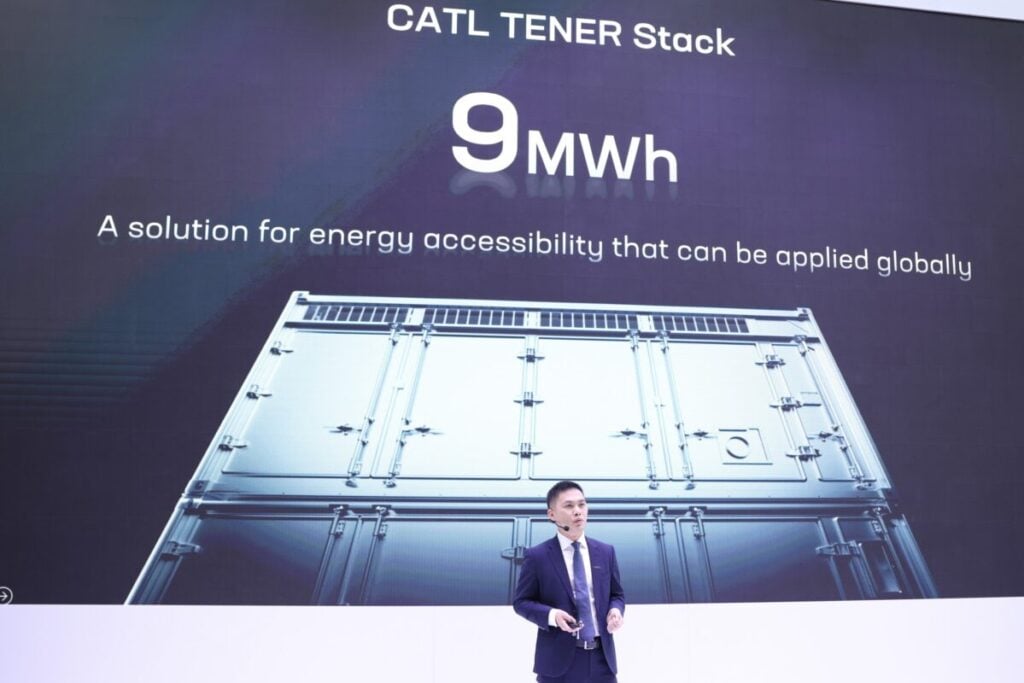
CATL has launched a 9MWh grid-scale BESS product which comprises two smaller units stacked on top of each other, which it said gets around weight challenges for transportation.
The lithium-ion OEM launched the Tener Stack product at the ees Europe 2025 clean energy trade show and conference in Munich, Germany, yesterday (7 May) following which it gave a Q&A to media including Energy-Storage.news.
The ‘two in one’ design comprises two half-height units, which are under 36 tonnes each, ensuring compliance with transport regulations across 99% of global markets, the company said. It can reduce waiting times and specialised transport costs by up to 35%, the company claimed.
CATL’s CTO ESS Europe Hank Zhou said the company saw a clear need for easy transportation while still having a higher energy density per square meter, which were the main reasons for developing the product.
Try Premium for just $1
- Full premium access for the first month at only $1
- Converts to an annual rate after 30 days unless cancelled
- Cancel anytime during the trial period
Premium Benefits
- Expert industry analysis and interviews
- Digital access to PV Tech Power journal
- Exclusive event discounts
Or get the full Premium subscription right away
Or continue reading this article for free
“It breaks the limitations of power capacity and product transportation, and makes breakthroughs in space utilisation, energy efficiency and cost,” added Amanda Xu, CTO ESS and president of ESS Europe for the company.
Energy-Storage.news has heard from many industry sources that the drive to ever higher energy density within the 20-foot shipping container form factor was beginning to present a challenge for transportation, particularly in geographies where roads could not support such heavy systems.
But as the largest battery cell and BESS manufacturer globally, this move is the clearest sign yet of a response from the BESS industry to that challenge.
The product is a sequel to the Tener, CATL’s 6.25MW, 20-foot product which made headlines last year for featuring no battery cell degradation for the first five years of operation. Since then, other companies have launched BESS with three to five years of no degradation too, while CATL has kept its feature at five.
In response to Energy-Storage.news about whether this was a technical limit for the tech during the Q&A, Zhou said:
“Theoretically you can go higher but you need to balance technical performance and cost. The prelithiation process is done at one of our product lines and the whole process is more complicated and costs much more than conventional lithium-ion chemistry. We could go to six years or more but considering the cost increase it isn’t that attractive to the industry right now.”
Energy-Storage.news will publish an article from the rest of the Q&A next week.