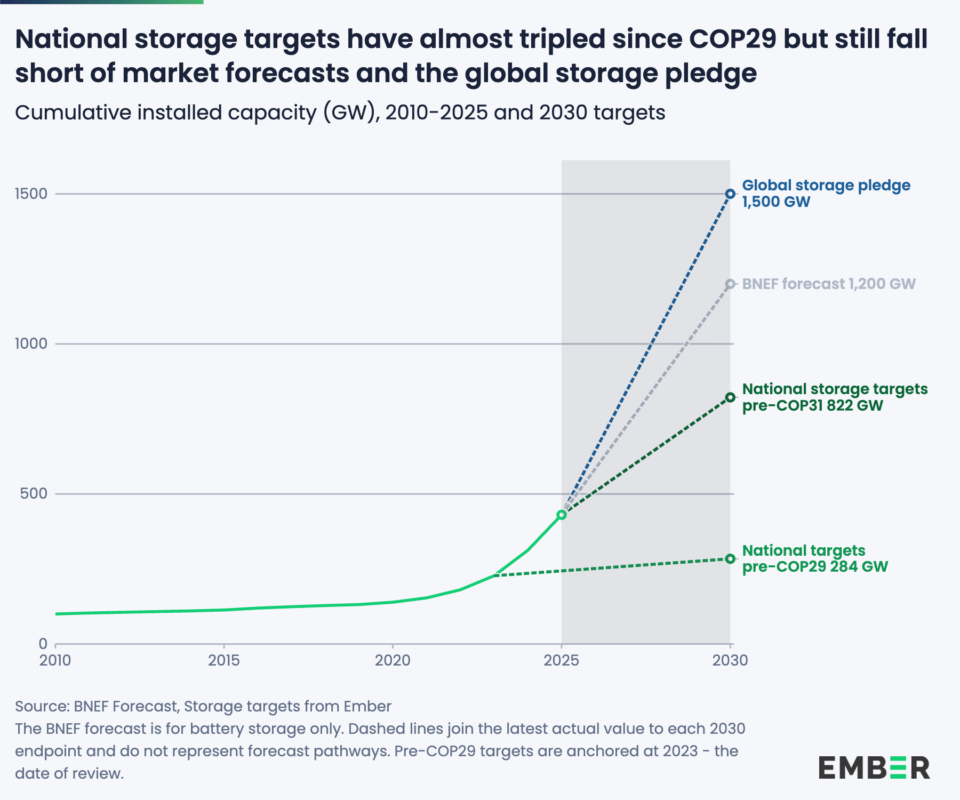
Insufficient progress has been made towards the Energy Storage and Grids Pledge, endorsed by dozens of countries at COP29 two years ago, to target 1,500GW of energy storage deployment by 2030.
According to a new analysis by the energy think tank Ember, despite the pledge at the United Nations (UN) climate conference in Azerbaijan in October 2024, national targets to follow through on that goal would deliver only 55% of the needed capacity.
Published today, the analysis comes from the Ember 203 Global Renewable Target Tracker, which covers 98 countries and the European Union (EU), which is counted as one bloc.
The featured countries represent 97% of global installed renewable energy capacity, 94% of electricity sector demand and 93% of power sector emissions as of 2025.
Try Premium for just $1
- Full premium access for the first month at only $1
- Converts to an annual rate after 30 days unless cancelled
- Cancel anytime during the trial period
Premium Benefits
- Expert industry analysis and interviews
- Digital access to PV Tech Power journal
- Exclusive event discounts
Or get the full Premium subscription right away
Or continue reading this article for free
The 1.5TW figure is the capacity of energy storage the world would need to deploy by the end of this decade to meet climate goals agreed at COP28 a year before the pledge, according to modelling by the International Energy Agency (IEA).
IEA found that 1,200GW, or 90% of the capacity, would likely come from batteries, with the rest from other storage technologies.
The total of national energy storage targets has almost tripled (+190%) since the signing of the pledge in the Azerbaijani capital, Baku, and now stands at 822GW across the tracked countries.
While it sounds encouraging, digging deeper, Ember found that the increase was almost entirely attributable to China’s recently ratified 15th Five-Year Plan and the EU’s new energy storage target.
EU Member States made their first-ever tripartite agreement on energy storage in June this year. With around 55GW installed in the bloc at the beginning of this year, the EU targets 200GW by 2030, a figure later confirmed in the EU’s first Electrification Action Plan.
China’s State Council, meanwhile, set priorities for decarbonisation and renewable energy growth in its Five-Year Plan, including a 25% share of non-fossil fuel energy by 2030. The country would also pursue 300GW of battery energy storage system (BESS) capacity and 160GW of pumped hydro energy storage (PHES) for a combined 460GW total. This was an increase of 330GW from China’s previously set target.
At the April 2024 Ministerial Communique for Climate, Energy, and Environment in Italy, G7 nations agreed to the 1,500GW global energy storage target, before the pledge went before COP29 and was endorsed by 65 national governments, the state government of California and five Brazilian states, as well as dozens of companies, trade associations, academic institutions and non-profits.
Countries signing included the US, UK, Spain, North Korea and South Korea, Germany and the UAE. Russia and China did not endorse the pledge. It is fair to say a lot of political water has gone under the metaphorical bridge since then.
Policy lags technology
However, faltering ambition—or, more accurately, fledgling ambition in many cases—on the policy stage does not reflect the global picture. According to Ember, actual battery storage deployments in the field far outpace the targets on paper.
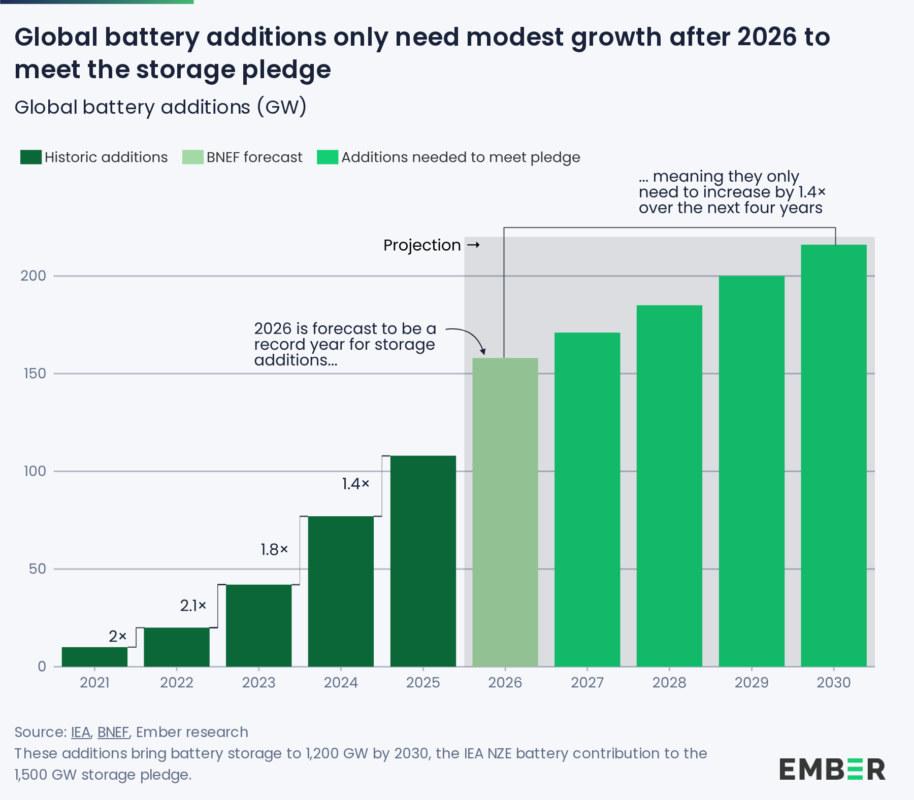
Quoting IEA statistics, the think tank said the acceleration and growth of deployment took the world from installing 9.5GW of battery storage in 2021 to 108GW in 2025 (of a total 118GW deployed last year, including pumped hydro and other technologies). Global additions increased 40% between 2024 and 2025. As of the end of last year, cumulative capacity reached 430GW.
That is even faster growth than was seen during the rapid growth phases of the solar PV and wind industries. From here, Ember calculated that 78GW of annual energy storage additions are needed from 2026 to 2030, meaning that if the pace of 2025 deployments were seen each year from now until then, the global cumulative total of 1,020GW would exceed the 822GW of national targets by 24%.
Ultimately, the lack of coherent targets and programmes to support energy storage is a missed opportunity to give investors certainty, Ember global programme consultant Dr Katye Altieri said.
Additionally, the fact that storage deployments are outpacing government targets but still fall short of the 1.5TW projection shows that increased ambitions and targets still have a potentially important role to play, according to Ember.