
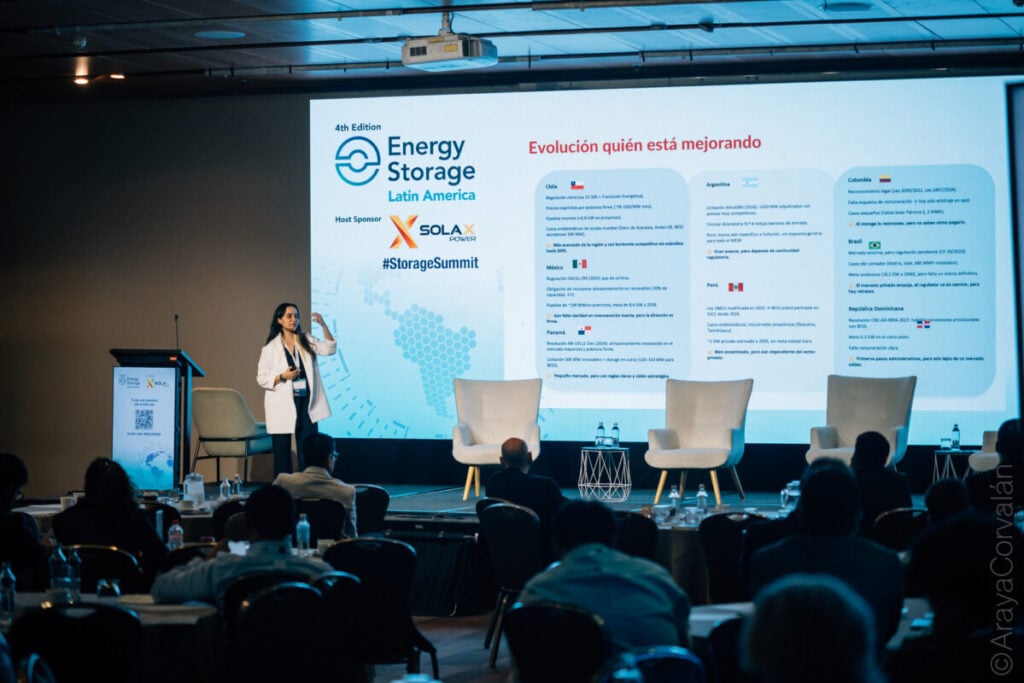
Ahead of Energy Storage Summit Latin America on 26-27 October in Santiago, Chile, Energy-storage.news spoke with Valentina Meneses, energy practice co-director at Americas Market Intelligence (AMI), about the battery energy storage system (BESS) market landscape in the region.
The discussion covered the big picture in the region, from regulation remaining the main challenge across Latin America to emerging markets worth keeping an eye on in the coming months, as well as a focus on specific markets beyond Chile, the leader in that technology, such as Brazil, Mexico, and Argentina.
Regulation or lack thereof, the main challenge in Latin America
One thing that the region has in common and which is also the main challenge for the growth of a BESS market in each of these countries is regulation, or the lack of it.
“The next step is to ensure that these regulatory advances translate into clear ground rules for understanding how business can be conducted in each of the countries—thereby providing clarity and instilling confidence in developers, investors, and so on,” explains Meneses.
Try Premium for just $1
- Full premium access for the first month at only $1
- Converts to an annual rate after 30 days unless cancelled
- Cancel anytime during the trial period
Premium Benefits
- Expert industry analysis and interviews
- Digital access to PV Tech Power journal
- Exclusive event discounts
Or get the full Premium subscription right away
Or continue reading this article for free
Meneses adds that regulation must be in place to determine how to monetise a BESS asset. Tied to that issue is the fact that the region needs investment to develop these projects, and the regulatory uncertainty makes it more complicated to secure investment.
Another key aspect for the region is that the discussion is no longer about whether there is a need for energy storage or how much is needed, but about whether there is enough grid infrastructure to absorb the growth in renewables, as well as energy storage to dispatch the power when it’s most needed.
“We need more robust infrastructure to reach centres of demand. This is something seen across Latin America—a deficiency in the grid—and, in that regard, there is a need to call for investment,” adds Meneses.
Brazil moves on BESS through behind-the-meter as regulation awaits
One of these markets where regulation is still lagging is Brazil, which has announced its first BESS tender. Despite that, the country has seen an increase in behind-the-meter projects, the same case happens in remote areas in Peru, where these projects have worked, explains Meneses.
“In Brazil, there is a regulatory intent, but it stayed like that since the mid-2025, with the regulatory entity stating that energy storage would be regulated, that the technology is important, that there is a political will, but it hasn’t moved since,” says Meneses.
She adds that the possibilities in Brazil are immense and that there has been a lot of movement behind-the-meter projects and private auctions, too.
“It would clearly be beneficial to eliminate this regulatory bottleneck in Brazil and finally see some progress—moving closer to the level seen in Chile. Brazil is poised to be a leader in this area,” explains Meneses.
Mexico, Colombia and Dominican Republic are countries to watch
When asked about countries aside from Chile, Argentina, or Brazil that are worth keeping an eye on in the coming months, Meneses says it has “a lot to do with the political willingness of each one of the countries” and adds that there is an opportunity in Mexico despite the “somewhat strange” public-private system set in place in the country, which involves the state-owned utility Federal Electricity Commission (CFE).
The Mexican government implemented a regulation requiring the co-location of BESS with solar PV and wind projects, thereby boosting the technology’s growth in the country. To accompany that, it has already held several auctions, one of which awarded 3.3GW of renewable energy capacity, with all the projects to be co-located with BESS.
The country’s Ministry of Energy has also recently opened a fast-track permitting process for BESS and renewable energy projects that would shorten the approval process from the 12-24 months it typically takes.
“The auctions end up being a quick solution to implement the technology and develop BESS into these [renewable energy] projects,” says Meneses. This, she adds, signals that beyond the regulation, there is an understanding that energy storage is an important technology.
Another country showing signs of building a BESS market is Colombia. Meneses mentions how the previous government left a regulatory intent, while the new Minister of Energy and Mining is quite well-versed in renewable energy. “We hope that with her it will help boost many [renewable energy] projects.”
Although it is still too early to gauge the new government’s stance regarding BESS or even renewables in general, the profile of the new Minister of Energy and Mines seems to bring some optimism for the growth of renewables in the coming years in Colombia.
Meneses also highlights two Central American countries: Panamá and the Dominican Republic.
“The Dominican Republic has a political willingness with a regulation that aims to help bring these new technologies. Panamá also has these changes.”
She also says that hopefully, in the next two to three years, we can start talking about Venezuela, too.
Argentina’s BESS market needs to expand beyond the auctions
Finally, Argentina has been one of the markets in the region that has been moving the needle for BESS over the past 12-24 months, with two successful auctions, the second of which awarded 700MW/2,800MWh of BESS across the country earlier this year. However, at the moment, the development of such projects seems tied to government-run auctions, while private investment is scarce.
Meneses highlights the importance of these auctions, which other countries, including Brazil and Mexico, have launched. These auctions are a rapid way to introduce BESS technology to the market and get projects deployed, too. She adds that: “It tells us that, beyond the regulation itself, there is an understanding that storage is important.”
In the case of Argentina, Meneses explains that these storage projects awarded capacity in the auctions remain niche and have their own set of rules. For her, there needs to be a discussion about the regulations and the mechanisms in place for BESS in the country.
“That doesn’t mean there aren’t opportunities [for BESS]; it means there must be other types of opportunities.”
After all, this comes back to the ongoing regulatory challenge in the region to accelerate the growth of energy storage projects, similar to what Chile has experienced these past few years. Governments across Latin America need to implement clear regulations that establish rules for how energy storage can be used in each country, which would give companies a clearer path for using their assets and help secure financing to develop their projects.
Valentina Meneses will be a speaker at the upcoming Energy Storage Summit Latin America in Santiago, Chile, on 26-27 October 2026. For more information about the event, including ticket booking, click the link above. Use our discount code ESN20 for 20% off tickets.
