
Elliot Squire, senior asset manager for Varco Energy, discusses current and future trends in battery storage.
UK-based battery energy storage system (BESS) asset owner and operator Varco has 350MW of projects in operation or due to finish construction by 2027, with a further 275MW in its pipeline. The company is backed by an Adaptogen Capital fund, which Varco Energy claims provides disciplined, targeted capital deployment for its BESS portfolio.
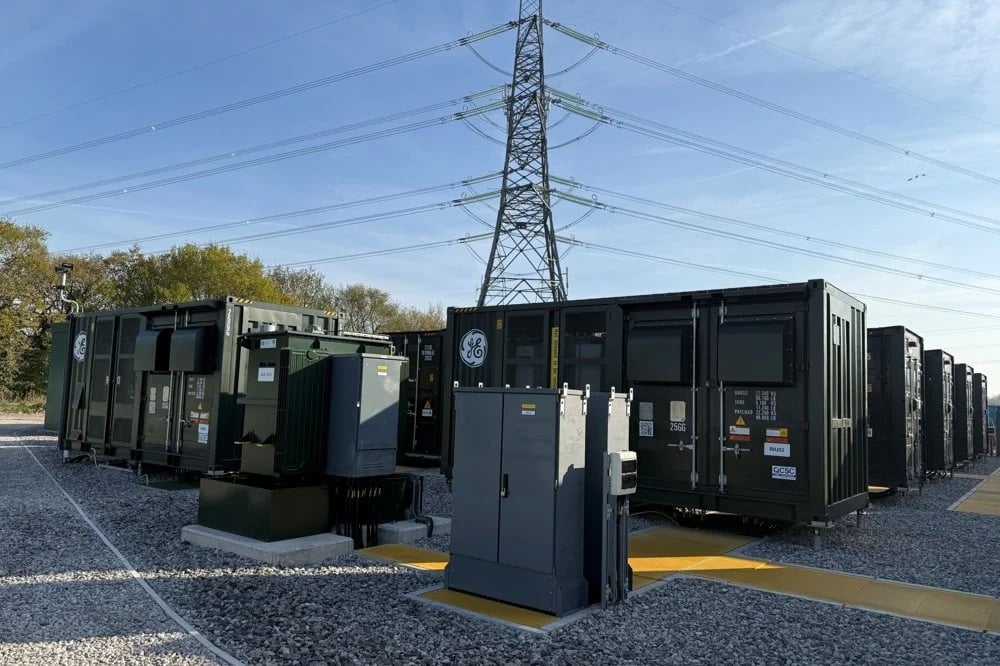
Its largest operational projects are the 57MW/138MWh Native River BESS at Capenhurst substation near Liverpool, energised in 2024 and the first phase of Project Sizing John, which is also 57MW/138MWh, operational since May 2025 and due to be followed onto the GB grid by Phase 2, which will add 86MW/201MWh and is expected to be energised during December this year. GE Vernova supplied BESS equipment for Native River, while Varco worked with Fluence on Sizing John.
This interview takes place ahead of the Battery Asset Management Summit UK & Ireland 2026, 13-14 October in London. See the bottom of this story for more details.
Try Premium for just $1
- Full premium access for the first month at only $1
- Converts to an annual rate after 30 days unless cancelled
- Cancel anytime during the trial period
Premium Benefits
- Expert industry analysis and interviews
- Digital access to PV Tech Power journal
- Exclusive event discounts
Or get the full Premium subscription right away
Or continue reading this article for free
Energy-Storage.news: How has BESS asset management best practice in the UK and Ireland evolved in the past three years?
Best practice in BESS asset management across the UK and Ireland has developed materially over the past three years. New revenue opportunities have emerged, including reserve services and stability tenders; insurance premiums have reduced as the sector has matured; and access to the Balancing Mechanism has improved, supported by longer instruction lead times of up to 30 minutes and the implementation of GC0166 (where the National Energy System Operator, NESO, introduces two new parameters – Maximum Delivery Offer (MDO) and Maximum Delivery Bid (MDB) into the Balancing Mechanism – Editor).
What are the key policy, regulation and market design changes you need to keep track of when it comes to formulating your BESS asset management strategy?
The principal priority is to monitor regulatory and market-design developments that directly affect revenue, particularly the implementation of GC0166 and the effect of negative pricing on ancillary services.
A further priority is the evolving treatment of critical-infrastructure risk, including cybersecurity obligations and fire-safety regulation.
What is your current approach to maximising returns from your BESS, and what key performance indicators drive your operational decisions?
Maximising technical availability is central to our approach to optimising returns. We regularly review planned and reactive maintenance schedules against prevailing market conditions, while ensuring that all operational decisions remain within warranty parameters. The principal performance indicators are technical availability, maintenance-related downtime and compliance with warranty limits.
How do you balance profitable market participation with preserving battery cell health, and what role do optimisation technologies play in this decision-making process?
Battery health is a core performance metric monitored by the asset management team. Varco’s assets are supported by long-term service agreements that guarantee energy availability for 15 years, enabling us to maximise returns while operating within agreed contractual parameters.
Optimisation technology is integral to this process: operating constraints must be communicated accurately to the route-to-market provider to avoid unnecessarily foregoing value. These constraints include cycling limits, temperature requirements and average state-of-charge limits.
What is your approach to augmentation?
Augmentation is considered from the outset of project acquisition and design. This includes securing lease options for additional land, specifying balance of plant (BOP) foundations capable of supporting future containers and ensuring that BESS supply contracts accommodate the integration of newer equipment with the existing system. Advanced control systems are also required to manage energy distribution effectively across assets of differing ages and technical specifications.
How do you view the current state of risk-sharing between parties in the UK and Ireland BESS industries, and how will this evolve over time?
Risk allocation within the industry continues to evolve. Early merchant optimisation agreements commanded relatively high fees, reflecting limited competition and a heightened perception of risk. As participation and competition increased, these fees declined materially.
More recently, products such as revenue floors and tolling agreements have been introduced at a premium, while OEM and O&M contracts increasingly allocate more complex warranty, availability and performance risks.
As the market matures, the availability of operational data and greater competition should improve the assessment and pricing of these risks, resulting in a more balanced allocation between parties and lower premiums over time.
What type of revenue contract structures are currently dominating, and which will we see in the market going forward?
Revenue floors and swaps are currently prevalent because contracted revenue support is often important to bankability in a volatile market influenced by macroeconomic and geopolitical factors.
Tolling structures can provide greater revenue certainty, although they constrain upside for asset owners. The volume of tolling capacity available may also be limited by an offtaker’s customer base and portfolio composition.
Going forward, the market is therefore likely to retain a mix of floors, swaps and tolling arrangements, with the preferred structure determined by each project’s financing requirements and risk appetite.
What is your strategy around end-of-life considerations when managing BESS assets?
End-of-life planning begins during the design phase, before construction commences, with appropriate access and infrastructure incorporated to facilitate safe and efficient decommissioning.
Lithium-ion cell recycling capabilities are developing rapidly, with OEMs establishing defined recycling procedures and appointing approved in-country contractors to support safe and compliant disposal.
Civil infrastructure is generally designed to outlast the initial battery system, and the potential for replacement or repowering is considered from the outset. This includes designing foundations capable of accommodating future battery systems that may be heavier or have a higher energy density.
Asset performance and degradation indicators are monitored throughout the operating life to identify repowering requirements and indicative timelines at an early stage. This allows contracts to be agreed and mobilisation activities to be planned in advance, thereby minimising downtime between the end of the initial system’s operating life and the subsequent repowering phase.
Additional reporting by Andy Colthorpe.
Elliot Squires will join the panel discussion ‘Premiums Down, Standards Up: Is the Insurance Market Matching BESS Reality’ at the third annual Battery Asset Management Summit UK & Ireland 2026. Taking place 13-14 October at Leonardo Royal Hotel St Paul’s, London, UK, this year’s event features two dedicated streams across two days: Technical Asset Management and Commercial & Financial. ESN readers can use the code ESN20 at checkout for a 20% ticket discount. Visit the website for more details.
