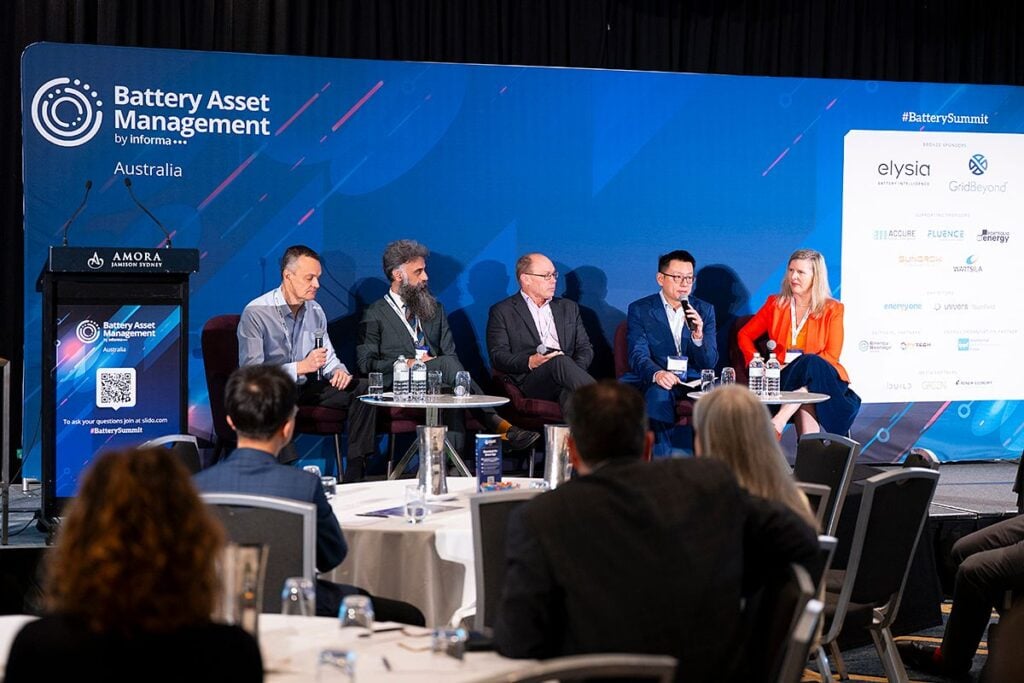
Developers who buy or flip battery storage projects mid-life risk inheriting decommissioning liabilities they had not properly accounted for, according to panellists speaking at the Battery Asset Management Summit Australia 2026 in Sydney last week.
Speaking on the panel “From Development to Decommissioning: Design, Operations, End-of-Life,” Dr Mahdi Behrangrad, head of the ESS/VPP business department at Pacifico Energy K.K., said the industry was only beginning to reckon with what decommissioning actually required.
“Before buying it, you’re buying a liability. Think well: is it ready for that or not?” he said.
“Decommissioning is going to have huge technical and safety issues, and it’s going to be costly if it’s not well thought out.”
Try Premium for just $1
- Full premium access for the first month at only $1
- Converts to an annual rate after 30 days unless cancelled
- Cancel anytime during the trial period
Premium Benefits
- Expert industry analysis and interviews
- Digital access to PV Tech Power journal
- Exclusive event discounts
Or get the full Premium subscription right away
Or continue reading this article for free
Behrangrad described battery modules reaching the end of life as carrying risks that current practice often overlooks.
“The module that was built 20 years ago, there might be a dent. It might be a cell that is really on the brink, and you want to load it on a truck,” he said, noting that once a warranty period lapsed, responsibility for safely transporting degraded modules fell on the asset owner rather than the manufacturer.
He challenged developers to check with logistics companies and EPC contractors whether they were equipped to remove battery modules that could individually weigh half a tonne.
“Communities and regulators really don’t care if you are technically prepared or not,” he said.
“They’re going to make it your liability.”
Glenn Dahlenburg, managing director of GCD Advisory and formerly of Energy Queensland, said the risk was heightened for anyone acquiring a project without full visibility of its condition.
“If you buy an asset later, and it’s already degraded a lot, you may find you’re buying a liability that’s much sooner than you expect,” he said.
Dahlenburg added that decommissioning costs money regardless of whether the asset was recycled.
“It costs money to dispose of lithium batteries, even if you recycle them,” he said.
That warning echoed concerns raised on a separate panel at the same summit, where insurers said contractual and coverage planning brought in too late in a project’s life routinely left owners exposed.
Gemma Claase, head of energy transition for Howden Insurance Brokers’ Pacific business, told that panel: “I’ve had a lot of clients in the past come to me with maybe a month to go needing an insurance solution, and that’s often too late,” a comment made about construction-phase cover but one that mirrored the end-of-life planning gap Behrangrad and Dahlenburg described.
Just as insurers warned developers to bring cover in earlier, this panel’s message was that decommissioning, recycling and liability planning belonged at the development stage, not the end of an asset’s operating life.
Sabiene Heindl, CEO of the Energy Charter, said decommissioning had shifted from a distant concern to an issue that communities wanted addressed up front.
“Landholders do not want to be in a position where they’ve got assets that are stranded on their properties, and then the obligation is upon them to move them on or decommission them,” she said.
Heindl pointed to a federal government requirement, announced during the same conference, that Capacity Investment Scheme (CIS) tenders would now include a developer rating scheme assessing community engagement.
“Social licence issues around batteries and other forms of renewable energy development are now one of the most expensive factors for developers,” she said.
Heindl noted that community concern was increasingly focused on battery storage, more so than on solar or wind.
“There certainly seems to be a sentiment that solar and wind, yes, they’ve had their issues, but now batteries are very much a focal point for communities,” she said, citing fire risk, visual amenity and decommissioning as recurring themes.
She also flagged cumulative impact as a distinct challenge: “By the time there are about three renewable energy development projects in a region, most communities are saying no to them in their entirety.”
Heindl’s emphasis on early, senior-level community engagement sat alongside a broader pattern of Australian battery storage projects needing to move faster through development to remain competitive.
Recycling infrastructure and cost recovery remained underdeveloped
On recycling, Dahlenburg said Australia currently had only two commercial recyclers capable of processing large-scale battery storage systems, and that gaps in documentation were already causing problems.
“Batteries are turning up to recyclers, and they look at them: no Material Safety Data Sheets (MSDS), no state of charge information, no idea the risk, no idea how to pull them apart,” he said.
Dahlenburg expects the volume of batteries being retired to escalate quickly.
“They’re going to get inundated with gigawatt-hours of batteries in the next five to ten years.”
Behrangrad said the financial provisioning for many projects currently set aside for decommissioning was not based on accurate cost estimates.
“People are putting 5%, for example, in bonds. Nobody calculated the costs,” he said. Dahlenburg added that residential battery disposal already carries a direct cost to consumers, citing figures from South Australia indicating it costs around AU$450 (US$322) to dispose of a residential battery storage system, and noting that there is no dedicated waste stream for electricians and installers to route batteries for recycling.
Underinvestment in decommissioning planning was not the only area where panellists said commercial pressure was reshaping how battery storage assets were built and financed.
Contracting structures across the sector are shifting quickly: on another panel at the summit, speakers described how Australia’s battery storage contracts were moving away from rigid physical tolling arrangements toward more commoditised, interchangeable products, a trend that added complexity to the kind of long-term liability and ownership questions Dahlenburg raised about buying or flipping projects mid-life.
If an asset changed hands multiple times under increasingly varied contract structures, tracking who was actually responsible for eventual decommissioning became harder, not easier.
On the operational side, Charlie Zha, asset manager at BW ESS, said commissioning handovers frequently arrived incomplete despite the project having technically achieved mechanical completion.
“Mechanical completion doesn’t mean that your battery can run under the compliance,” he said, describing handovers with unfinished punch lists and drawings missing red-line markups.
Zha said involving asset management and operations teams early in development had become a core strategy for BW ESS to reduce those gaps.
Behrangrad also identified software and cybersecurity as underappreciated risks that spanned a project’s full lifecycle, particularly as staff and vendors turned over.
“Your engineers, the ones who did commissioning, might not be there after five years,” he said.
Asked directly about attitudes toward cybersecurity investment, he said the systems were frequently underweighted relative to their importance.
“They are critical,” he said. “Your downtime is going to come from these things.”
Never miss an Australian energy storage story. Sign up for our Australia newsletter and get the latest project announcements, policy updates and market analysis delivered directly to you.