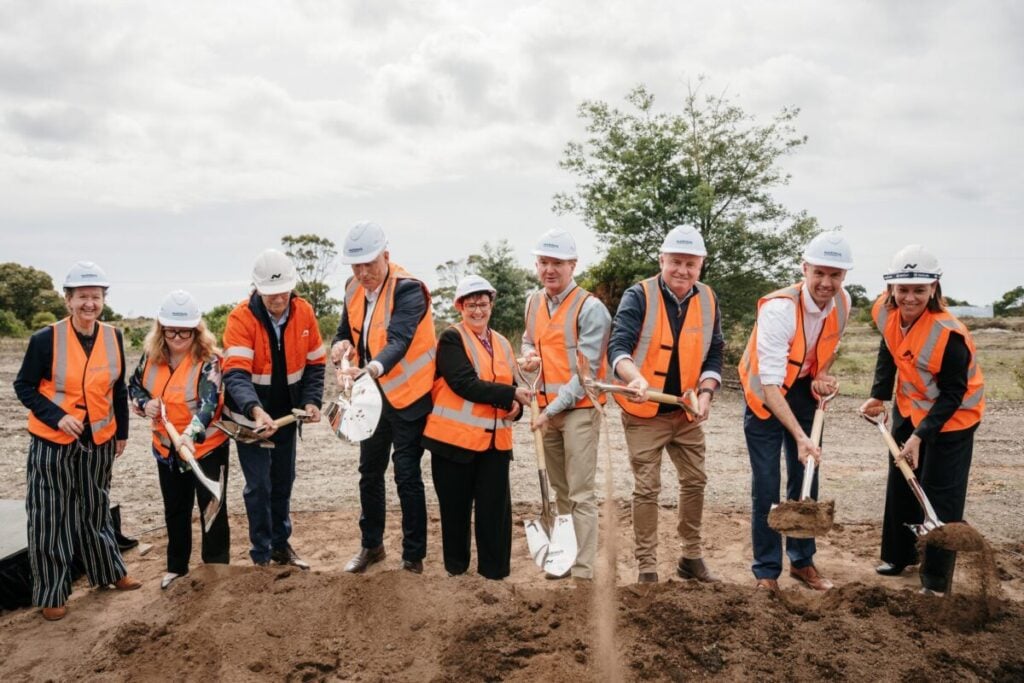
Marinus Link, the second electricity interconnector between Tasmania and Victoria in Australia, held a sod turning ceremony in North West Tasmania to mark the start of expanded construction in both states.
The event was attended by federal climate change and energy minister Chris Bowen, Tasmanian premier Jeremy Rockliff and Marinus Link chair Sandra Gamble, with TasNetworks chair Roger Gill also speaking.
Marinus Link Pty Ltd is the government-owned company delivering the undersea and underground cable, and it is owned by the Commonwealth (49%), Victoria (33.3%) and Tasmania (17.7%).
TasNetworks, the Tasmanian state-owned network operator, is building the North West Transmission Developments (NWTD), which will strengthen the state’s grid so it can carry the extra power.
Try Premium for just $1
- Full premium access for the first month at only $1
- Converts to an annual rate after 30 days unless cancelled
- Cancel anytime during the trial period
Premium Benefits
- Expert industry analysis and interviews
- Digital access to PV Tech Power journal
- Exclusive event discounts
Or get the full Premium subscription right away
Or continue reading this article for free
The link itself is a 1.5GW high-voltage direct current interconnector between north-west Tasmania and Victoria’s Latrobe Valley, planned in two stages of 750MW each. Gamble said its two-way design will let power flow in either direction across the National Electricity Market (NEM), improving flexibility and reliability, with Stage 1 due for completion in late 2030.
The link supports Tasmania’s “Battery of the Nation” plan, which Hydro Tasmania proposed in 2022, and which envisages 1.5GWh to 3.5GWh of new pumped hydro storage in the state.
Tasmania currently relies on a single interconnector, the 500MW Basslink, and the Australian Energy Regulator approved its conversion to a regulated transmission service in June 2025, allowing part of its costs to be recovered through network charges.
Cable and converter manufacturing and construction will ramp up into 2027, starting at the Heybridge and Hazelwood North converter stations, the Sandy Point shore crossing and the Mardan site compound. Work will also begin along the 90km underground cable route in Gippsland.
On the Tasmanian side, NWTD construction has already started between Sheffield and Burnie, covering access tracks, fencing, tower foundations and works at the Sheffield substation. Stage One of the NWTD spans 130km and is due in service by 2030.
Marinus Link said 119 businesses and suppliers have been engaged so far, 59 of them from North and North West Tasmania.
A joint venture of Gamuda, a Malaysian construction group, and Samsung C&T, a South Korean engineering and construction company, holds the AU$994 million (US$691 million) balance of works contract, which covers civil, structural and electrical work, including the converter station buildings.
In September, Marinus Link was also granted Australia’s first transmission and infrastructure licence under the offshore electricity infrastructure regime, which is considered the final federal approval required before construction.
Shareholders took a positive final investment decision in August 2025, and the project received federal environmental approval at the same time.
The Clean Energy Finance Corporation (CEFC), the federal government’s green bank, then committed AU$3.8 billion, its largest investment commitment, from its Rewiring the Nation Fund and structured to lower the project’s borrowing costs.
An updated cost-benefit analysis put the combined construction costs for Stage 1 and the NWTD above AU$5 billion, while the proponent has forecast wholesale price reductions of AU$15/MWh in Tasmania and AU$17/MWh in Victoria.
Never miss an Australian energy storage story. Sign up for our Australia newsletter and get the latest project announcements, policy updates and market analysis delivered directly to you.