A battery storage system can meet every contracted performance guarantee and still leave its owner watching day-to-day output fall short of expectations.
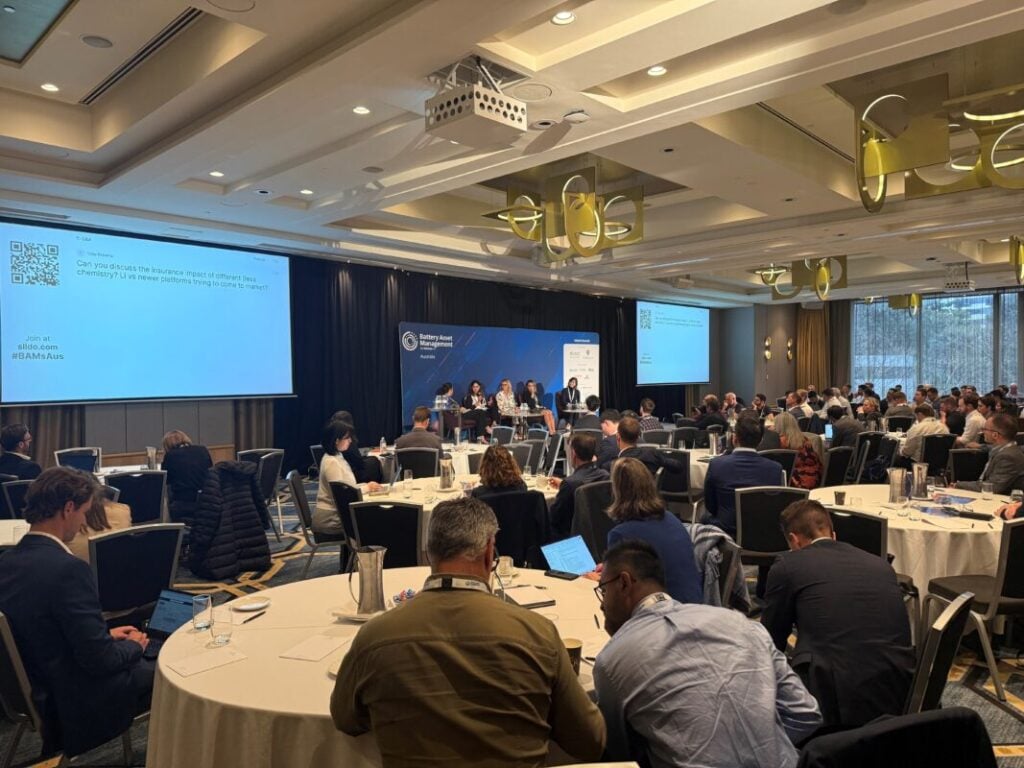
This is according to insurers, brokers, engineers and lawyers who spoke on a panel on warranties and insurance at the Battery Asset Management Summit Australia 2026.
The gap between paper compliance and lived performance ran through much of the discussion. Anya Krol, an engineering manager with close to a decade of battery energy storage system (BESS) experience across the technology’s full lifecycle, put it plainly: a system passing its performance guarantee test told an owner less than they might assume.
“The performance guarantee test is a structured, well-defined test under certain conditions and follows certain steps,” she said.
Try Premium for just $1
- Full premium access for the first month at only $1
- Converts to an annual rate after 30 days unless cancelled
- Cancel anytime during the trial period
Premium Benefits
- Expert industry analysis and interviews
- Digital access to PV Tech Power journal
- Exclusive event discounts
Or get the full Premium subscription right away
Or continue reading this article for free
“Whereas in the real-life day-to-day operation, it’s not uncommon for the owner-operator to see different values as the actual usable energy.”
Krol listed several quiet causes behind that divergence. Intermittent internal faults, derating, cell balancing, and a design quirk in which a project’s point of connection and its contracted point of guarantee can diverge, leaving an owner staring at reduced capacity while the supplier’s own metrics still read 100% availability.
“The supplier is not incentivised to investigate and rectify,” she said of that scenario.
Arzu Perwin, a commercial manager who has worked on battery storage projects from development through operations, added that even a technically intact warranty could leave an owner exposed if individual components underperformed without breaching the contract’s headline metrics.
Much of the discussion turned on language rather than hardware. Perwin said the definition of a “defect” in a contract matters more than developers often assume, particularly as multi-contract structures have become common on Australian projects.
“A lot of the regimes that we do see now are split contracting,” she said.
“Every contract might have a slightly different definition of what constitutes a defect and how that defect can be identified.”
Her advice to developers was to treat contracts horizontally rather than vertically, aligning defect definitions across supply, engineering, procurement, and construction (EPC), and other agreements from the earliest development stage to reduce the odds of disputes later.
Gemma Claase, head of energy transition for Howden Insurance Brokers’ Pacific business, said insurers brought their own competing definitions into that picture.
She pointed to the London Engineering Group’s three separate defect definitions, an area she described as a persistent source of contention in claims, with new clauses expected from the group before the end of the year.
“This is really something developers should check with their broker,” Claase said, recommending a claims workshop with a lead underwriter well before any dispute arises, to pin down how particular wording would actually be interpreted.
Claase’s broader message, delivered early in the session, was that insurance needed to be part of a project’s thinking long before construction neared completion.
“I’ve had a lot of clients in the past come to me with maybe a month to go needing an insurance solution, and that is often too late,” she said, warning that contractual risk allocation settled without insurers at the table could produce terms that turn out not to be bankable once debt is involved.
Fire certification, weather models and questions from the floor
On fire, Krol said testing and certification had matured considerably, but did not, on their own, protect a project.
“Each supplier has their own solution around the system architecture, protection, detection and the management of thermal events,” she said, adding that the industry remained “not particularly transparent about the failures” it has already had, with root cause analyses rarely shared publicly even when incidents become known.
Namrata Soni, lead underwriter for energy and construction at Canopius Group, described a similarly layered view from the insurance side. Compliance with mandated testing such as UL 9540A was a baseline, not the full picture.
“It’s not the question whether a fire will occur or not happen. It’s about, can we isolate these fires if there is an event?” she said, listing separation distances between BESS units, proximity to transformers and substations, gas detection triggers and site access for emergency services among the details underwriters scrutinise closely, down to whether a water tank sits nearby.
Weather posed a related but distinct challenge, and Soni argued that the industry needed to look ahead rather than rely on historical loss data alone, given the 20-to-30-year horizon over which a project built today will need to perform.
Claase went further, calling the reinsurance models that set pricing across much of the market “grossly outdated.”
“A lot of the reinsurance models are very much based on historical data, backwards looking,” she said. “We need to be forward-looking.”
Both suggested that the current soft insurance market gave developers unusual leverage to push insurers toward newer, more predictive weather-modelling approaches.
Claase said the market had begun producing alternative insurance products that cover underperformance without requiring physical damage, a departure from traditional construction and property policies that pay out only when damage triggers them.
“Just because it isn’t quite working as you thought it would, there usually wouldn’t be any payout under insurance,” she said of the older model, adding that insurers had “come to the table” to design bespoke solutions once they understand a project’s specific risk.
Audience questions pushed into the territory where the panel had more mixed views.
Asked whether insurance products existed to cover merchant revenue risk, specifically a seller-style revenue floor triggered by low spot market volatility or by quarterly revenue falling below a lender’s break-even threshold, Claase said pricing existed for almost anything, but that developers should approach the market directly.
On battery chemistry, Soni said insurers remained most confident underwriting lithium-ion given its track record, while newer chemistries faced a steeper path to full coverage.
Claase said around 8,500 hours of loss-free operation, somewhere in the world excluding China, are typically required before insurers begin adjusting terms in a new technology’s favour.
“It doesn’t mean you don’t have any insurance,” she said. “It’s a coverage challenge.”
Krol raised a separate, less-discussed risk toward the session’s end: supplier longevity.
With software-critical components such as power plant controllers and battery management systems increasingly central to BESS operation, and with many suppliers only two or three years into the market, she questioned what would happen if a critical vendor exited before a project’s 20-year life was up.
Escrow arrangements borrowed from the IT industry offered a partial answer, she said, but raised their own unresolved questions around verifying the completeness of what’s held in escrow, interdependencies, and ongoing software updates.
“That should not be a problem for each individual owner and operator,” Krol said. “That’s the wider industry issue.”
Never miss an Australian energy storage story. Sign up for our Australia newsletter and get the latest project announcements, policy updates and market analysis delivered directly to you.